Battery Energy Storage Surges with 3.3 GW New Capacity
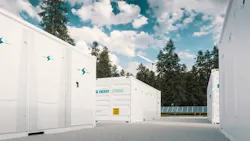
The U.S. energy market is gaining momentum in the battery energy storage systems (BESS) sector, as researchers highlight utility-scale activity hitting new record highs. Utility, commercial and residential spaces all helped BESS installations surpass 3.3 GW/ 8.4 GWh in Q1 2026, according to the latest U.S. Energy Storage Monitor report released Tuesday by Wood Mackenzie (WoodMac) and the American Clean Power Association (ACP).
This latest data from the research firms reveal BESS installation activity is up by 54% year over year (YOY), with more than 2.3 GW/6.8 GWh of capacity currently in the market. The residential segment alone accounted for a record 1.3 GWh in Q1 2026, up 86% YOY.
Despite a strong start to the year, WoodMac’s research analyst Allison Feeney attributes a 5% residential contraction in 2026 to constraints in tax equity availability and updated permitting rules.
Project delays from late 2025 are largely driving this surge in activity, the firms state. Developers pushed deferred completions into the new year to focus on meeting tax incentive eligibility deadlines for pipeline projects. As a result, the report states the U.S. energy storage market is poised to grow by 275% in cumulative installed capacity over the next six years.
Between 2026 and 2031, the utility sector will comprise 85% of the BESS market, according to the firms' projections. This pace translates to 200 GW of new BESS capacity additions by 2031—a critical buildout for managing the complexities of an evolving energy grid.
“Co-location and contracting with large loads will be a key market driver for the foreseeable future,” said Allison Feeney, research analyst at Wood Mackenzie, in a statement. “Utility-scale is poised for the most explosive expansion, but the CCI market will grow a steady 26% by 2031 as well.”
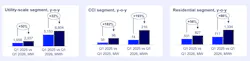
In Q1 2026, the Community, Commercial and Industrial (CCI) sector installed 97.7 MW of BESS capacity, marking a 193% year-over-year increase that was largely driven by California's 75 MW. Researchers expect states like Illinois, Maryland, Massachusetts and New York to sustain this momentum with over 215 MW in their collective project pipeline.
Although Texas, California and Arizona continue to lead the BESS market, Wood Mackenzie and ACP note that Michigan and Georgia are also gaining traction, driven by new procurement from vertically integrated utilities that control each stage of their power supply chain.
“The industry is delivering on what the market needs—fast, flexible power that supports load growth, resource adequacy, and a modern grid,” said John Hensley, SVP of market and policy analysis at ACP.
According to WoodMac, BESS developers with mature pipelines and available capital are rushing to secure supply agreements with domestic manufacturers. However, BESS manufacturers must secure limited foreign entity of concern (FEOC)-free components over the next two to four years due to a critical market bottleneck.
This two-to-four-year window is the timeline researchers project it will take for domestic and friendly-nation supply chains to reach giga-scale capacity to meet the rising U.S. demand.
The Trump administration expanded these sourcing restrictions under the “One Big Beautiful Bill (OBBBA),” modifying the existing framework from the 2021 Bipartisan Infrastructure Law and the 2022 Inflation Reduction Act (IRA). Under these FEOC rules, BESS and solar developers could face a financial ban in federal tax credits if their battery tech, software or raw materials are owned or controlled by Iranian, North Korean, Russian or Chinese companies.
To mitigate this risk, the OBBBA advanced the 45X tax credit, paid directly to the manufacturer for every eligible energy unit physically produced in the U.S. and sold to an unrelated party, which has become a key factor in domestic factories maintaining cost competitiveness against foreign supply chains.
About the Author
 Eric Moody