Duke Energy Announces Operations of $100 Million 50 MW, Four-Hour BESS at its Former Allen Coal Plant on Lake Wylie
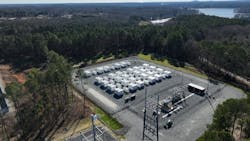
Duke Energy has announced operations of a 50 MW, four-hour BESS at its former Allen coal plant on Lake Wylie to serve customers in North Carolina and South Carolina, and has unveiled plans for additional battery storage and new jobs at the Gaston County site.
The BESS, at a cost of approximately $100 million, was completed under budget and before schedule, serving customers beginning in November. Final testing was completed in January 2026. Construction of a second BESS, a 167‑MW, four-hour system, will initiate in May on 10 acres, where the coal plant’s currently demolished emissions control system was situated.
Both lithium-ion battery systems are suitable for federal investment tax credits, which will offset 40 percent of the cost for Duke Energy customers. This includes an extra 10 percent for reinvesting into an energy community; the coal plant retired in December 2024.
“We’re building new resources to keep the Carolinas’ economy thriving, while reinvesting in a former coal plant community that helped power this region for decades,” said Kendal Bowman, Duke Energy’s North Carolina president. “Repurposing existing energy infrastructure and taking advantage of federal funding significantly offset costs for our customers while continuing to support rapid growth across the region.”
Utility-scale battery systems are useful for cold winter mornings, before solar generation is available. During low-demand periods, they can also store excess energy, such as the clean power generated by Catawba Nuclear Station across Lake Wylie, for use during high-demand periods.
Duke Energy plans to make similar battery storage investments in multiple counties across the Carolinas. The company’s 2025 Carolinas Resource Plan, now under review by state regulators, projects the addition of 6,550 MW of batteries by 2035 to protect reliability and meet growth needs in North Carolina and South Carolina, which is enough storage to power more than 5 million homes during times of peak energy use.
Duke Energy’s long-term plan maintains a diverse energy mix, adding solar, storage, nuclear and natural gas generation to meet electricity demand that’s rising at an unprecedented pace. Across the Carolinas, customer energy needs over the next 15 years are expected to grow at eight times the growth rate of the prior 15 years.
Duke Energy plans for battery storage at both of Gaston county’s retired coal plant sites along the Catawba River, Allen (1957-2024 in Belmont) and Riverbend (1929-2013 in Mount Holly). Construction of the latter, a 115-MW, four-hour BESS, is expected to begin in late 2026, coming on line in late 2027.
“Multiple former Allen plant employees now work on our Regulated Renewables team, which maintains and operates the new batteries at Allen and elsewhere in the Carolinas,” said Bryan Walsh, Duke Energy’s vice president of Regulated Renewables and Lake Services. “Duke Energy’s test site for new battery technologies, its Emerging Technology and Innovation Center, is also in Mount Holly.”
As part of the company’s rate review before the North Carolina Utilities Commission, Duke Energy has proposed a third BESS at Allen to come on line by the end of 2028, as well as a regional operations, training and warehouse facility for batteries and renewables that could house 20-50 employees. Plans for both are under progress and subject to regulatory approval.