Small Components, Big Consequences: How Component-Level Insights Reduce Catastrophic Grid Risks
Key Highlights
- Component-level inspections provide critical data that improve hazard modeling, risk forecasting, and targeted mitigation efforts.
- Focusing on small hardware components like cotter pins and connectors can significantly reduce outage risks during wildfires and storms.
- A lifecycle framework enables utilities to prioritize maintenance, optimize operational responses, and accelerate post-event recovery based on detailed asset condition insights.
- Integrating inspection data into a unified risk-ranking system allows for precise resource allocation, addressing the most vulnerable segments first.
- Continuous collection and analysis of component condition data foster ongoing improvements in standards, asset design, and resilience strategies.
Utilities have long understood that no single threat defines resilience. Wildfire, wind, ice, flooding, heat, and even routine conductor fatigue all share a common truth: the grid’s performance during extreme events often hinges on the smallest components. Cotter pins, hooks, splices, connectors, insulators, shackles, and other pieces of “minor” hardware have an outsized influence on ignition potential, mechanical integrity, and outage risk — particularly when hazards are escalating faster than traditional inspection cycles can keep up.
Recent wildfire and storm investigations show that catastrophic failures frequently originate not from core grid equipment but rather from the fasteners, attachments, clearances, and conductor interfaces designed to keep assets stable under stress. When one of these components loosens, corrodes, cracks, or is installed incorrectly, the result can create risks that scale quickly under extreme weather or high-fire conditions. This isn’t speculative; that stats are well documented with 10% of California wildfires ignited by utility asset, and nationally known utility-caused fires burning 104,000-390,000 acres annually.
At the same time, hazards themselves are intensifying. PNNL notes wildfire exposure is expanding geographically and seasonally, with longer durations of high-risk weather and increased fire potential even in regions that historically saw little wildfire activity. Meanwhile, climate-driven heat, severe storms, and changing wind patterns are stressing transmission and distribution assets outside traditional high-risk prone areas. Extreme weather caused $131B in global losses in the first half of 2025 alone, and customers experiencing an average of 18.2 hours of outages in Southeast US.
If resilience is the ability to withstand, adapt to, and recover from extreme conditions, then the foundation of resilience is understanding, at a granular level, which components are most likely to fail when conditions are at their worst.
A Lifecycle Framework for All-Hazards Resilience
Utilities increasingly anchor their resilience plans around a lifecycle model that spans Pre‑Event, Peri‑Event, and Post‑Event phases. This approach maps directly to how utilities plan, operate, and restore, and aligns with the “Triple Line of Defense” model highlighted in PNNL’s wildfire and resilience best-practices work.
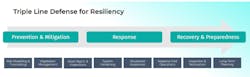
Each phase is driven by different engineering questions:
- Pre‑Event: Which segments, assets and components are approaching critical condition?
- Peri‑Event: Which structures or spans are most vulnerable under today’s weather?
- Post‑Event: What failed, where, and why — and how do we rebuild stronger?
Critically, each phase depends on trusted asset condition intelligence, especially at the component level.
Why Component-Level Inspections Are Foundational to Resilience
1. Turn hazard modeling into actionable engineering risk
Risk emerges from the interaction of hazard and asset vulnerability. Wildfire and extreme-weather risk forecasting improves when combined with reliable, current component condition data. This makes long-duration hazard events more predictable in terms of likely failure points.
2. Support targeted, defensible investment
Patchwork mitigation rarely delivers sustained improvement without common frameworks and measurable risk reduction. Component-level inspection data, as part of a triple line of defense approach, provides exactly that:
- directing hardening where degraded hardware and environmental hazards intersect,
- targeting vegetation management to spans with combined condition and encroachment risk, and
- sequencing capital projects based on failure-mode likelihood rather than geography alone.
3. Enable precision operations during elevated threat windows
Peri‑event operations (such as switching, fast-trip settings, sectionalization boundaries, and PSPS alternatives) depend on knowing which assets are least likely to withstand the day’s wind, heat, or lightning. Operators armed with the knowledge of certain hardware configurations or degraded fittings that historically fail under high-wind loading, can more precisely tailor protective schemes.
4. Accelerate post-event restoration and long-term improvement
Accurate pre-event condition data allows utilities to triage restoration based on known vulnerabilities. Post-event, high-resolution component imagery supports root-cause analysis, enabling utilities to refine engineering standards and mitigate recurring failure modes.
When Conditions, Components, and Consequences Align
A Mountain West utility set out to modernize its inspection workflow in response to rising wildfire exposure and increasingly severe seasonal wind events. The core challenge wasn’t a lack of inspection findings, but rather how to prioritize them effectively. By implementing Grid Vision, the utility brought inspection observations, component classifications, and environmental context into a unified risk-ranking framework—enabling defects to be evaluated not just by what was wrong, but by the likelihood of failure and the potential severity of the consequences. In practice, this meant scoring findings across three dimensions:
- Condition risk - loose, upside‑down, corroded, cracked, contaminated, or missing elements
- Component type and failure-mode risk - with particular attention to cotter pins, C‑hooks, chain shackles, splices and connectors, insulators, and conductor hardware such as armor rods, dampers, and attachment fittings
- Location/environment risk - wind corridors, dense vegetation, steep or inaccessible terrain, elevated fire-weather zones, and wildland–urban interface adjacencies.
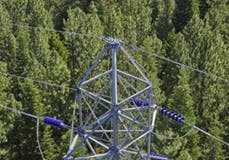
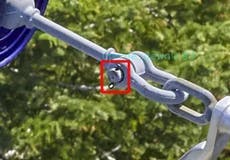
Importantly, the highest-risk findings were not evenly distributed; they clustered in wind-exposed corridors, tight drainages, and other high-consequence segments, enabling the utility to produce a focused work plan that directed maintenance and hardening resources to the places where component degradation and environmental hazard intersected most acutely. The shift was simple but significant: away from “fix everything” and toward “fix what matters most.”
How Component-Level Intelligence Enables the Full Resilience Flow
Component-level grid intelligence is most valuable when it doesn’t live in a silo. When inspection findings are consistently attributed to specific assets and component types, they become the connective tissue that links resilience planning, operations, and restoration into a single, closed loop.
Pre-event, component condition data strengthens risk modeling and forecasting by grounding hazard exposure in real asset vulnerability. It also sharpens capital and maintenance prioritization - helping utilities target hardening programs and vegetation work where degraded hardware and high-consequence environments overlap.
Peri‑event, operators can pair real-time weather and situational awareness with known component vulnerabilities to apply more precise operational strategies. Instead of treating the system uniformly under elevated threat, utilities can focus settings, switching, and field response around the assets most likely to fail under the conditions that day.
Post‑event, a high-fidelity inspection history accelerates triage and restoration by helping crews distinguish between legacy defects and event-driven damage. That same structured record supports defensible documentation, both for internal engineering review and for the reporting and learning cycles that drive better outcomes in the next season.
Over time, this intelligence feeds long-term planning by revealing recurring failure modes across component families and environments. This enables utilities to refine specifications, adjust standards, and sequence capital work around measured risk reduction rather than time-based / cyclical actions.
Most importantly, it enables continuous improvement. Sustained progress on catastrophic risk challenges requires common measures and repeatable frameworks. Component-level data provides the baseline for those measures by making risk visible, comparable, and improvable year over year.
Put simply: this “data thread” is what transforms inspections from a periodic compliance activity into the backbone of a triple line of defense resilience model. It links risk to action, action to outcomes, and outcomes back to better decisions.
Where Resilience Becomes Real
Extreme weather and wildfire will be critical in shaping utility performance (and public trust) for the next decade. The industry will of course continue to invest in hardening, automation, and vegetation programs, as those investments remain essential. But field experience keeps reinforcing a less glamorous truth: resilience often comes down to whether the smallest pieces of hardware (across the existing hundreds of thousands of miles of lines) are going to be able to do their job when conditions are at their worst.
Cotter pins, splices, connectors, insulators, shackles, and other “minor” components can be the difference between a routine disturbance and a cascading event. Between a momentary fault and a serious event. When those components are visible, measurable, and prioritized in context (condition plus component type plus environment) utilities can shift from broadly “doing more” to surgically optimizing investment towards what matters most.
That’s what component-level inspection intelligence enables across the full resilience lifecycle: smarter pre-event prioritization, more precise perievent operations, and faster, better-informed postevent recovery. And that’s the real shift underway: a resilience operating model utilities can defend, scale, and continuously improve. ‑event prioritization, more precise peri‑event operations, and faster, better‑informed post‑event recovery. And that’s the real shift underway: a resilience operating model utilities can defend.
About the Author
Donald McPhail
Donald McPhail is Vice President of Market Development at eSmart Systems. He has more than 15 years of experience working with electric utilities and technology vendors across the United States, Australia, the United Kingdom, and Europe, helping organizations integrate asset intelligence, component-level inspection data, and risk modeling into wildfire mitigation, extreme weather resilience, and grid modernization strategies.