Key Highlights
- Concrete production accounts for approximately 8% of global CO2 emissions, emphasizing the need for sustainable alternatives.
- Innovations such as LC3, bio-cement, and volcanic rock cement are reducing emissions by up to 67%, making concrete more eco-friendly.
- Regulatory policies worldwide are mandating environmental disclosures, accelerating the adoption of green concrete technologies.
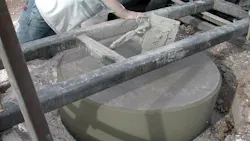
Did you know concrete is the second most consumed material globally? Over 30 billion metric tons are manufactured each year worldwide and it’s highly damaging to the environment. That is why developing eco-friendly concrete is one of the hottest tech-topics on the planet, which is why it made my list of top tech trends. Back in 2024, I wrote about high-tech green concrete. That got me on a lot of media mailing lists from innovative companies expanding this technology. It’s been quite an education watching the field expanded to the point that I’m seeing a conversation shift from green to eco-friendly concrete. The staggering numbers of these communications is indicative of the growing awareness of the technology.
There was, however, one media account that stood out from the rest. It declared that eco-friendly concrete has “transitioned from alternative to default.” That told me it was time to revisit the world of eco-friendly concrete and see what was taking place. The report said there was “a global regulatory wave” of “Buy Clean,” “Construction Products Regulation,” and “Whole-Life Carbon Reporting” policies. These and other regulatory strategies are requiring mandatory environmental disclosures for structural materials worldwide. That puts concrete and all the products made from it in the center of environmentalist’s crosshairs. How is it that concrete is getting so much ecological awareness?
Environmentally Hazardous
Let’s see, it’s precarious. Making concrete requires Portland cement and traditionally making cement is energy-intensive because it requires superheating limestone in massive kilns to convert it to calcium oxide. That’s accomplished by burning copious quantities of fossil-fuels. Experts say that for every ton of cement produced, about one ton of carbon dioxide (CO2) is released.
In everyday terms, this practice is responsible for generating about 8% of the world’s total CO2 emissions. Considering the billions of metric tons of concrete manufactured annually, even small reductions in cement production will have a ripple effect on these CO2 emissions. So there is a lot riding on encouraging the use of eco-friendly concrete. Fortunately, there are a variety of emerging cutting-edge technologies for eco-friendly concrete. These technologies range from different types of materials to innovative methodologies.
Some different materials are direct replacements of limestone, while others are blends of suitable additives that reduce the amount of Portland cement required. Blends are time-tested industrial byproducts like fly ash, silica fume, and slag, have been used as a partial replacement for Portland cement for a long time. They are, however, experiencing a resurgence in popularity. It’s estimated that about 300 million metric tons of fly ash are being recycled. Fortune Business Insights said the global cement fly ash market was valued at UD$7.32 billion in 2025 and is projected to reach US$9.87 billion by 2034.
Non-Traditional Approaches
Limestone Calcined Clay Cement (LC3) isn’t new, but it’s gaining traction as an alternative to traditional Portland cement. It combines limestone with calcined clay producing a high-performance, low-carbon mixture. LC3 is cost-effective and works easily with existing equipment. Experts report that LC3 reduces manufacturing-related CO2 emissions by up to 40%, which makes it an eco-friendly substitute.
Another innovative alternative comes from the biotechnology sphere. Biomason created a bio-cement using bacteria as an alternative to conventional cement for an eco-friendly concrete. By utilizing microorganisms, Biomason can “grow” bio-cement at ambient temperatures without high-energy kilns. This process reduces direct carbon emissions associated with the established limestone to cement method, which cuts CO2 emissions about 60% associated with conventional concrete production.
Closely related but not the same thing is biomineralization. It’s a natural process that living organisms use to produce minerals. Prometheus Materials and Green Stream Algae (GSA) announced a partnership recently. They will use GSA’s microalgae to produce ProZERO. ProZERO is a “supplemental bio-cement and bio-concrete blend that replaces carbon-intensive cement in a 1:1 ratio.” It replaces traditional cement in ready-mix concrete without altering the existing manufacturing process. They estimate that by swapping just 40% accomplishes “full carbon negativity by sequestering carbon.”
Green Choices
Green technologies are producing sustainable alternatives for concrete construction that are cost effective, low-carbon, amazingly durable and we have only touched the surface. There’s a volcanic rock cement that reduces carbon emissions by up to 67%, and an electrochemical process that eliminates CO2 emissions entirely. There’s a 3D printed biomineral-infused concrete that captures atmospheric CO2. It’s no wonder that the demand for eco-friendly concrete is increasing. High-tech concrete is another tool in our battle against greenhouse gases. With it, we can reduce the grid’s carbon footprint!
About the Author
Gene Wolf
Technical Editor
Gene Wolf has been designing and building substations and other high technology facilities for over 32 years. He received his BSEE from Wichita State University. He received his MSEE from New Mexico State University. He is a registered professional engineer in the states of California and New Mexico. He started his career as a substation engineer for Kansas Gas and Electric, retired as the Principal Engineer of Stations for Public Service Company of New Mexico recently, and founded Lone Wolf Engineering, LLC an engineering consulting company.
Gene is widely recognized as a technical leader in the electric power industry. Gene is a fellow of the IEEE. He is the former Chairman of the IEEE PES T&D Committee. He has held the position of the Chairman of the HVDC & FACTS Subcommittee and membership in many T&D working groups. Gene is also active in renewable energy. He sponsored the formation of the “Integration of Renewable Energy into the Transmission & Distribution Grids” subcommittee and the “Intelligent Grid Transmission and Distribution” subcommittee within the Transmission and Distribution committee.