Can Data Center Design Reduce Grid Impact of Al Growth? Next-Gen Tech Seeks the Answer Vertically
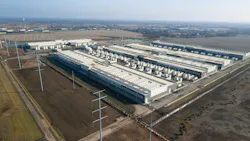
Utility companies in today's energy landscape are caught between the billions of dollars needed for data center-related infrastructure and their ratepayers, both residential consumers and small businesses, who push back against paying for those investments.
This dilemma often triggers supply issues, as these large-scale commercial projects strain an already aging U.S. power grid.
According to a recent J.P. Morgan report, more than 60% of data-center capacity planned for completion in 2027 has yet to break ground, with another 7% delayed. One of the major hurdles J.P. Morgan highlights is the ability of tech companies to secure the massive amounts of electric power required from utilities.
As a result, grid interconnection has emerged as a major bottleneck for transmission and distribution networks attempting to keep pace with demand. In many regions, data center growth is even outpacing planned grid expansion, while transmission upgrades can take many years to design, permit and construct.
For distribution networks, these massive projects require multi-hundred-megawatt loads that far exceed their existing system capacity. To provide this context, Nevada's largest utility, NV Energy, states in its ongoing case with the Public Utilities Commission of Nevada (Docket No. 26-05007) that it will need 47% more peak electricity to serve Northern Nevada by 2033 compared to projections made just two years ago. This demand associated with proposed data centers is roughly three times the size of the region's current power load.
For utilities, the challenge extends beyond simply supplying additional megawatts. Large data center projects can require new substations, transmission upgrades, generation resources and long-term capacity commitments. As a result, utilities are increasingly evaluating whether efficiency improvements within data centers themselves could help reduce the scale of required infrastructure investments.
At the same time, policymakers and utilities are exploring a wide range of generation options to support growing electricity demand. The Trump administration has encouraged states to use coal-fired generation to meet manufacturing and data center demands.
On June 4, the U.S. Department of Energy unveiled an $850 million plan to build, upgrade and modernize coal-powered infrastructure. Utilities like NextEra Energy have dropped their zero-emission goals by 2045, citing a “demand for all forms of power generation.”
While utilities continue pursuing transmission expansion, generation additions and demand-side strategies, some technology developers argue that reducing losses inside data centers themselves may offer another pathway to managing AI-driven load growth.
Liquid cooling challenges have also garnered attention amid growing strain on water resources, which is heavily impacting local and regional supplies. A recent study conducted by the Desert Research Institute indicates that just the 12 main proposed data center facilities in Nevada, the driest state in the U.S., are on pace to consume roughly 3.1 billion gallons of water annually by 2033.
Solutions: #1 Data center design
One company advancing this approach is California-based manufacturer Amber Semiconductor (AmberSemi), which contends that both energy consumption and cooling requirements can be reduced by moving away from traditional lateral power delivery layouts in favor of alternative hardware designs that utilize vertical power frameworks.
AmberSemi, a fabless semiconductor company, recently closed its initial $30 million Series C financing round from new and existing investors. The startup company plans to use funding to advance next-generation power management for AI data centers.

According to AmberSemi CEO Thar Casey, conventional server architectures deliver power across relatively long pathways within the server board, creating losses that increase as processors become larger and more power-intensive. AmberSemi's approach, which it calls "Vertical Power Delivery," places power-conversion components directly beneath the processor, shortening the electrical path and reducing resistance.
“Unfortunately, with larger CPUs and further placement resistance only increases,” Casey explained to T&D World. “The solution to this is to rethink the delivery path and how to get that final power supply as close as possible to the CPU to minimize its distribution path.”
The company says its design leverages advanced 3D packaging and micro-architecture technologies to position power components underneath the processor rather than along the board’s periphery. By reducing the distance electricity must travel, Casey claims the approach can reduce power-distribution losses by more than 85% while helping mitigate heat generation within high-density AI computing environments.
If technologies that reduce server-level losses can be deployed at scale, utilities could potentially see lower aggregate demand, reduced cooling requirements and slower growth in infrastructure needs associated with large AI facilities. This matters to utilities as they navigate the largest surge in U.S. electricity demand in over 20 years.
#2: Behind-the-meter solutions
In many cases, natural gas-fired generators have emerged as a near-term solution for addressing these physical bottlenecks from data centers. These internal combustion engines, installed in many of today's natural-gas-fueled power plants, convert liquid fuels into mechanical energy to drive electrical generation.
PJM, the largest grid operator in the U.S., saw more than $1 billion in congestion costs in May, according to its latest grid congestion report. This monthly surge follows an annual total of $3 billion in congestion costs last year. In one single transmission line event, PJM saw $150 million in costs over three days.
Operating behind-the-meter (BTM) allows these large-scale facilities to bypass the local grid and generate power on-site, using gas turbines to supply hyperscalers' massive electrical loads continuously.
According to a 2026 report by market intelligence platform Cleanview, more than 25% of planned data centers in the U.S. intend to build their own BTM. Among the 59 data centers identified since last year, Cleanview states that they account for 90 GW of combined capacity. They add that this trend has grown from "niche to mainstream."
Many developers are pursuing these gas turbines as a way to bypass clean energy alternatives to allow extensive multi-year infrastructure timelines to catch. Critics argue that widespread deployment of natural-gas-fueled BTM generation could complicate state decarbonization goals and raise questions about how grid infrastructure costs are allocated among customers.
Companies like AmberSemi are working to help engineers solve these power challenges, beginning with key observations of processor trends.
The growth-efficiency equation
“Realizing that with advanced process nodes driving power exponentially, incremental improvements in power conversion would no longer work,” Casey stated. “In a very short period of time, just a few years, we are moving from a 10kW rack to a 1000kW rack inside a data center, an increase of 100x!”
Casey adds that growing processor power requirements are forcing the industry to rethink how electricity is distributed within data centers. AmberSemi's approach combines higher-voltage power distribution with its vertical power delivery architecture to reduce conversion losses and improve efficiency.
The company argues that these “vertical” alternatives could help AI data centers better integrate on-site generation, utility power and backup resources while reducing overall energy waste to align with state clean energy goals.
“With this re-imagined power architecture, leveraging high voltage DC distribution within a data center, it provides the opportunity to integrate utilities and co-located power sources in a different manner,” Casey stated.
For utilities facing unprecedented data center growth, the question is not whether new infrastructure will be required, but how much. While transmission expansion, generation additions and BTM resources remain central strategies, next-gen technologies could eventually become another tool for managing growth within data centers and reducing essential resource constraints.
Whether approaches such as vertical power delivery achieve widespread adoption remains to be seen, but they highlight a growing focus on reducing energy demand at the source rather than solely expanding supply.
About the Author
 Eric Moody