Resilience in Action: Utility Response to Hurricanes Helene and Milton
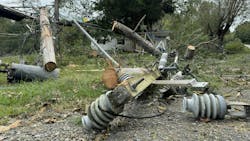
When hurricanes hit, our industry mobilizes. EVERYONE in the utility has a part in storm response and recovery, from line workers repairing and replacing damaged equipment, vegetation crews clearing fallen trees, customer service reps and communications managers keeping the public informed, logistics coordinators providing materials and shelter, and CEOs and directors overseeing resources, plans and coordination. And that’s just a start. There is also engineering, data analytics, mutual aid coordination; it is a highly coordinated effort.
Our coverage of Hurricanes Helene and Milton, just a little over a year after they hit, looks at a slice of that response. On Sept. 26, 2024, Hurricane Helene struck as a powerful Category 4 storm, leaving widespread destruction in its wake and claiming more than 250 lives. Just two weeks later, on Oct. 9, Hurricane Milton hit Florida as a dangerous Category 3 storm, battering coastal communities still reeling from prior storms
Helene and Milton were two of the most significant storms to hit Florida’s West Coast in the past 100 years. Together, they left an estimated 5.5 million customers without power across multiple states. Helene was unprecedented in its unusually slow inland track, bringing prolonged heavy rain and wind that caused flooding and extended outages in Georgia and the Carolinas. The storms caused severe damage to electric and water utilities well inland, and the combination of wind, flooding, and downed trees left some areas without power for several days.
Last month we featured a story about the aftermath, highlighting the tireless efforts of Duke Energy line workers and mutual aid crews, who worked long hours under extreme conditions to restore electricity, reopen critical services, and help communities rebuild. The article, written by Head of Content Amy Fischbach, shared the resilience, teamwork, and dedication that made the recovery possible. One of those line workers featured in the story was Greyson Stewart, a line apprentice 4 for Duke Energy in South Carolina. He said that growing up in Florida, he has seen a lot of hurricanes and what they can do, but the devastation that happened across the Carolinas was something he’d never seen before.
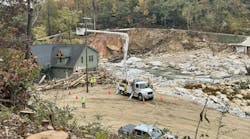
This month our special coverage continues with a “part 2” from Amy, looking at the massive destruction caused in iconic Chimney Rock and nearby Bat Cave, North Carolina. Both communities are along the Broad River watershed, so flooding heavily affects both areas. Duke Energy line crews had to restore power and rebuild infrastructure in extremely challenging conditions. With bridges washed out, roads inaccessible, and communication systems down, crews relied on “old-school” line work, helicopters, track equipment, and community support to reach stranded homes. Even a year later, rebuilding the community and infrastructure continues.
We also feature a Straight Talk from the manager of Distribution Systems at AEP’s Applachian Power, also deeply affected by Hurricane Helene. Glenn Edwards shares how Helene pushed Appalachian Power to rethink storm restoration. With roads washed out, crews scattered across the mountains, and hundreds of mutual-aid workers showing up at once, the old “bird-dog” system just couldn’t keep up for them. Helene became a proving ground for digital coordination for Appalachian Power.
Wildlife Faults: Bridging Instinct and Data
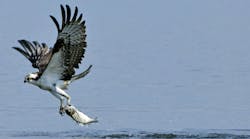
As an animal lover, I always appreciate it when we have wildlife mitigation articles. They can run the gamut from physical barriers and deterrents to habitat considerations, to detection and monitoring systems. This month, we feature a piece from an engineer on “bird faults.” Kendrick Schaben offers an engaging look at wildlife faults, and why they’re harder to diagnose than we like to admit. Field crews may instinctively know the difference between a squirrel, a bird or a tree, but proving the cause when oscillography tells a different story is where things get interesting.
What makes this piece compelling is that it bridges field intuition with protection analytics. Birds, in particular, are a much bigger reliability player than people think. In some regions, they’re driving the majority of wildlife outages and, in fire territory, even ignition events. Schaben walks through real case studies (including multiple turkeys in a single Christmas morning flight path) to show how bird faults often behave like bolted faults and how reclosing tends to clear them quickly.
But the more important takeaway is about learning: More awareness of local wildlife behavior, paired with targeted mitigation like spacing, insulator covers or diverters, can make a meaningful difference in both SAIDI and fire risk.
These storms may have passed for now, but the lessons they left behind are shaping how utilities plan, respond, and restore. Storms like Helene and Milton remind us that the grid is only as strong as the people, processes, and knowledge behind it. What we’re seeing—from line work to protection analytics to digital coordination—is the industry learning in real time, adapting as landscapes, weather, and risks change. And the effort doesn’t stop when the headlines do.
Read More
 bird with prey
About the Author
 Nikki Chandler
Nikki Chandler
Group Editorial Director, Energy
Nikki is Market Content Director for the Endeavor Business Media Energy group, which includes T&D World, EnergyTech and Microgrid Knowledge media brands. She has 30 years of experience as an award-winning business-to-business editor, with 24 years of it covering the electric utility industry. She started out as an editorial intern with T&D World while finishing her degree, then joined Mobile Radio Technology and RF Design magazines. She returned to T&D World as an online editor in 2002, and took over as managing editor in 2017, then market content director in 2023. She has contributed to several publications over the past 30 years, including Waste Age, Wireless Review, Power Electronics Technology, and Arkansas Times. She graduated Phi Beta Kappa with a B.S. in journalism from the University of Kansas.