Hurricanes Helene and Milton: One Year Later
Key Highlights
- Hurricane Helene made landfall as a Category 4 storm, causing severe flooding, wind damage, and fatalities across the southeastern US.
- Duke Energy’s crews restored power to over 1.1 million customers within 48 hours, demonstrating rapid response and teamwork.
- Lineworkers faced challenging terrain, extensive debris, and long shifts, often working 16-18 hours daily to restore services.
- Community support played a vital role, with donations, thank you cards, and local efforts helping crews and boosting morale.
- One year later, the storm’s impact remains visible, but the resilience and dedication of utility workers and communities continue to shine.
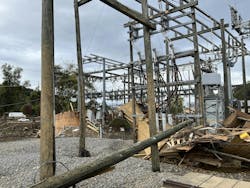
Hurricane-force winds, inland flooding and a deadly storm surge struck the southeastern United States and the southern Appalachians in September 2024. After Hurricane Helene made landfall as a Category 4 storm in Florida’s Big Bend region, the hurricane rapidly intensified, inflicting catastrophic damage and widespread power outages and leading to at least 250 fatalities, making it the deadliest hurricane in the United States since Hurricane Katrina 20 years ago.
In the wake of the storm, lineworkers joined forces to restore power to affected communities and rebuild damaged infrastructure. In Duke Energy’s service territory in the Carolinas, Hurricane Helene left 2 million customers in the dark. Less than 48 hours after the hurricane made landfall, however, the utility’s line crews and mutual assistance teams restored power to more than 1.1 million customers.
To expedite storm response, Duke Energy dispatched lineworkers to Spartanburg, Sumter and Lancaster, South Carolina, to support other crews with the restoration effort for several weeks. One of those lineworkers was Greyson Stewart, a Line Apprentice 4 for Duke Energy in Hartsville, South Carolina.
“Growing up in Florida, I’ve seen a lot of hurricanes and what they can do, but the devastation that happened across the Carolinas from Helene was something I’d never seen,” he said. “Western North Carolina was devastating, but even the amount of damage just driving to the Spartanburg Operations Center in South Carolina was heartbreaking. Hurricane Helene was one of the most significant events our company has ever experienced and brought with it some highly complex challenges in the field.”
Tyler Nickols, a journeyman lineworker for Duke Energy, said it is very surreal to be a year out from the hurricane response.
“You drive through areas of the community, and you can still see signs of the aftermath,” he said. “The area will never be the same, but it’s good to see people healing and carrying on with their lives as best they can. It really hits your feelings to be able to hook up service to a home or temporary home to help get our community going again.”
A year after Hurricane Helene hit Duke Energy’s service territory — and Hurricane Milton came right in on its heels — the response team looks back on the restoration and response.
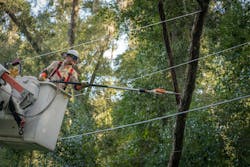
Tyler Nickols: Restoring Power in His Community
Nickols, who works out of Marion, North Carolina, recalls handling calls all week leading up to the storm. He has been working in the line trade for 19 years, and when the storm hit around 7 a.m., he had already worked a 24-hour shift.
“I went home to get rest, and then was called back in to help within five hours of being home,” he said. “I was amazed at the amount of damage the storm did in a short period of time. When I went to bed, we had minimal outages, but upon returning, almost the entire grid in our service area was down.”
Nickols described the impact on the Marion and Old Fort areas as some of the worst and most widespread damage from any storm he’s ever been on.
“Flooding and tree damage were catastrophic to our area,” he said. “Damage to roadway infrastructure was a real issue for access to restoring service, and flooding was severe to many structures and homes along waterways. Our community came together in a huge way to help each other. It was some of the best acts of volunteering that I’ve ever witnessed.”
During the restoration, he was responsible for patrolling for damage. He also performed switching to restore crucial infrastructure, such as emergency services and retail, to get food and gas services back up and running. He wound up working 40 straight 16- to 18-hour work days in the aftermath of the storm, and many of the other lineworkers also put in 16-hour work days.
“We adjusted roles after a few days to leading out-of-town crews around to helping to get repairs made,” he said. “I adopted what role was needed to help get service going during the storm.”
Many of the local lineworkers stayed at their homes — most without power — for up to two weeks. Nickols said his home didn’t receive service for almost two weeks.
“Having to work and then come home to no power was an issue,” he said. “There was limited cell service during the first week, so having to communicate via radio was a hard obstacle to deal with. Our updated radio system helped with communication during the storm.”
Due to access challenges in the service territory, the line crews relied heavily on rigging, off-road equipment, and track equipment to access the right-of-way. The tree crews and the North Carolina Department of Transportation also helped to open roadways and remove trees.
“Teamwork from our group, amazing support from our contract crews and work management kept the work rolling and helped to get restoration done,” he said.
Technology also played a role in the storm response. Once the line crews had signal, they could close feeders remotely on the SCADA-controlled switches.
Seeing the impact of the hurricane on his local community was very humbling, and he said he was glad to help the local community.
“Being able to make a difference to help friends, family and coworkers get their lights back on was amazing,” he said. “It was a great feeling to be able to give back to our community.”
Nickols said all his friends and family were very supportive throughout the storm.
“My family was obviously worried the entire time because of the long hours,” he said. “I was able to call them when I could during the day. Most nights, my kids were already in bed when I came home, and I had to leave early in the morning. Getting to see them was a blessing when I could. My wife was super supportive the entire time.”
The community donated supplies to the operations center, and local schools gave the lineworkers thank-you cards, which definitely brightened the days of the work group. The utility’s work management division coordinated the meals and used food trucks and a few restaurants to feed all the crews. In addition, local meals were provided a few times, and Nickols said it was some of the best food he had during the entire time.
“I am very thankful for our community and the people in it,” he said.
Nickols said one of the most memorable aspects of the restoration was the camaraderie of his 12-person work group.
“Pulling together to help our community made a huge difference in my eyes,” he said. “We were able to help the local people get their lights back on, and we had a lot of gratitude from our community. We got thank-you cards from local kids and schools thanking us for our service. Knowing that we made a true difference during the chaos after the storm was truly a humbling experience for me to help rebuild our community.”
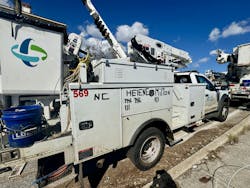
Sandy Barnhill: Getting the Lights Back on in North Carolina
Sandy Barnhill, a line tech and director of operations for Duke Energy in Raleigh, North Carolina, was working in his assigned location the day Hurricane Helene hit. As a 37-year veteran of the line trade, he spent the day working in his assigned location, expecting some impact, but nothing too significant. Instead, the aftermath was unimaginable.
“I was part of a team that started in Charlotte and then went on to Spruce Pine, North Carolina,” he said. “Once in Spruce Pine, there were no lights, no cell phone service and no water in the entire area. The devastation was significant and beyond belief. The team was just over 300 strong, and we were gone for about 21 days. No one wanted to leave until the job was complete, and we had helped everyone we could.”
During the restoration, the team faced challenges with communications, terrain and logistics for feeding the lineworkers, taking care of them and arranging bedding for the crews. Because the lineworkers worked 16- to 18-hour days, the logistics teams prepared meals at the base camp and delivered them to the field to minimize lost time.
To arrange accommodations for such a large team, Duke Energy housed the workers in base camps with sleep trailers or in local hotels, with or without power.
“We tried to make the best of it,” he said. “There was also a night or two spent in the trucks. Everyone was very flexible and willing to be inconvenienced under the circumstances.”
Because the restoration lasted longer than a typical storm response, he said the lineworkers’ families were worried, yet supportive and glad their loved ones were able to help.
“The deployment was longer than normal, but this was not a normal storm,” he said. “Families were a bit relieved once communications were re-established, and we could check in and let them know everyone was OK.”
He said the team came together and solved problems as they came up.
“We figured out a path for communicating so everyone could stay on the same page and be safe,” he said. “We used special equipment to overcome terrain issues and took care of each other with what we had or could get together.”
For example, the line crews used drones, helicopters, bulldozers, track hoes and other specialized track and off-road equipment.
“I believe all avenues were explored to get communities restored,” he said.
He said the local Asheville, North Carolina, team did a great job with logistics and supplies.
“It was all part of a much larger effort by teams all over the company that we may not have even known were working to help,” he said. “Every employee had a job to do in the effort.”
Case in point: Duke Energy’s employees made special trips with supplies to make sure the line crews had everything they needed. The members of the affected communities also showed their appreciation in many ways, and he said he and the other lineworkers were glad to have helped so many people return to some level of normalcy.
“A bottle of water or a pack of crackers as a snack was their way of saying thank you for coming to help,” he said. “The communities we worked in had so many who had lost everything. They were still helping their neighbors by having patience and giving them a shoulder to cry on or someone to talk to.”
While Barnhill relocated about two years ago, he and his family lived in Western North Carolina for more than 22 years. He has lifelong friendships with people in the community that will never be broken, and his relationships with co-workers across all the operations centers in the area will always be special to him.
“As I returned, I was glad to know the area and where things were at, but my heart was broken to see the devastation and the lives impacted,” he said. “That storm will be part of my memory for the rest of my life.”
One year later, it hopes it will never happen again. He and his team qualified to compete for the 2024 International Lineman’s Rodeo, but had to miss it to work on the storm.
“Priorities must be kept in check, and our customers were in need,” he said. “Our team is excited and looking forward to returning.”
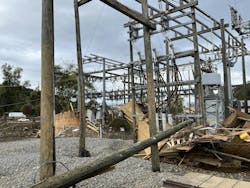
Suzy Macke: Confronting Challenges with Back-to-Back Florida Hurricanes
Suzy Macke, a troubleman for the Walsingham Yard for Duke Energy in Largo, Florida, recalls restoring power to the beach communities last fall after Hurricane Helene’s extreme storm surge. At that point in time, she realized that Hurricane Milton was on its way and was looking like it may be a direct hit to the Tampa Bay, Florida, area.
“We had already been working crazy long hours and trying to put our community back together,” she said. “To hear that we were about to be hit even harder was heartbreaking and scary, but we didn’t have a lot of time to dwell on it. We just had to keep going and get as prepared as we could.”
While Hurricane Helene caused extreme flooding to a lot of the coastal areas, Milton brought heavy winds, breaking poles, downing trees and scattering debris across the service area.
“Wind gusts of over 100 mph ripped the roof off of Tropicana Field, our baseball stadium,” she said. “Fifteen to 20 in. of rain caused flooding in areas that had not experienced that before. The ground was already saturated from the previous storm, so with 100-mph winds, entire trees were uprooted. Some broke poles and brought down overhead lines and others tossed pad-mounted transformers on our underground system. Trampolines, fences and roofs hung from overhead lines. At every turn, there was a new destruction to discover.”
Macke said she worked under storm duty for Hurricane Milton for about two weeks, and nearly a year later, she is still finding uprooted trees that are finally falling the rest of the way.
“So as part of the local utility, our storm restoration efforts have extended past the official end of the declared storm,” she said. “Just trying to keep going day after day and night after night was challenging. We just worked as a team and knew that the work we were doing was important, and we would see all the lights back on as long as we worked safely.”
As with any storm, she said it was important to take every job one step at a time.
“A lot of it was hazard recognition due to the amount of debris and downed trees and lines,” she said. “Just trying to access some of the neighborhoods was challenging. It was difficult to figure out how to remove a trampoline from a pole in the backyard when it was nearly impossible to even get your truck down the street.”
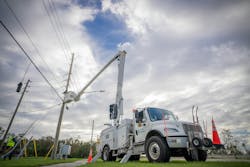
She said she would never forget how quickly she and the other line crews restored power to the community through their hard work and the help of other utilities and contractors who came to assist. She said everyone in the community was very grateful for the efforts of the line crews.
“My neighbors were amazing,” she said. “Even though we had no power in our neighborhood, they cleared debris from the street so that I would have a place to park my truck when I came home to sleep for a few hours between shifts.”
She also experienced how the whole community came together in the aftermath of the storm.
“One call took us down a street where several people had set up an entire outdoor kitchen and were grilling and feeding anyone who needed it,” she said. “It really showed the best of people.”
Macke said living in Florida on the coast has given her a completely different perspective on storm restoration.
“When I started in line work in Ohio, we would travel to where hurricanes hit, knowing we would go home in a couple of weeks. Living here, I’ve seen that when all the outside help leaves, the work doesn’t stop for the home utility. We spend months helping our community rebuild.”
Because she lived where the storm hit, she was able to sleep in her own bed, but it also meant she had to assess damage to her house and go without electricity, just like her neighbors.
“We were working 16-hour shifts, and I was working the overnight shift, so my sleep time was during daylight hours,” she said. “I had people drop thank you cards off, and my neighbors were all outside to say thanks the morning after we finally restored power to my neighborhood.”
Duke Energy’s team provided meals to the line crews at the yard to keep them well nourished during the restoration.
“The crews I was working with would come in, have dinner for breakfast and breakfast before we even went home to go to bed,” she said. “Honestly, we were just happy to have something hot to eat.”
She said it’s surreal that it has already been a year since Hurricanes Helene and Milton caused destruction in Duke Energy’s service territory.
“We are back in hurricane season, and it almost feels like Milton was just yesterday,” she said. “I was working locally for both storms. It was a lot, but we got it done.”
Todd Fountain, storm director for Duke Energy Florida, said Hurricane Milton left much of Florida’s west-central coast in the dark, but the team’s strategic response helped to expedite restoration to customers.
“It allowed them to focus on what really matters, like their families and businesses, and begin to pick up pieces of their lives,” he said. “We know they depend on us for that, and it’s a responsibility that we take extremely seriously — not just during hurricane season — but all year long.”
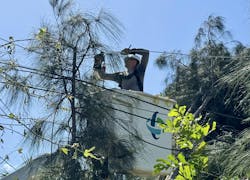
Sharing 10 Best Practices for Hurricane Response
Now that Hurricanes Helene and Milton are in the rear-view mirror, Duke Energy’s line crews are already preparing for the next hurricane season, along with lineworkers from other utilities. Here are some of their tips to help their brothers and sisters in the trade restore power safely and swiftly following a hurricane.
1. Start every day with a team meeting and pre-job briefing. Make sure everyone is connected and focused on the task at hand. Also, begin the day with a pre-job briefing to review the work to be done and the hazards to be faced, said Sandy Barnhill of Duke Energy. “All that leads to the focus on safety with every task performed, as every day, there should be no shortcuts,” he said.
2. Put safety first. Be patient and methodical in your response and always keep safety at the top of the priority list for restoration efforts, Barnhill added.
3. Always treat every wire as energized. Make sure you don’t assume a wire is de-energized until you can safely verify it and you can test and ground it, advised Suzy Macke of Duke Energy. In addition, watch out for the generators and take the time to check whether you are working around one, Journeyman Lineworker Tyler Nickols added.
4. Keep your head on a swivel. “The danger isn’t always electrical,” Macke said. For example, after the recent hurricanes, a lot of fences had blown down, leaving nails and broken wood sticking up and letting dogs out. Tree branches and other debris were also hanging everywhere, uprooted trees had left craters in the yards and broken sewer and water mains were creating sink holes.
5. Pack twice as many socks as you think you’ll need. “Hurricanes mean lots of flooded areas, and clean, dry socks are a must,” Macke said.
6. Watch out for yourself and your team. “The number one best practice is to look out for each other,” she said. “Being in an unfamiliar place on an unfamiliar system can be challenging.”
7. Always wear your PPE. “It will always save your life,” Nickols said.
8. Listen and ask questions. As a “local guy helping the out-of-town crews,” Nickols said he took the extra time to give maps and answer questions.
9. Pace yourself. Lineworkers should take care of themselves mentally and physically and know their limits, Nickols said.
10. Follow the safety rules and keep in mind your reason for working safely every day. “So you can go home to your loved ones, always keep that on your mind to do the job right,” Nickols said.
Hurricane Milton: Restoring Power in Record Time
The Edison Electric Institute awarded Duke Energy Florida with the Emergency Response Award for its response following Hurricane Milton. EEI presents the awards to EEI member companies twice a year to recognize electric companies’ recovery and assistance efforts following service disruptions caused by extreme weather or other natural events.
“America’s electric companies and their dedicated workforces work tirelessly throughout the year to strengthen the energy grid and to restore power – and peace of mind – for American families and businesses after extreme weather events and natural disasters,” said EEI president and CEO Drew Maloney. “EEI is proud to recognize Duke Energy Florida for its extraordinary response efforts following Hurricane Milton. This recovery award reflects Duke Energy Florida and its storm response team’s incredible commitment to the customers and communities they serve.”
Here are some fast facts on the hurricane:
· Hurricane Milton made landfall in Florida as a Category 3 storm on Oct. 9, 2024. About 96 hours later, after mobilizing 16,000 resources, Duke Energy Florida restored 95% of the 1 million reported power outages. As part of its response, the company replaced damaged equipment, including 1,640 power poles, 1,350 transformers and nearly 1 million feet of wire and cable.
· Duke Energy Florida’s self-healing technology, which extends to about 80% of the company’s customers, saved 3.3 million hours of power outages during this storm by automatically detecting outages and rerouting power to other lines.
About the Author
Amy Fischbach
Electric Utilities Operations
Amy Fischbach is the Head of Content for T&D World magazine and manages the Electric Utility Operations section. She is the host of the Line Life Podcast, which celebrates the grit, courage and inspirational teamwork of the line trade. She also works on the annual Lineworker Supplement and the Vegetation Management Supplement as well as the Lineman Life and Lineman's Rodeo News enewsletters. Amy also covers events such as the Trees & Utilities conference and the International Lineman's Rodeo. She is the past president of the ASBPE Educational Foundation and ASBPE and earned her bachelor's and master's degrees in journalism from Kansas State University. She can be reached at [email protected].