Hurricane Helene: Coming Together to Rebuild
Key Highlights
- Duke Energy’s crews faced unprecedented challenges, including inaccessible areas and complete infrastructure destruction, requiring innovative solutions like helicopter pole setting and drone inspections.
- Old-school line work practices became essential due to lack of cell service and digital tools, emphasizing grounding, flagging, and manual communication methods for safety and efficiency.
- Community involvement was crucial, with local residents, farmers, and families helping clear debris and support crews, demonstrating resilience and unity in recovery efforts.
- Lessons learned highlighted the importance of delegation, planning with paper maps, understanding customer hardships, and pacing oneself to prevent burnout during prolonged storm responses.
- Technological tools like helicopters, drones, and side-by-sides played vital roles in accessing remote areas, speeding up repairs, and saving time in the recovery process.
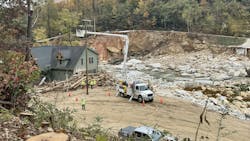
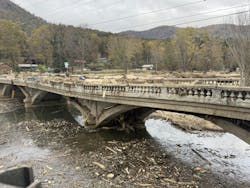
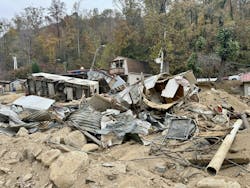
One year after Hurricane Helene swept away homes and uprooted trees, the community of Chimney Rock, North Carolina, is still under recovery. In October 2024, a raging river roared down Main Street, taking out five bridges and a mile-long street. As a result of the hurricane, at least one resident died, and homes disappeared due to the floodwater and devastation.
As soon as it was safe to begin restoration, Duke Energy’s line crews worked alongside mutual assistance partners to rebuild infrastructure and restore power, and due to the lack of cell service and inaccessibility of work areas, they resorted to old-school line work practices to get the job done in both Chimney Rock and the nearby community of Bat Cave.
Miles Bell, a journeyman lineworker with 11 years in the trade, said he worked on storm restoration for three months, with the first 31 days without a day off.
“Still today, we are technically on storm duty in certain places,” he said. “We literally had to build from the ground up.”
Bell, who competes on an International Lineman’s Rodeo journeyman team with Heath Burrell and Jordan Henderson, worked alongside other line crews to put in long hours even as they didn’t have power in their own homes. Here’s a look back at the restoration following Hurricane Helene.
Damage Discovery
A few days before the hurricane hit, Burrell focused on onboarding crews, reviewing rules and coming up with a game plan. The day of the storm, however, he remembered the wind gusts getting stronger, water rising and the interstate washing out. He was stuck in traffic for four hours before he could finally head back toward Asheville.
“It was total chaos,” he said. “I couldn’t even make it back to my service territory, there was no cell service and no one could communicate with anybody. You were trying to just make it through the day.”
Meanwhile, Henderson, who works as a first responder and troubleman for Duke Energy, said he recalled all the substations being out except for one in Hendersonville. As a result, he and the other line crews spent the first few days clearing the roads and removing trees from the lines so they could get the lineworkers to work.
When Bell first arrived at Chimney Rock, he said the best way to describe it was “insanity.” He said it looked just like a war zone.
“Chimney Rock is an iconic place, and people all over the country know about it because it’s got a lot of history and is a big tourist location,” Bell said. “I live close by there, and it’s been kind of a staple for my whole life. When we were first able to make it there, it looked just like a scene out of a movie if somebody dropped a bomb. I would say 50% of the buildings were gone, the road was gone and the river was three or four times as wide as it used to be. It was total chaos and required a total rebuild.”
The line crews first focused on restoring power to the fire department. Because the structures at Chimney Rock were so damaged, they focused instead on repairing the lights.
“We got as many streetlights on as we could just to bring some light back to the place,” he said.
Right up the road, the line crews discovered similar damage in Bat Cave, which is on the same river. Because there was no road to get there, Bell remembered riding a Polaris side-by-side for eight hours just trying to reach the area. They finally got permission to ride across private property and use private roads, which were “sketchy at best,” Bell said.
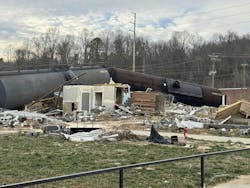
“Driving was nearly impossible,” Bell said. “The poor people who lived there were stranded for multiple days with no way out except by helicopter because every road going in or going out was gone.”
After discovering a path, Duke Energy’s crews started getting big trucks into the area and trying to work, but the devastation was just unreal and the rights of way (ROWs) had completely disappeared, he said.
“We had to walk sometimes from house to house asking people, ‘Hey, can we put a power line through your backyard that didn’t use to be there?’” he said. “It was the only real estate left that we could get wire in the air. Everyone was accepting of that and told us to do what we had to do to get everyone’s lights back on. Everyone’s mantra was, ‘until we have power, nothing else matters.'”
Gaining Access to an Inaccessible Area
Due to the inaccessibility of the work area, the Duke Energy line crews focused primarily on track machine work and on setting poles using helicopters. For example, Burrell said they ended up setting 11 poles with a helicopter on the Big Hungry and Deep Gap line.
“Big Hungry Dam collapsed and washed the bridge out, and it had about 90 to 100 customers on the other side of the bridge,” he recalled. “There was zero access to any of it, so everybody was hand-digging the holes, and then a helicopter came in for two days. There was some rough stuff on that line.”
At that time, Burrell was working on a circuit to a substation, which is currently feeding the community of Chimney Rock. His crews set 48 poles and built two miles of three-phase line in about three days thanks to the leadership of Joe Daniels.
“That was a huge project,” he said. “We had tree crews in there for five days just trying to give us access to our poles, lines and whatever was left. Half the road collapsed, and it was probably 70 ft to the bottom of the river. We also had rock crews in there beating on rock for a few days until we could get the pole line.”
Normally, the three lineworkers compete on a Rodeo team together, but during the storm response, they were working on opposite sides of the river, and the bridge was gone.
“We could see each other, but it took an hour to drive around to actually get to each other,” he said. “They were bringing the power line down one side, and we were rebuilding it on the other. We were trying to meet in the middle so we could get all the lights back on.”
Five Lessons Learned from the Hurricane Helene Response
The Lineman’s Rodeo team of Miles Bell, Jordan Henderson and Heath Burrell share their tips for other lineworkers who need to restore power following a hurricane.
- Don’t try to do it all yourself. Bell said it’s important to give up some tasks, delegate when possible and let others help you. While Bell hopes he never has to face a hurricane response like Helene again, he said he learned a valuable lesson. He was managing 200 people at the peak of the storm, and at first, he tried to do everything on his own.
- Get help with logistics. Burrell agreed, saying he eventually asked another lineworker from down east to help him with meals and logistics for the crews. “It was unreal the amount of stress that took from what I had to do each day,” he said.
- Request a paper map for each storm response. Burrell said he has been in the line trade for 20 years, but he had never been on a storm where he had to work off a map and manage a big crew. He remembers managing a crew from Canada, and they came in requesting maps. “We spent hours printing maps, and through this, we found out that’s the way to go,” Burrell said. “We get too reliant on these computers, and we’ve been using our mapping system for years, but the map doesn’t lie, and it’s easy to follow the road. One thing I’ve learned is I would probably request a map from here on out, anywhere I’m working.”
- Understand what others are going through. While Henderson has worked a lot of major storms including hurricanes in Florida, having that big of a storm at home where he lived put it into a different perspective. “I’ll always have that in the back of my mind as I’m traveling on other storms,” he said. “It opened my eyes a little more about what other people are going through in their homes and communities now that I’ve seen it happen here and had to deal with it while working.”
- Look out for yourself and don’t get burned out. Before Helene, Henderson had worked at the most on two-week storms. After working 16-hour days for two weeks straight, he burned himself out. “I would really learn to pace myself if I had to work a storm of that magnitude again.”
Going Old School
When it comes to storm restoration, today’s line crews often depend on tools and technology to expedite response. In the case of the Hurricane Helene response, however, the lineworkers had to rely on old-school methods due to a lack of cell phone coverage or electricity.
“Everything is now on the computer, but we had to go back to pen and paper,” Bell said. “We had no phones, and radios didn’t work because they were digital. I had to go home and get my kids’ walkie talkies just so we could talk. Our best practices were to just go back to the fundamentals when we all learned how to do line work without all the fancy stuff. We just had to take it back there, do all the little things and stay safe.”
Reverting to line work before the advent of technology gave apprentices a valuable learning opportunity. With the substation submerged, they had to learn about the dangers of generators and the importance of testing and grounding.
“There’s still a bunch of guys coming up that might not ever get to experience anything like that,” Bell said. “Without having access to their phones, they had to go back to the basics of line work. They started at a substation and worked their way out without any direction. It was a good learning experience because the substation was completely underwater, and we knew there was no power coming to it from our sides.”
To safeguard the line crews, it boiled down to flagging and tagging their lines, grounding and wearing their personal protective equipment (PPE). This was especially important because even though the substation was flooded and submerged underwater, generators could be on.
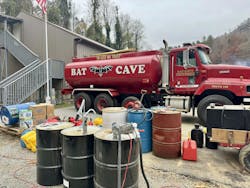
“Even though they were saying that everything was dead and there was no way there was power, you never know,” Burrell said. “You have so many people with generators and everything else, so we stuck to the basics of testing and grounding. I don’t know how many different lines were tested and grounded the whole time we were working. If I had a $5 bill every time we tested and grounded the line, I could probably go ahead and retire this year.”
While technology was basically “thrown out the window” at the beginning of restoration, he said the best equipment the line crews had access to was a helicopter. In one area alone, the line crews set 190 poles with a helicopter, and if it hadn’t been for this assistance, restoration would have lasted weeks longer. In many places, it was challenging to hike over the rough terrain, let alone carry a pole.
“I can’t emphasize how much time that thing saved us as far as getting poles in and in the ground,” Henderson said. “Next to that was getting a track bucket in some places that would have taken us a full day to do off hooks. With the track bucket, it took us two hours. The track machines and helicopter played a big role in this storm because there was a lot of inaccessible stuff.”
Another important tool in their storm restoration toolbox was a drone. Burrell said he teamed up with the local fire department for several days to fly the lines.
“We couldn’t get vehicles there, and the drone helped us out a lot just by being able to see what we had down and what we needed to plan for,” he said. “Other than that, the track equipment really saved the day.”
He said he was also an advocate for the side-by-sides due to the lack of roads available for the restoration.
“We’ve got two in our ops center, and there’s no telling how many miles we put on them,” he said. “Those saved a lot of walking.”
Clearing Trees and Roads
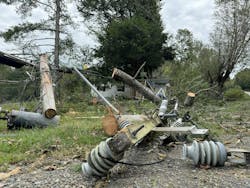
During the first few days of restoration, the lineworkers not only had to overcome challenges such as a lack of coverage and technology, but also floodwater. The standing water, however, was no match for the number of trees that were downed by the hurricane. Bell said it normally takes him five minutes to drive to the op center, but after the hurricane, it took him 15 to 20 minutes just to navigate to it. His brother, who is a lineman on the transmission side for Duke Energy, however, had an even harder time.
“His op center is 45 minutes away from his house, but it took him 13 hours to get to work on the first day because he would run into a flooded bridge that was out and had to turn around,” Bell said. “He basically had to cut trees out of the road.”
With the bridge and road completely gone, Duke Energy had local vegetation management crews on site, but the lineworkers also jumped into action to clear the debris and fallen trees.
“We had tree crews, but honestly, for the first week, everyone was a tree crew,” Bell said. “Our foremen would jump on their machines and build their own right-of-ways to get to the pole or across the creek. Everyone just kind of jumped in and made it happen.”
While they assigned the technical tree-trimming jobs to the professional arborists, the line crews worked together to clear the roads.
“Everyone had chainsaw chaps and their PPE on to cut trees,” Bell said. “We had a lot of help from the community too. I’ve got several friends who do grading work, and they were following us around helping us to clear roads and anything they could to help us get the lights back on.”
The local farmers also pitched in with their tractors to help clear the road. Because the line crews couldn’t start restoring power until the trees were off the lines and away from the roads, the restoration required a joint effort.
“If we had waited, it would have doubled the time, and we wouldn’t have had the community come together as it did,” Burrell said. “Everyone jumped in, and that’s what got the lights back on the quickest.”
Coming Together as a Community
While the line crews were working 16-hour days in the field, their families were helping at home. Bell said without help from his wife and kids he couldn’t have been on the job helping people every day. After working 16- to 20-hour days, he would go home and kiss his kids on the head as they were sleeping and fire up the generator to take a hot shower at his house.
“They were really the backbone for me,” Bell said. “The only time they were able to see us is when they were helping to bring water or lunch. I was gone in the morning when they woke up and asleep whenever I got home.”
Burrell said his wife also volunteered a lot of her time to the restoration.
“She gave a lot,” he said. “She would come in and help in the op center with laundry and putting bags together and just provide assistance to me and those around us, so I am very thankful for her.”
Because he was managing more than 200 lineworkers, Bell had to find a way to feed the crews. He asked a friend who owns a BBQ restaurant to prepare meals using his food truck fueled by propane. Others also pitched in.
“Linemen’s wives were making sandwiches and trying to prepare meals for people because there was nothing available,” Bell said. “Most of the restaurants’ food spoiled before they could even use it. So it was kind of get what you can get and keep working.”
Case in point: for the first few days, Burrell said he and his crew members were living off of water and beef jerky bags. Henderson remembers eating lots of apples during the restoration.
“One day, a farmer came through, and most of their crop was destroyed,” Henderson said. “The whole bed of their truck was filled with apples, and they bagged them up and gave us 300 bags of apples. We ate apples for days and days.”
Looking to the Future
After the initial restoration, Duke Energy’s line crews are still working in the area to rebuild or repair the lines to the point where they can receive power.
“We are rebuilding lines and turning meters on to try to get power back on these structures,” Bell said. “We are trying to answer the calls of the individual structures that are ready, and we are figuring out how to build a line to it. As far as the community, there’s still a lot of work to be done there. Several relief groups are building all the town back. They’ve come a long way, but there’s still a lot of construction left to do.”
In fact, Duke Energy is still feeding all the customers with an alternate source and still doesn’t have the line built to where it used to be located.
“We had to backfeed from two different areas and split the customers up just to get the power back on,” Bell said. “It will probably be like that for at least two or three years, because that’s how long it will take for the road construction to be finished. I hope I never face another one like Helene ever again.”
Editor’s Note: To hear Miles Bell, Jordan Henderson and Heath Burrell share the stories about the Hurricane Helene response in their own words, listen to the two-part series about the hurricane response for the Line Life Podcast at linelife.podbean.com. Also check out Part 1 of this series, which talks about not only Hurricane Helene, but also the response following Hurricane Milton.
About the Author
Amy Fischbach
Electric Utilities Operations
Amy Fischbach is the Head of Content for T&D World magazine and manages the Electric Utility Operations section. She is the host of the Line Life Podcast, which celebrates the grit, courage and inspirational teamwork of the line trade. She also works on the annual Lineworker Supplement and the Vegetation Management Supplement as well as the Lineman Life and Lineman's Rodeo News enewsletters. Amy also covers events such as the Trees & Utilities conference and the International Lineman's Rodeo. She is the past president of the ASBPE Educational Foundation and ASBPE and earned her bachelor's and master's degrees in journalism from Kansas State University. She can be reached at [email protected].