Lessons Learned from Hurricane Helene: How Appalachian Power Safely Scaled Mutual Aid
Hurricane Helene was the most destructive storm to hit AEP’s Appalachian Power territory since 2012. It washed out roads, limited access, and across mountainous terrain, devastated entire circuits.
But Helene is not an outlier. Utilities across the country are confronting severe weather, wildfires and other major emergencies that are larger and more unpredictable than ever before. As conditions evolve, the old playbook for directing field crews is reaching its limits. What once worked for smaller, slower events now creates friction when hundreds of mutual-aid crews arrive needing clear, immediate guidance. Hurricane Helene made that reality unmistakable and highlighted how digital coordination is transforming restoration.
Beyond ‘Bird Dogs’
For decades, storm restoration across the country depended on guides, often called bird dogs, who met incoming crews, physically led them to work locations, explained the job and returned later with the next assignment. In an era of smaller storms, fewer outside resources and limited digital tools, this approach ensured safety, helped crews unfamiliar with the territory and kept restoration efforts moving.
However, Helene’s damage wasn’t confined to isolated failures. Crews faced multi-point outages on the same circuit, limited access routes and conditions that required real-time decisions on where to isolate, how to backfeed, what to prioritize and when to request switching support.
Under those conditions, escorting crews from job to job would have created significant bottlenecks, slowing restoration and increasing risk. Going head-to-head with Helene required a different approach.
The turning point was a shift from paper-based workflows to shared, real-time visibility across crews, circuits and coordinators. Using Arcos workforce management solutions, we assigned work digitally, eliminating the need for constant manual guidance. It enabled us to safely absorb two to three times as many mutual aid crews as in previous storms without creating new coordination bottlenecks.
We were able to provide each crew digitally with:
- GPS routing to exact work locations
- A complete circuit view, rather than a single trouble ticket
- Photos and notes from damage assessors, tied directly to the outage case
- Visibility into nearby crews, devices and switching points
This shared context changed how crews worked. Instead of operating in isolation, they could see upstream and downstream conditions, identify opportunities for partial restoration and coordinate safely with other crews on the same circuit. Critical details, such as the latest circuit maps, were always readily available. Maps updated as portions of the grid were energized, so crews could see where it was safe to work and where lines were live. This visibility improved awareness and removed the small, compounding delays that slow restoration.
Accelerating Restoration with Shared, Real-Time Visibility
Unproductive time during restoration rarely shows up in a single moment. It accumulates through waiting, backtracking and unnecessary travel. During Helene, digital coordination and workflows helped eliminate much of that friction.
- Crews quickly transitioned between jobs.
- Damage photos improved material staging before leaving the yard.
- Circuit-level visibility reduced unnecessary patrols.
With digital tickets updated in near real-time, coordinators could see which crews were actively working, which were finishing their work, and which were ready for reassignment.
Our digital workforce management tools connected crews and back office staff in real time. Rather than relying on end-of-shift updates, restoration progress was always visible.
In past storms, identifying the source of a workmanship issue weeks later was often impossible. Today, digital records directly tied to restoration activities eliminate that uncertainty. As part of our post-Helene improvements, we are expanding the use of photoverified repairs to confirm work quality and reduce repeat outages.
Looking Ahead
While bird dogs played a critical role in utility storm response for decades, Helene made it clear that these models can’t keep up with today’s storms. By replacing manual guidance and paperwork flows with shared digital visibility, we were able to safely scale mutual aid, improve coordination and accelerate restoration across some of the most challenging conditions we’ve faced.
In just 10 days, Appalachian Power crews and mutual aid partners:
- Logged more than 1 million work hours
- Replaced 1,485 poles
- Installed 471 Transformers
- Rebuilt 214 miles of wire
Storm response will always be complex, but Hurricane Helene showed that with the right strategy, technology and process in place, scale becomes an advantage, not a liability.
About the Author
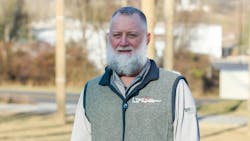
Glenn Edwards
Glenn Edwards is manager, Distribution Systems at Appalachian Power.