Protecting Birds and Ecosystems: Ameren Safeguards Power Lines and Wildlife
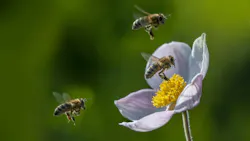
Electric utilities nationwide are tasked with powering their communities. At the same time, they must find ways to safeguard the birds perching on their power lines, the pollinators landing on their rights-of-way and the animals trying to slither, crawl, or sneak into their substations.
At Ameren, the utility focuses on four key areas throughout its service territory: pollinators, birds, bats and big river ecology, said Julianne Randanzzo, career environmental scientist at Ameren.
“As a utility company that manages and operates assets across a 67,700-square-mile area, Ameren recognizes the value of supporting biodiversity in the regions we serve,” she said. “From installing reflectors and coverings on power lines to partnering with organizations across Missouri and Illinois, Ameren has taken numerous steps to protect animals and support suitable habitats for all species.”
Creating a Safe Space for Peregrines
Ameren partnered with an internationally renowned consultant specializing in assessing impacts to avian populations to develop its Avian Protection Plan (APP). Since its inception, the Ameren avian protection program has reduced reported avian fatalities by 64%.
The utility applies the APP's best practices across its assets in Missouri and Illinois. For example, Ameren invests in avian enhancements, such as supporting bird rehabilitation centers like the World Bird Sanctuary and the Illinois Raptor Center. In addition, the utility proactively retrofits facilities at the highest risk of avian incidents and whenever incidents may occur. Beyond these best practices, Ameren also develops avian-safe standards for transmission and distribution construction and trains line crews, supervisors and outside contractors.
Three years ago, Ameren took its avian protection efforts a step further by installing a nesting box for peregrine falcons at the Labadie Energy Center in Franklin County, Missouri. Steve Sehrt, now retired shift supervisor at Labadie, partnered with Jeff Meshach, deputy director at the World Bird Sanctuary, on the blueprints for the current box. Sehrt and his wife then constructed the box from western cedar and stained it so it would last for many generations of peregrines.
“Creating a nesting box for peregrine falcons offers a sense of environmental responsibility and a way for Ameren to connect people with nature,” she said.
To place the nesting box on one of the utility’s stacks, the operations department safely lifted it several hundred feet and secured it to the floor decking with wire. This approach helped to withstand the wind and stay in view of Ameren’s camera, which was turned on during the nesting period of the chicks from early spring until mid-June. Reintroducing these birds to nature has been vital using nesting boxes, she said.
“This year marks the fourth generation of falcons in Franklin County, and the Falcon Cam will continue to offer the local community and those beyond a way to witness the spectacle of the world’s fastest animal raising its young,” she said.
Supporting the Local Falcon Population
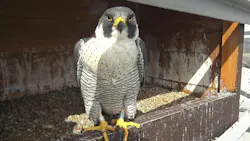
Peregrine falcons were once endangered due to the now-banned chemical DDT. Although they were removed from the federal endangered species list in 1998 and Missouri’s endangered species list in 2024, they remain a vulnerable species in Missouri, the Show Me State.
“Peregrine falcons are an incredible comeback story,” she said. “With only a handful of breeding pairs documented in the St. Louis region, Ameren’s Falcon Cam plays a key role in tracking and supporting the local and North American population.”
Peregrine falcons are philopatric, meaning they are loyal to their nest sites. She said she is proud that Ameren’s infrastructure is safe for the peregrines, and she was excited to see them raise the next generation in the nesting box.
“Seeing Thor (our female) and the unbanded male (which appears to be the same male as last year) return is a great sign that the habitat Ameren is providing and maintaining is likely leading to a healthy local population of peregrines,” she said.
Peregrines are different from other bird species because they prey extensively on “nuisance” birds such as pigeons and, as such, offer a natural pest-control option for Ameren’s facilities.
“By hosting a falcon nesting box, you are not just saving a species; you are hiring a 200-mph security guard that keeps pigeons away from your sensitive equipment,” she said.
In addition, they do not build large, messy nests from sticks and twigs, which could bridge electrical conductors and cause potential outages. Instead, they use simple scrapes on flat surfaces, like nesting boxes, which makes their infrastructure-safe nests on energy centers especially attractive, she said.
“Ameren, the Missouri Department of Conservation and the World Bird Sanctuary are working together to use their diverse resources to protect and preserve the wildlife of the heartland,” she said. “The Falcon Cam project is the latest result of these efforts. The project is part of Ameren’s ongoing commitment to being responsible stewards of the environment.”
Installing Other Avian-Safe Upgrades
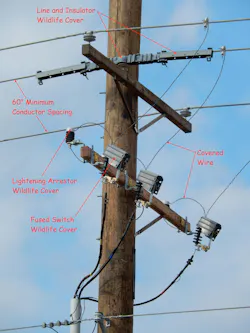
Ameren continues to upgrade infrastructure and shield equipment to make it avian-safe, especially in areas that are high risk for eagles. Avian-safe poles make it physically impossible for an eagle to bridge a circuit with its wingspan length. Additionally, Ameren continues to document bird mortality events and plans to install diverters, marker balls or other appropriate technology that is effective in reducing mortality for birds foraging and migrating at twilight or in foggy conditions.
In addition, Ameren initiated a territory-wide review of more than 100 substations in Illinois to assess their current level of avian-safe design. For example, lineworkers installed 92,000 avian-safe distribution poles and 180,000 protective covers on energized equipment and retrofitted 1,400 structures, resulting in reduced avian-related incidents at substations.
“The program has become a model of best practices for other utilities in the region,” she said.
For other utilities seeking to safeguard their local avian populations, she advises adopting the Avian Power Line Interaction Committee (APLIC) standards for new construction in high-risk areas.
“Build a pole with the correct spacing for wingspan length or retrofit it with covers after a bird-caused outage,” she said. “This approach will also set you up for success if your utility chooses to apply for an Eagles Wire Permit in the future by eliminating high-risk areas, provided the poles in those areas are already constructed as avian safe.”
By taking a proactive, rather than a reactive, approach to avian protection and animal conservation, Ameren is helping to safeguard the local wildlife population while bringing light and power to its service territory.
Spotlight on Conservation: Ameren’s Projects Across Missouri and Illinois
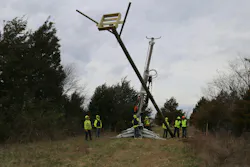
- Flight Diverter Installation: Ameren installed flight diverters on transmission lines within the Riverlands Migratory Bird Sanctuary, adjacent to the Mississippi River near Sioux Energy Center, among other locations, to prevent collisions between trumpeter swans and high-voltage lines.
- Illinois Raptor Center: Ameren supported the construction of 36 raptor cages to house educational raptors at the center in Decatur, Illinois. The cages allow public access to view raptors and learn more about raptor awareness and power line safety and provide a safe place for injured raptors until they build enough strength to be released.
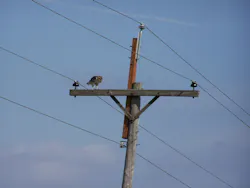
- Reflector Installation: Ameren installs reflectors and protective coverings on power lines where birds like to perch to protect them from contact with high-voltage lines.
- TreeHouse Wildlife Center: Ameren supported the construction of a 96-ft-long flight cage with more than 200 ft of safe flight space for injured raptors to redevelop strength and skills during the final stages of rehabilitation.
- World Bird Sanctuary: Ameren continues to partner with the World Bird Sanctuary by supporting suitable habitats for all bird species.
- Native Vegetation Restoration: Areas planted and managed for native vegetation within our owned or managed properties and rights-of-way provide beneficial habitat for a variety of bird species for foraging, nesting and stopover cover during migration.
A Look Inside the Nesting Box
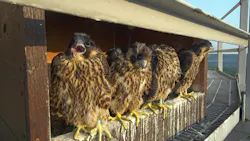
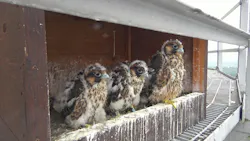
For the third year, the pair of Peregrine falcons welcomed new hatchlings in the nesting box. They typically lay three to five eggs in early spring, incubate them for 30 days and then see their young take their first flight by mid-June.
“Known for reaching hunting speeds of more than 200 mph as they hunt other birds in flight, adult peregrines spend the season fiercely defending the nest, incubating their eggs and caring for their chicks until they leave the nest or fledge,” said Julianne Randanzzo, career environmental scientist at Ameren Missouri
Each season, she looks forward to welcoming and naming the year’s hatchlings and then monitoring their bands after they leave the nest.
“Some of our chicks have been spotted in areas like Texas, so we are excited to see where they end up,” she said. “If anyone spots a peregrine, they report their band number to www.usgs.gov to help track the population.”
During the nesting season, from early spring to mid-June of 2026, viewers of Ameren’s Falcon cam stream could have real-time glimpses into egg laying, incubation shifts, feeding routines as well as the dramatic moment when the chicks begin exploring life beyond the box. The cam was available daily from 7 a.m. to 8 p.m. CDT during this time, and now, by visiting this page, visitors can learn more about peregrine falcon chicks of 2026 by reading the “Ask Jeff” personal blogs by Jeff Meshach, deputy director of World Bird Sanctuary.
About the Author
Amy Fischbach
Electric Utilities Operations
Amy Fischbach is the Head of Content for T&D World magazine and manages the Electric Utility Operations section. She is the host of the Line Life Podcast, which celebrates the grit, courage and inspirational teamwork of the line trade. She also works on the annual Lineworker Supplement and the Vegetation Management Supplement as well as the Lineman Life and Lineman's Rodeo News enewsletters. Amy also covers events such as the Trees & Utilities conference and the International Lineman's Rodeo. She is the past president of the ASBPE Educational Foundation and ASBPE and earned her bachelor's and master's degrees in journalism from Kansas State University. She can be reached at [email protected].