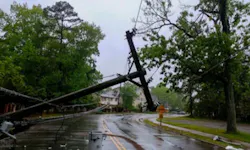
—W H I T E PA P E R Utilities have options when it comes to grid hardening The power grid makes modern life possible, and it is essential to the functioning of all other critical infrastructure like water systems, hospitals, and data centers. Now, a combination of aging equipment, shrinking reserve margins, and increasing frequency and severity of weather events are challenging grid operators to maintain the flow of power. Meanwhile, renewables, energy storage, and new uses (e.g., EV charging) are changing how the grid is operated. New business models are rewriting the industry, too, for example by enabling more entities and technologies to participate in ancillary services markets like frequency regulation and voltage support. Grid hardening has three components: • Reduction in impact, the ability to mitigate the size and duration of an outage • Withstand capability, which refers to the ability of the utility distribution systems to manage disruptions automatically (without human intervention) • Response, specifically how quickly a utility can get the right assets into the field and restore service Grid hardening seeks to address these three areas by making the grid more resilient against a wide range of threats. These include natural disasters (floods, storms, lightning, wildfires etc.), human error (whether in the field or in the control room), vandalism/physical attack, cyberattack and equipment failure. We won’t cover cyber security risks here as this topic warrants its own discussion, but there are many available, proven solutions to address the other risks. Money well spent Between 2003 and 2012, weather-related power outages alone are estimated to have cost the US economy an inflation-adjusted annual average of $18 billion to $33 billion. But that was then; now the Federal Energy Regulatory Commission (FERC) says the annual hit to GDP is around $150 billion. The 2021 blackout induced by record cold temperatures in Texas is estimated to have cost the state’s economy between $80 and $130 billion. The economic impact of major outages continues to have a ripple effect on the global supply chain of some commodities. — 01 Equipment like circuit breakers and reclosers are essential for rapid recovery from storms — 01 — 02 — 02 Undergrounding distribution lines virtually eliminates exposure to storms and other disruptions Grid hardening, then, comes with a compelling business case. According to FERC, every $1 million in direct spending on grid modernization and hardening generates some $2.5 million in GDP growth thanks mostly to avoided or reduced outages. That’s why grid spending makes up the second largest category of the bi-partisan Infrastructure Investment and Jobs Act of 2022. A wakeup call on flood risk Flooding is always a concern for utilities in low lying areas, and according to IEEE, many utilities design substation switchyards and/or control house elevations at the 100-year-flood elevation, plus 1 foot. IEEE suggests that this approach is practical for inland substations impacted only by rivers, wetlands, or waterway flooding, but additional steps are needed for substations that face risks from storm surge, tidal cycles, tropical precipitation, hurricane-force winds, and tsunamis. Since 2012’s “superstorm” Sandy, coastal utilities in particular have hardened substations against flooding by building dams and walls, deploying distributed and elevation-adjustable relay panels, and raising transformers, control houses and other major substation components. Sandy was a wakeup call for many US utilities. Dan Taft, Consolidated Edison’s Chief Engineer, Control Systems at the time, was shocked by the damage inflicted by the introduction of salt water to the copper wiring and control wiring of a Manhattan substation during Sandy. “The corrosion we saw looked like it might have taken decades to occur,” he said in a 2012 ABB interview, “and yet it occurred in a matter of hours.” Determined never to let it happen again, ConEd replaced its copper wires with a whole new fiber optic communication network that is virtually immune to water damage. Part of a $1 billion program to protect New Yorkers from the next major storm, this effort also effectively digitized the substation, giving ConEd eyes and ears over their entire program. Digitalization defense ConEd’s experience is being shared at least in part by many other utilities looking to gain greater situational awareness of grid conditions and the status of grid assets. Digital switchgear plays a major role as it provides real-time data to SCADA and asset management systems. By using multiple sensors to measure temperature and humidity, and by monitoring utilization and operating cycles of electrical devices, digital switchgear can monitor its own health and indicate when conditions change. That way it can predict potential failures before they occur or alert grid operators when maintenance is needed. Digital switchgear is also easier to install than conventional gear, occupies a smaller footprint, and can save up to 30% on operating costs. GIS and submersible gear Elevating equipment out of projected storm surge or flood levels still leaves substations “outdoors” and, thus, vulnerable. An additional solution for flood- prone substations is gas-insulated switchgear (GIS) in which all primary electrical components are encapsulated. It can be safely operated in confined spaces with a significantly reduced footprint. Perhaps more important, according to IEEE, wind and atmospheric contaminates (e.g., dust, salt, industrial pollutants, etc.) cannot impact the substation’s operation, improving reliability, safety, and life cycle costs. That’s aboveground. Then there are underground distribution substations, many of which were installed decades ago. Primary equipment was often designed with open-air electrical connections and multiple circuits, meaning personnel may find themselves working on a de-energized circuit adjacent to energized ones, a significant safety risk. — 03 Electric vehicles represent new load but also potentially storage capability for utilities These designs are becoming increasingly problematic given safety concerns and the increasing threat of flooding, among other issues. Submersible apparatus and control systems represent one solution. Underground vaults should be designed to operate in floods, incorporating a water level monitor and a working pump and drainage system as well as a local battery system that maintains vault operations if source power is lost. Early warning Florida Power and Light (FPL) took a lesson from Sandy in 2012 and installed 223 flood monitors in flood-prone substations to warn operators to de- energize equipment. Eric Silagy, President of FPL, reported that the monitors performed well during subsequent hurricane Irma. “Those flood monitors saved three or four days of work and millions of dollars’ worth of equipment” said Silagy. In addition to hardening the substation to protect vulnerable equipment against wind and water, it is important to maintain strategic spare equipment, especially in cases where older, obsolete equipment is in service. More on this in a moment. Microgrids Loosely defined as a collection of generation assets (potentially including energy storage) and loads that can operate connected to or islanded from the grid, microgrids offer a number of benefits with regard to grid resilience. State regulators have taken notice. Over the last five years, a total of 112 bills supporting microgrid deployments have been introduced or passed in 18 different states. Policy support like this is reflective of microgrids’ ability to address multiple utility priorities from reliability and resilience to the integration of more renewable energy sources and energy storage. Some utilities may offer microgrid design and engineering services to their customers while others opt to work with partners, but it seems clear that more deployments are on the way. In either case, it’s important to design a microgrid as a whole from the outset. Often this will reveal opportunities to optimize the system and reduce costs (e.g., by right- sizing equipment). Renewables, energy storage and electrified transport Renewable energy sources are relevant to grid resilience because they are not beholden to fuel supply chains. With the right equipment and interconnection, solar and wind installations can even provide black start capability to the surrounding grid. Energy storage can also provide emergency services while facilitating more renewable energy to flow during day-to-day operations, as well as provide power quality solutions to mitigate transients. Storage is also a key enabler for electric vehicle charging, whether passenger cars, transit buses or fleets. On-site energy storage reduces the size of the grid connection needed to support charging, but it also shifts load to off-peak periods and can be used to reduce peak demand on the surrounding grid. Many renewable and/or storage installations are constructed as a microgrid, so there is often substantial overlap between business cases, which can help to justify a given project. — 03 9AKK108466A7171 REV.A APRIL 2022 — We reserve the right to make technical changes or modify the contents of this document without prior notice. With regard to purchase orders, the agreed particulars shall prevail. ABB Inc. does not accept any responsibility whatsoever for potential errors or possible lack of information in this document. We reserve all rights in this document and in the subject matter and illustrations contained therein. Any reproduction, disclosure to third parties or utilization of its contents – in whole or in parts – is forbidden without prior written consent of ABB Inc. © 2022 ABB. All rights reserved. — ABB Inc. 305 Gregson Drive Cary, NC 27511 electrification.us.abb.comVendor relationships Just as utilities once moved to establish mutual assistance programs, they are now increasingly engaged in advanced storm planning and agreements with vendors that might include provisions like the following: • Guaranteed supply chain and channel partner relationships • A single point of contact so it is clear who to call • Defined roles and responsibilities, requirements, estimated scope of work, and manpower • Defined work locations (whether at vendor or customer site, or both) • A blanket PO, typically including a not-to-exceed amount and finalized invoice process for easy flow, sign off, and payment • A safety training plan, (on site or ahead of project execution) to ensure everyone is working to industry safety standards and any customer-specific safety requirements • Risk/reward sharing (i.e., partnerships) • Services (e.g., triage and condition assessment of equipment in the field) In addition, more recent supply chain woes have put a spotlight on the importance of vendors particularly with regard to the availability of spares and commodity products and the lead times on engineered equipment. Utilities are well advised to examine their supplier relationships and ensure they have the means to respond to any threat to the continuity of operations. A growing threat: wildfires Unlike storms, fires come without warning and can start anytime. While vegetation management remains essential to reducing fire risk to power systems, there are technologies available now that can help prevent grid-initiated fires from starting. Specially designed fuses prevent the escape of sparks that could ignite nearby brush, for example. Products and systems that provide remote protection and control capabilities allow utilities to act quickly, for example to de-energize equipment in fire- threatened areas. Undergrounding is another, albeit longer-term, solution to protecting grid assets not only from fires but exposure to storms and human mischief as well. Utilities with gas-fired generation or natural gas distribution systems must also be concerned about the risk of leaks. Fortunately, they can now meet this challenge with extremely sensitive detection devices to sniff out methane leaks. These devices can be drone- or vehicle-based and deliver a dramatic improvement over legacy systems that require field technicians to walk around the given site. That saves time and money, and potentially could save lives. Looking ahead Utilities face an unprecedented challenge in protecting the grid at the very moment when new consumers (think EVs and data centers) are placing greater demands on our aging infrastructure. But with a focus on reliability and resilience, grid operators can leverage both long-established and newer technologies to meet this challenge.