Birds and Utilities: Coexistence and Conservation Strategies
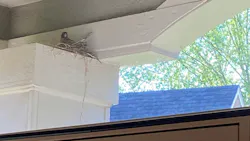
We have a window transom with a great view of the top of a porch column that sits just outside our front door. Our first bird family built their nest there during COVID, which was special for us because we had plenty of time to watch them raise their babies. Almost every year since then, we’ve had robins return to lay their eggs there and successfully raise their young.
We had a special surprise just a few weeks ago. A new species decided to borrow the spot: a pair of morning doves took up residence and raised two babies. A couple of weeks ago, the young birds were enthralled watching my husband work on some landscaping. I then left for T&D World Live, and when I came back, they were already exploring the bushes and nearby trees.
This nesting spot is safe, cool (or warm) and hidden, so I am thrilled that the birds have found such a place to raise their young and that I can feel like I’m contributing by letting them share our residence.
Utilities also provide safe nesting spots for birds — for many reasons, including not only wildlife conservation but also reliability. As soon as power lines started being built, birds recognized power poles as vantage points that provided an elevated, unobstructed view to hunt for prey and spot predators.
In 1923, the Big Creek hydroelectric lines in California were upgraded to carry a world-record 220,000 V. Almost immediately, the multimillion-dollar grid started suffering massive, mysterious short circuits every few days. Desperate engineers blamed everything from spiderwebs to lightning until they finally caught a massive eagle perched on a steel transmission tower. They realized that large raptors weren’t just nesting; their stream of highly conductive excrement (known as “streamers”) was bridging the gap between live wires and steel towers, causing catastrophic electrical arcs, according to an IEEE Spectrum article by Charles Q. Choi.
For decades, power companies tried to keep up with the issue by knocking down nests and shooting or poisoning birds that chose to squat on power infrastructure. But in the 1970s, two major shifts happened: Large raptor populations had plummeted by 90% due to heavy use of the pesticide DDT, and ospreys and eagles found that utility poles were sturdier, taller and safer from climbing predators, such as raccoons, than trees.
We then had millions of eagles, hawks and owls being electrocuted when their wingspans touched two lines simultaneously. So, in 1989, the Avian Power Line Interaction Committee was created. APLIC was a collaboration between the Edison Electric Institute, federal wildlife agencies and utilities to design safer, avian-friendly power grids.
By the 1990s and 2000s, utilities also discovered how persistent birds like ospreys could be. If a crew knocked down a nest, the pair would rebuild it in the exact same spot within days.
Utilities’ answer to this was brilliant: They began erecting dedicated, safe platforms adjacent to or higher than power lines. Because generations of ospreys and white storks have now successfully hatched on artificial structures, wildlife biologists note that humans have essentially “trained” the birds to prefer utility infrastructure over natural trees. Today, in many coastal and rural regions, a massive portion of the regional raptor population is entirely dependent on utility poles for reproduction. Rather than fighting the birds’ instincts, utilities worked with them.
This brings me to our cover story. I always enjoy our wildlife mitigation features, and if you browse through our back-issue covers, you’ll see we’ve been able to tell quite a few stories about the ways utilities are protecting wildlife while keeping the grid reliable.
Our newest one, written by Head of Content Amy Fischbach, takes us to Ameren, where that philosophy is playing out in some pretty fascinating ways. From an ambitious effort to make thousands of poles and structures safer for birds to a Peregrine falcon nesting box perched high above the ground, Ameren is finding practical ways to coexist with the wildlife that shares its service territory. And, as it turns out, some of those solutions can benefit the utility, too.
When Communications Are Mission Critical
More to come on the conversations around T&D World Live that took place in September, but one of the “leapfrog” technologies or initiatives mentioned in a general session was private LTE networks that enable utilities to connect the modern grid safely and reliably. This month, we also feature a story on a big private LTE project that was put to the test during Hurricane Helene.
When the storm hit, more than 40% of public carrier sites across 46 disaster-declared counties in Georgia were out of service. Yet Georgia Power’s private LTE network kept voice and data flowing for the people working to restore power. More than 20,000 workers from 35 states relied on the network, with more than 2.85 million push-to-talk calls made during the restoration effort.
The network wasn’t just keeping line crews connected. Engineers, grid operators, logistics teams, control room staff and others also relied on the network to access the information and applications they needed to keep restoration efforts moving. As utilities become increasingly dependent on digital tools and real-time data, communications resilience is becoming an important part of grid resilience.
About the Author
 Nikki Chandler
Group Editorial Director, Energy
Nikki is Market Content Director for the Endeavor Business Media Energy group, which includes T&D World, EnergyTech and Microgrid Knowledge media brands. She has 30 years of experience as an award-winning business-to-business editor, with 24 years of it covering the electric utility industry. She started out as an editorial intern with T&D World while finishing her degree, then joined Mobile Radio Technology and RF Design magazines. She returned to T&D World as an online editor in 2002, and took over as managing editor in 2017, then market content director in 2023. She has contributed to several publications over the past 30 years, including Waste Age, Wireless Review, Power Electronics Technology, and Arkansas Times. She graduated Phi Beta Kappa with a B.S. in journalism from the University of Kansas.