The Power of Mission-Critical Private LTE & 5G Networks During Hurricanes
Key Highlights
- Private LTE and 5G networks provide deterministic, high-priority communication channels that remain operational when public networks are impaired during storms.
- Design principles such as site hardening, redundancy, and mobile assets enable rapid restoration of cellular services post-disaster, supporting thousands of emergency calls and operational data flows.
- Utilities leverage mission-critical networks for real-time grid monitoring, automated control, and field operations, significantly improving response times and safety during storm recovery.
- A comprehensive storm resilience strategy involves planning, testing, and integrating private wireless with public networks, ensuring critical applications stay online under extreme conditions.
- Lessons from Hurricane Helene underscore the shift toward treating mission-critical communications as essential infrastructure for both disaster response and everyday grid modernization.
The morning after Hurricane Helene, Georgia counties looked much the same as neighboring territories: streets blocked by fallen trees, neighborhoods dark, and public cellular networks still down when crews needed them most.
Yet as line workers and mutual aid teams rolled out, one crucial difference emerged. Behind Georgia Power’s grid stood a mission-critical private LTE network that kept voice and data flowing even as more than 40 percent of public carrier sites across 46 disaster-declared counties were out of service. What followed was a real-world stress test of communications resilience that helped 20,000 people in the field restore power to 1.5 million customers faster and more safely than peers who relied only on public networks.
Crucially, this resilience extended far beyond the line workers using push-to-talk handsets. The same LTE network enabled engineers, grid operators, logistics coordinators, accountants, control room staff, and other professionals to connect laptops, tablets, and mobile devices to company networks and applications. In a storm environment where offices, command centers, staging areas, and remote workers all depend on cellular connectivity, the ability to keep these teams online is as essential to restoration as keeping radios on the utility trucks.
The difference was not the storm. It was the network that stood behind the grid.

In the Georgia Power service territory, Southern Linc’s Ericsson-powered mission critical private LTE network carried more than 2.85 million push-to-talk calls during the restoration period, even as public carrier networks across 46 disaster declared counties had more than 40 percent of sites out of service for days. The network is built on Ericsson mission-critical LTE infrastructure that is engineered to maintain service when commercial networks are impaired by storm damage, congestion, or loss of backhaul. Within 15 hours of landfall, Southern Linc restored cellular operations to 38 of the 72 cell sites that were knocked off the air or destroyed. Within 48 hours, all but two completely destroyed sites were back in operation, supported by 72 mobile networking assets, including generators, satellite links, cells on wheels, and an airborne LTE platform.
For utilities and public safety organizations, Hurricane Helene and other recent storms have made it clear that grid resilience now depends on communications resilience. The question is no longer whether another severe storm is coming. The question is whether the communications network that supports grid operations will hold when it does.
This article examines how mission-critical private LTE and 5G networks support operations before, during, and after a storm, and offers a focused playbook for utilities that want to strengthen communications resilience ahead of the next hurricane season.
From Routine Operations to Life Safety
Over the past decade, utilities have deployed advanced metering infrastructure, distribution automation, fault location and isolation, supervisory control and data acquisition, and connected sensors that deliver real-time visibility from the bulk power system down to individual feeders and laterals. These systems help utilities detect faults, manage voltage and reactive power, and understand the state of critical assets.
Field crews, contractors, and mutual aid partners rely on digital tools for work management, digital switching orders, geospatial information, and safety procedures. Work tickets arrive on tablets, switching orders are validated electronically, and safety tailboards depend on shared situational awareness across multiple crews and agencies. All of these applications assume that crews have reliable connectivity.
Just as importantly, storm restoration now depends on the broader workforce that supports field operations. Engineers analyzing fault data, planners and dispatchers coordinating the movement of crews, warehouse and logistics teams moving materials, IT and operations staff maintaining critical systems, and corporate functions such as finance and customer operations all rely on secure connectivity from offices, command centers, and remote locations. Their laptops and mobile devices must reach company networks and applications to process switching plans, issue work packages, manage inventory, and communicate with customers. When cellular service is impaired, these teams cannot perform tasks that allow field crews to work efficiently and safely, slowing restoration and increasing risk at every stage.
In normal conditions, public cellular networks can support many of these needs. They provide broad coverage and high throughput and support a wide ecosystem of devices. For day-to-day tasks, a best-effort service model may be acceptable.
In a hurricane or other major disaster, that assumption often fails. Public networks are designed to optimize capacity and coverage across millions of consumer devices, not to guarantee availability for a single utility under extreme loading, power loss, and backhaul failure. When the same network must support streaming video, social media, and emergency coordination traffic at once, capacity and quality can degrade quickly.
When public networks fail or are congested, utility crews and employees who support them lose more than convenience. They lose visibility into grid conditions, the ability to track and route crews in real time, and the push-to-talk tools that allow incident commanders to coordinate dozens of crews across a wide area. Office and control-room staff lose access to operational systems, work management platforms, and analytics tools that guide restoration. The impact can include slower restoration, higher operational costs, and increased safety risks.
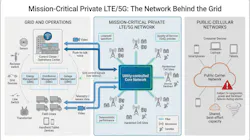
For these reasons, leading utilities now treat mission-critical communications as an integral part of grid resilience planning rather than a separate telecommunications concern. Mission-critical private LTE and 5G networks use dedicated spectrum, hardened infrastructure, and utility-controlled core networks to provide deterministic performance for voice, video, and data, even when public networks are unavailable. Experiences during Hurricane Helene showed that this difference is most visible when conditions are at their worst.
Before And During the Storm: Designing for a Real-World Stress Test
Communications resilience in a hurricane begins well before landfall. Utilities and mission-critical network operators invest years in designing, hardening, and testing networks to withstand wind, flooding, and extended commercial power outages. Several design principles have emerged from recent deployments, reflecting lessons learned across multiple mission-critical private LTE and 5G networks that Ericsson has supported for utilities and public safety organizations in North America.
Private LTE and 5G networks operate in licensed spectrum reserved for utility and public safety traffic. This avoids competition with consumer usage when demand spikes and allows operators to prioritize applications such as push-to-talk and grid control. Critical radio sites are hardened and built with redundancy. Towers are reinforced, backup batteries and generators are sized for extended outages, and backhaul paths may include fiber, microwave, and satellite. Sites that support control centers and major substations often receive additional structural and flood protection.
Utilities and their communications subsidiaries operate their own core networks and apply quality-of-service policies that guarantee latency and throughput for high-priority applications. Traffic classes for voice, control traffic, and video are treated differently, which helps maintain key functions when capacity is constrained. Private wireless networks are also integrated with energy management systems, distribution management systems, outage management systems, and geospatial systems so that data from the field flows where it is needed in real time.
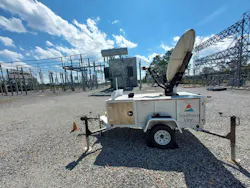
In the days before Hurricane Helene made landfall in the Big Bend region of Florida, these design choices were translated into specific actions. Georgia Power and Southern Linc monitored the storm’s projected path and anticipated its impact on both power and communications infrastructure. Crews pre-staged mobile assets such as cells on wheels, portable satellite backhaul units, and generators in locations expected to remain accessible after the storm. Southern Linc’s storm team confirmed fuel supplies and backup power at key communications sites and verified that critical talk groups for push-to-talk were provisioned and tested.
When Helene came ashore, it did so as the strongest hurricane on record to strike the Big Bend area. As it moved inland through central Georgia and into Tennessee and the Carolinas, the storm left more than 3,200 downed trees, approximately 1,200 broken power poles, thousands of spans of downed wire, and more than 5,600 damaged transformers in the Georgia Power service territory.
Southern Linc experienced 72 cell sites knocked off the air or destroyed outright, and other carriers saw similar or greater damage within the 46 Georgia counties later designated disaster areas by the Federal Emergency Management Agency (FEMA). Following FEMA’s declaration, the Federal Communications Commission (FCC) activated its Disaster Information Reporting System (DIRS), and carriers reported network status to support situational awareness. As soon as conditions allowed, Southern Linc crews began reestablishing communications for power restoration teams. Within 15 hours of landfall, cellular operations had been restored to 38 of the 72 impacted sites. Within 48 hours, all but two destroyed sites were back on the air. To restore service rapidly for its users, Southern Linc deployed 72 mobile networking assets, including generators, satellite links, cells on wheels, and an airborne LTE platform to cover hard-hit or inaccessible areas.
During this same period, public carrier networks serving the same 46 counties had more than 40 percent of their sites out of service. Even where some public sites remained on the air, capacity was constrained as residents, businesses, and responders all attempted to use the network at once. For Georgia Power, the difference was measured in operations. The company deployed 34 command centers across the territory to coordinate storm restoration teams. More than 20,000 men and women from 35 states worked to repair and restore power, supported by more than 2.85 million push-to-talk calls over the private LTE network. Utilities that had invested in mission-critical private LTE and 5G maintained a higher level of situational awareness and coordination at every stage of the response.
After The Storm: Everyday Value and a Focused Playbook
Once the lights are back on and the last crews have returned home, the same network that supported storm response becomes the foundation for everyday grid modernization. The attributes that make a mission-critical private network vital during a hurricane are increasingly important on a typical day.
Utilities use mission-critical private wireless networks to connect devices and applications that form the backbone of a smarter grid. High-resolution fault recorders, line sensors, and condition monitoring systems stream data back to control centers to support asset health analytics and predictive maintenance. Reclosers, sectionalizers, capacitor banks, and voltage regulators are automated and coordinated over wireless links, which enables self-healing feeders and faster isolation of faults. Crews receive digital work packages, real-time switching orders, and safety briefings on hardened tablets and handhelds, while supervisors maintain live views of locations, work status, and hazards. As more distributed generation and storage connect to the system, secure, low-latency communications support integration of these resources.
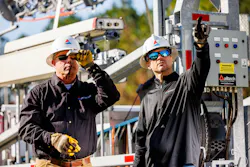
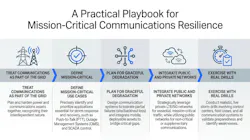
Experiences from Hurricanes Helene and other recent storms suggest a practical playbook for utilities that are evaluating mission-critical private LTE and 5G:
Treat communications as part of the grid. Plan resilience for power system assets and communications assets together, with joint hardening, coordinated backup power, and integrated restoration plans that prioritize both wires and wireless.
Define mission-critical use cases first. Identify applications that must remain available in a storm, such as push-to-talk, outage management, and specific control functions, and use these to drive network design requirements for coverage, capacity, latency, and availability.
Plan to minimize network performance degradation during weather emergencies. Assume loss of individual sites or backhaul paths and use redundancy and mobile assets to preserve service where it is needed most.
Integrate public and private networks. Use mission-critical private LTE and 5G for essential operations and augment with public networks for non-critical applications and overflow capacity, with clear policies for priority, failover, and fallback modes.
Exercise the system with real drills. Tabletop exercises and live drills that involve control centers, field crews, and communications teams can reveal gaps in coverage, training, or procedures before a storm exposes them under pressure.
Lessons Learned and the Road Ahead
Hurricane Helene was one of the most destructive hurricanes in the history of the regions it affected. It left thousands of poles, transformers, and spans of wire damaged or destroyed, and it created communications challenges that stressed every network in its path. The experience, together with other storms, underscored that grid resilience now depends on communications networks that are engineered specifically for life safety, operational continuity, and utility control.
Utilities that had invested in mission-critical private LTE and 5G entered these storms with a different set of tools. Their crews had push-to-talk communications that remained available when public networks were still recovering. Their Field-based RAN Technicians had visibility into field operations that allowed them to direct resources more efficiently. Their grid operators-maintained data flows from sensors and automated devices that helped them restore service faster and more safely.
As a result, the industry conversation is shifting from why deploy private wireless to how to scale it before the next storm. From the perspective of mission-critical networks, utilities are moving rapidly from early deployments toward scaled implementations that treat communications as core grid infrastructure. As hurricane seasons grow more intense and less predictable, utilities that treat mission-critical communications as a central part of their resilience strategy, and that learn from real-world events such as Hurricane Helene, will be better prepared for the next real-world test, whenever it arrives.
About the Author
Dana Jaber Diab
Dana Jaber Diab is Head of Mission Critical Networks for Ericsson in the United States, where she leads private LTE and 5G deployments for utilities and defense across the US. She has more than 20 years of experience in designing, delivering, and managing telecommunication networks, especially those focused on mission critical infrastructure and grid modernization.
Alan McIntyre
Alan McIntyre is Vice President of Engineering and Operations at Southern Linc. His team is known for providing highly reliable, highly resilient wireless voice and data services for Southern Company systems and users, and for local and state government customers. He was responsible for developing the company's technology transformation plan that migrated Southern Linc's prior wireless network system to LTE.