Closing the Gap in Wildfire Risk: Ignition Modeling is the Next Frontier for Utilities
Key Highlights
- Wildfire risk depends on ignition likelihood, fire spread, and consequences, but ignition remains a major modeling gap.
- Ignition requires a chain of events: a fault, enough energy to create an ignition source, and receptive environmental conditions.
- Hybrid approaches combining statistical models, engineering judgment, and ignition research can help address sparse data and changing conditions.
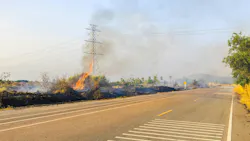
Wildfire risk has become one of the defining challenges facing electric utilities today. For those operating in fire-prone regions, it is no longer a long-term planning concern; it’s a daily operational reality. Crews are adjusting protection settings in real time, operators are weighing the tradeoffs between reliability and risk, and executives are facing the possibility that a single ignition event could trigger billions in liability. But while the industry has made real progress in modeling wildfire spread and potential impacts, there’s still a critical blind spot: understanding the likelihood that utility assets will ignite a fire.
That’s the gap a recent Guidehouse white paper aims to address, asserting that ignition modeling isn’t just another layer of analytics; it’s the missing piece needed to make wildfire risk models actionable. As wildfire conditions intensify and expectations continue to rise, utilities that can quantify ignition risk—and act on it—will be better positioned to manage risk, reliability, and affordability.
Beyond Spread
Over the past decade, utilities have gotten much better at understanding how wildfires behave once they start. Modern tools can simulate millions of fire scenarios, helping identify where fires are most likely to spread aggressively and where the consequences could be most severe. That capability has been a major step forward for planning and prioritization.
But in most cases, those models start with a built-in assumption: that a fire has already ignited. This avoids the question utilities are increasingly being asked to answer: Where are we most likely to start a fire in the first place? Wildfire risk isn’t just about spread. It’s a combination of ignition probability, spread probability, and consequences. And while the industry has made major advances in the latter two, ignition remains the least developed piece of the puzzle. That gap is becoming harder to justify. Regulators are asking for more specificity, and utilities need a clearer understanding of where risk originates if they want to target mitigation investments effectively.
Unlike wildfire spread, which can be studied across thousands of historical events, utility-caused ignitions are both rarer and more complex. In practice, ignition comes down to a sequence of events. A fault has to occur. That fault has to produce enough energy—through arcing, sparking, or molten material—to create an ignition source. And that source must land in conditions that are conducive to burning. If any one of those steps doesn’t happen, there’s no fire. Each step introduces uncertainty, and each one depends on a different combination of asset behavior and environmental conditions.
There’s also a data challenge. Most utilities have plenty of fault data, but far fewer confirmed ignition events, especially outside the highest-risk regions. Furthermore, environmental drivers like fuel moisture, vegetation type, wind, and humidity are constantly changing and often difficult to measure with the level of granularity necessary.
And then there’s scale. Ignition risk isn’t uniform across a circuit. It can vary dramatically from one pole or span to the next. Aggregating that risk can make it harder to see where the real problems are, which in turn makes it harder to act on them. Even validation is a challenge. Because ignitions are relatively rare, there simply aren’t many data points available to test models. That means uncertainty is unavoidable, even in more advanced implementations.
Bringing Physics into the Conversation
Ignition modeling can’t be purely data-driven. Iit has to be grounded in the underlying physics. At a basic level, ignition comes down to energy. Electrical faults release energy in the form of arcs, and the magnitude and duration of those arcs determine whether ignition is possible. From there, the mechanisms are familiar. Downed conductors, vegetation contact, conductor movement in high winds, and equipment failures all create scenarios where ignition can occur.
But what ultimately determines whether a fire starts isn’t just the fault. It’s the surrounding environment: Dry fuels, low moisture content, and high winds all increase the chances that a spark will turn into a fire. That combination of electrical behavior and environmental receptivity is what makes ignition risk both difficult to model and highly valuable to understand.
Machine learning has been the go-to approach for ignition modeling, particularly in regions with extensive historical data. By combining fault data, environmental conditions, and ignition records, these models attempt to predict where ignitions are most likely to occur. In the right conditions, they can be effective. But they are also data-hungry and can struggle to keep up with changing climate conditions. That’s a real limitation for utilities operating outside traditional high-risk areas, where historical ignition data may be sparse. Even in more mature programs, model performance can be uneven, reflecting the complexity of the problem.
Because of this, a more pragmatic approach is starting to emerge. Instead of relying entirely on machine learning, utilities are combining statistical fault modeling, engineering judgment, and established research on fuel ignition behavior. For many utilities, especially those just beginning to quantify ignition risk, that hybrid approach may be the most practical way forward.
Turning Insight into Action
Historically, wildfire mitigation has leaned heavily on capital-intensive solutions like undergrounding or covered conductors. These approaches can reduce ignition risk significantly, but they are expensive and difficult to scale across an entire system. That’s why there’s growing interest in operational and protection-based strategies that focus on reducing ignition risk more directly. Instead of trying to eliminate faults entirely, these approaches aim to limit the energy released during faults and prevent that energy from leading to ignition.
Advances in protection technology have made this more feasible. Modern relays and communication systems can detect a wider range of fault conditions, including high-impedance faults that historically went undetected. Faster detection means faster isolation, which reduces arc duration and lowers ignition potential. Enhanced powerline safety settings (EPSS) are an example of how this plays out in practice. By adjusting protection settings during high-risk conditions, utilities can reduce ignition likelihood without shutting power off system-wide. Pacific Gas & Electric reports that circuits using EPSS have seen ignition reductions on the order of 65% versus prior-year averages. Compared to blanket approaches like public safety power shutoffs, that kind of targeted intervention offers a more balanced path, addressing wildfire risk while minimizing customer disruption.
Moving toward ignition-aware modeling will take time and investment. Utilities will need better data on asset condition, more detailed fault information, and improved environmental monitoring, especially for variables like fuel moisture. They’ll need to integrate different modeling approaches and continue refining them as conditions evolve. Ignition modeling isn’t a one-and-done effort; it will improve incrementally over time, and there is need for broader industry cooperation. Data sharing, collaboration, and alignment across utilities, regulators, and researchers will all be critical in advancing these methods.
Wildfire mitigation is often framed as a cost challenge—and it is—but it’s also an opportunity to be more precise about how that money is spent. The next phase of wildfire risk management will be about doing it smarter: targeting the highest-risk locations, applying the most effective mitigation strategies, and balancin
About the Author
Hector Artze
Hector Artze is a partner for Guidehouse.
Bilhuda Rasheed
Bilhuda Rasheed is director, Grid Transformation and Resilience, of Guidehouse. She is a distribution grid modernization expert with 14 years of experience driving measurable improvements in electric utility performance metrics through investments like: smart metering (AMI), distribution automation, monitoring & control, resiliency investments and IT/OT integration.
Silvia Valerio
Silvia Valerio is Associate, Director Energy Sustainability and Infrastructure, at Guidehouse.
Related
 dreamstime_m_40965536