The Beauty and Complexity of Modern Substations
Substations are beautiful. At least to me, a longtime power industry editor. So are high-voltage lines set against a sunset. Many of our readers probably agree; electricity is our life (well, it’s life for everyone, but you know what I mean). What still excites me is seeing how utilities and engineers design infrastructure to fit its environment.
Urban Substations as Design Challenges and Opportunities
This month, we get to feature a substation on our cover. In fact, some of our most memorable covers have highlighted unique substation projects—ones that consider aesthetics because of their location or tackle tricky upgrades and rebuilds in dense urban areas.
The most recent substation cover in recent memory was Eversource Energy’s underground substation featured last June. Our cover showed the 3D cutaway, which we hadn’t done on a cover before, but it turned out well, showing the details of components for the project. The substation is being installed in Cambridge, Massachusetts, specifically Kendall Square, home to MIT.
Eversource considered space constraints and reliability in deciding to move this substation underground. The project is complex; the utility and its partners used advanced 3D/4D modeling, gas-insulated bus and SF6-free technology. The coordination is another impressive feat for this project; developers, city officials and the community are all cooperating to make the project viable. Construction started in January 2025 and is slated for completion in March 2029, with full energization in December 2031.
The project shows us that grid expansion isn’t necessarily always about adding capacity, but like other projects we have featured, it can be about integrating infrastructure into the fabric of modern cities in a way that’s technically sound, publicly acceptable and environmentally forward-looking.
Designing for the City, Not Just Within It
This reminded me of another cover story from October 2018 from Seattle City Light and POWER Engineers (now part of WSP). Seattle City Light has built a reputation as one of the more innovative municipals, having been carbon neutral since 2005 and with its willingness to pilot and scale new technologies. For that issue, we featured its Denny substation, “a stunning addition to the Emerald City’s South Lake Union neighborhood.”
The cover featured an overhead shot of the complete substation, surrounded by modern and aesthetically pleasing walls. This was similar to the Eversource urban substation in that state-of-the-art technology, skilled and diverse engineering, and a community-focused public involvement program enabled the utility to integrate its high-voltage substation into an urban setting in a way that is entirely compatible with the densely populated neighborhood. If you check out the article online, we have embedded a Youtube video simulating the construction stages.
Rewinding to April 2020—if you mark your life as pre- and post-COVID—this cover actually falls in the pre-COVID period, since we produce print issues at least two months in advance. It’s one of my favorite articles from the past few years; it’s such a good example of a substation rebuild. In Providence, Rhode Island, National Grid’s 100-year-old South Street substation, once a state-of-the-art facility serving hospitals, universities and much of downtown, had reached the end of its useful life. With parts no longer manufactured and the city’s downtown redevelopment accelerating, the utility had to rethink how to serve a growing, denser load. The result was a full replacement built in one of the most constrained construction environments imaginable, right alongside major development projects near the riverfront.
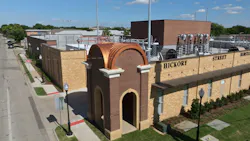
So this brings me back to this month’s cover story. This one is another municipal project in Denton, Texas. Denton Municipal Electric partnered with Beta Engineering to replace an aging 1960s-era substation that could no longer support a rapidly growing, dense downtown area. Rather than trying to squeeze a larger traditional installation into a constrained footprint, the utility leaned into gas-insulated switchgear technology and effectively “hid” a fully modern 138/13.2 kV substation behind a 22-foot architectural facade designed to blend into the historic cityscape.
The result is Hickory GIS: a compact, high-capacity facility that more than doubles the capability of what it replaced while dramatically reducing footprint, noise, and visual impact. What stands out was how deliberately the project was shaped by community input alongside careful technical planning using BIM modeling to manage tight underground utilities, expansive soils, and construction staging.
Across these projects, a clear pattern emerges. Whether it’s Boston, Providence, Seattle, or Denton, the driver is the same: dense urban load growth coming up against limited physical space and aging infrastructure. The technical responses vary—underground builds, GIS adoption, breaker-and-a-half configurations, advanced modeling, SF6-free equipment—but the underlying strategy is consistent. Utilities are no longer just expanding capacity; they’re re-engineering how substations fit into cities. That means heavy emphasis on community engagement, aesthetic integration, and multi-stakeholder coordination, alongside the increasingly complex engineering required to thread critical infrastructure through congested urban environments. In many cases, these projects are also enabling broader policy goals (decarbonization, electrification, and long-term resilience) while reducing visual and environmental impact.
And as always, if you’re working on a unique substation or grid modernization project, we want to hear about it for future issues. Also be sure to check out our wildfire mitigation supplement and subscribe to our YouTube channel for more coverage of the people and projects shaping the grid.
About the Author
 Nikki Chandler
Nikki Chandler
Group Editorial Director, Energy
Nikki is Market Content Director for the Endeavor Business Media Energy group, which includes T&D World, EnergyTech and Microgrid Knowledge media brands. She has 30 years of experience as an award-winning business-to-business editor, with 24 years of it covering the electric utility industry. She started out as an editorial intern with T&D World while finishing her degree, then joined Mobile Radio Technology and RF Design magazines. She returned to T&D World as an online editor in 2002, and took over as managing editor in 2017, then market content director in 2023. She has contributed to several publications over the past 30 years, including Waste Age, Wireless Review, Power Electronics Technology, and Arkansas Times. She graduated Phi Beta Kappa with a B.S. in journalism from the University of Kansas.