Invisible Infrastructure: Inside a Dallas Community-Driven GIS Substation
Key Highlights
- The Hickory GIS substation doubles capacity and reduces safety risks while maintaining visual harmony with Denton’s historic downtown.
- Community stakeholders actively participated in planning, ensuring the substation’s design reflected local aesthetics and secured city approval.
- Advanced BIM modeling facilitated precise planning for underground infrastructure, addressing site constraints and complex geotechnical conditions.
- The project supports Denton’s renewable energy goals and enhances grid reliability for critical institutions like universities and hospitals.
- DME’s innovative approach demonstrates how urban utilities can leverage GIS technology for efficient, community-friendly infrastructure upgrades.
Texas utilities are no stranger to growing pains, with cities across the Lone Star state making the list in 2024 U.S. census growth reports. As utility leaders in the Dallas suburb of Denton watched their population climb — more than doubling from 2000 to 2024 — they realized their existing grid couldn’t sustain continued growth. But finding space to expand in a dense urban area wasn’t easy. Nobody wanted a view of a substation, and the city didn’t want to displace residents.
Their solution — designed in collaboration with community stakeholders — delivers critical grid resilience and doubles capacity. And best of all, nobody sees a substation when they look out their kitchen window.
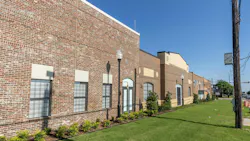
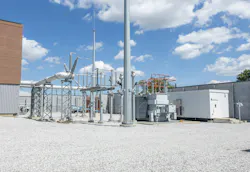
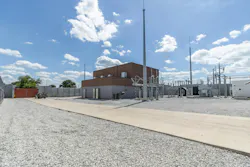
Hidden behind custom screen walls, Hickory GIS is a 138/13.2kV gas-insulated switchgear substation in the heart of Denton, Texas, that redefines what essential infrastructure can look like in a growing city. This fully-enclosed facility operated by Denton Municipal Electric (DME) reduces safety risks and disappears behind a 22-foot (6.7-meter) facade designed to reflect the nearby historic town square.
DME is a community-owned, not-for-profit utility and powers more than 64,000 customers in this North Dallas suburb with 100% renewable energy. The utility has served this region for more than 120 years.
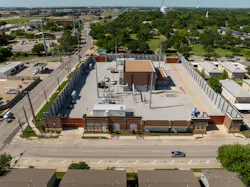
The substation is located near a historic downtown district and two large public universities — an area with substantial foot and vehicle traffic and where land is at a premium. The GIS substation replaced an air-insulated 69kV substation (AIS) originally constructed in the 1960s that had reached the end of its useful life and been deemed a safety hazard for DME staff. The project involved rerouting transmission and distribution lines into the new substation and the demolition and removal of the original station.
The project moved overhead lines underground to preserve the streetscape. As Denton’s first GIS facility, it sets a new standard for compact, community-conscious utility design—combining technical excellence with thoughtful integration into the urban environment.
Originality and Innovation
Starting in 2014, DME initiated plans to increase grid capacity and improve reliability. The same growth driving the need for additional power, though, also meant this area had limited land available for a larger station. The utility found a solution in GIS technology, which offers a smaller footprint than a traditional air-insulated substation.
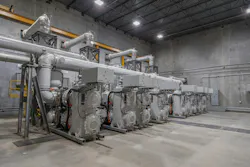
The Hickory GIS Substation includes two 25 MVA transformers, with the option for the addition of two additional transformers for a total of four, or 100 MVA. This is more than double the capacity of the aging substation across the street that it replaces. Its smaller 2.1-acre (8,498-meter2) footprint (compared to 7 acres, or 28,328 square meters, for a comparable AIS site) made it ideal for this established urban neighborhood.
While GIS is not a typical approach to municipal utility substation design and comes with a higher initial cost, its maintenance, safety, and aesthetic considerations led DME to select it as the best solution. Using GIS also reduced fire risk and meant minimal noise or radio interference for the area compared to an AIS substation.
Ensuring Community Buy-In Through Early Engagement
Substation and transmission line projects in urban areas regularly face resistance from local communities, especially when utilities recommend building with new or unfamiliar technology like GIS. DME’s community engagement efforts helped overcome those concerns, paving the way for the city’s approval.
Throughout the planning and design of this project, though, community stakeholders played an active role in guiding project decisions. DME held an open house explaining the reasons why the Hickory project was necessary to maintain reliability and allow for Denton’s continued growth. In fact, the idea of a gas-insulated substation was first introduced via a citizen’s comment. A committee of community members also identified and recommended potential locations for the project.
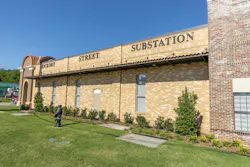
Planners selected a historic storefront style for the facade to mimic the nearby downtown square. This unique design, which involved nearly a dozen different types of brick and three mortar colors, hides the view of the structure from the surrounding residential area and provides enhanced security. To create this design, the Denton City Council directed DME to establish an Aesthetics Committee, consisting of seven citizens, who helped guide decisions about the substation’s exterior appearance.
“Hickory is a great example of GIS and how it can benefit a downtown commercial area,” said Kevin Vercher, Project Manager at Beta Engineering.
Resourcefulness in Planning and Solving Design Challenges
Community buy-in is only one piece of the puzzle when adopting new technology—DME’s operations and maintenance team also needed to understand how GIS works. Beta Engineering, which performed engineering, procurement, and construction for Hickory GIS, coordinated visits to other GIS substations with the same equipment so DME’s team could gain familiarity with it.
The complexity of this project, which involved multiple stakeholders, tight site constraints, and complex underground conditions, created design challenges. Beta leveraged 3D building information modeling (BIM) to account for these design complexities. The Beta team, in conjunction with other engineering and architectural project team members, harnessed the software tool Autodesk Revit to collate stakeholder drawings and models to ensure clear direction for DME as well as the design and construction teams. This approach proved especially helpful for the following designs:
Conduit entry into GIS foundations
Consistent coordination between foundation design and conduit modeling was critical to execution. The substation includes both outdoor and indoor GIS equipment. Much of the conduit leading to and from this equipment was run underground and routed through foundations. The exact location, orientation, and arrangement of this cabling required precise planning.
Conduit arrangements within underground duct banks
Similar to the conduit within the foundations, underground duct banks required detailed modeling and stakeholder coordination to ensure adequate space, proper lengths, and achievable layouts.
Foundations accommodating highly expansive soils with tight deflection limitations for outdoor GIS equipment
Geotechnical studies revealed highly expansive soils with a potential vertical rise (PVR) of up to five inches. GIS equipment requires tight deflection tolerances to maintain proper gaseous seals. To address this, the team designed drilled shaft pedestal foundations that met all structural and cabling needs while minimizing concrete volume.
Construction phasing and staging within a tight urban environment
With limited laydown space and construction hours (8 a.m.–5 p.m. weekdays, 8 a.m.–2 p.m. Saturdays), detailed planning for staging, deliveries, and timelines was essential. Using BIM allowed the design team to account for these constraints from the start.
Architectural design within an urban environment
Coordinating the 22-foot architectural wall and building facade with electrical safety requirements added design complexity. Beta’s engineers worked closely with structural and architectural teams to align aesthetics and utility standards.
Sustainability and Resiliency Considerations
DME identified the reconstruction of the Hickory Substation as a critical component to maintaining electric reliability and supporting Denton’s continued growth. To avoid extended outages, DME continued operating the existing 69kV substation until operations could be transferred to the new GIS substation.
Sustainable construction strategies included a Stormwater Pollution Prevention Plan and use of straw waddles to prevent sediment from entering storm drains. DME and its contractors reused or repurposed surplus construction materials to avoid landfill disposal.
The expanded grid capacity provided by this substation supports power delivery to homes, schools, businesses, and institutions, including the University of North Texas, a major university with over 46,000 students, as well as other critical community infrastructure. It also supports Denton’s Climate Action Plan and future development through a more reliable, resilient transmission network.
Project Planning and Delivery
The project began in June 2022 and was energized and operational as of March 2025.
The project enables full conversion of Denton’s 69kV loop to 138kV, improving reliability citywide. This solution also allowed the city to defer another planned substation until 2034, saving approximately $17.4 million.
The project team prioritized the community’s needs, adjusting the construction schedule to minimize traffic closures. Coordination with the city in advance of any lane closures ensured proper barricade placement. No traffic safety incidents were recorded during construction. Laydown space was tightly managed to reduce visual and noise impacts in the dense urban setting.
Because of the complex underground scope of the project, Beta had to complete a lot of work below the street. “It was a busy area of town,” Vercher explained, “But we were able to work with the city through the challenges of lane closures with a large university being next door, without power interruptions.”
Commenting on the challenges that come with a complex brownfield substation project and factors that contributed to Hickory’s success, Vercher said, “We made connections to existing distribution, and it was really seamless. The documentation that the city had, and the coordination with the city helped make it seamless.”
Leading the Way in Utility Innovation
DME has embraced a role as a leader in utility innovation. Throughout the project, DME has shared lessons learned from this substation with other utilities who are also considering whether to use GIS technology. In 2024, they also hosted guided site tours for utilities from other states during the annual Southeastern Electric Exchange conference that was hosted in nearby Frisco, Texas.
In 2020, DME reached its goal of providing 100% renewable energy to its customers. The Hickory GIS Substation continues this mission, strengthening the grid to reliably distribute solar and wind energy to homes and businesses throughout the region.
“Just looking at Hickory from outside the walls,” said Vercher, “It’s hard to grasp the technology contained in such a small space, providing power to the university and the surrounding neighbors.”
The project demonstrates how utilities can leverage GIS technology to upgrade power grid infrastructure within small footprints and leverage building and wall designs to enhance site security and improve curb appeal in residential areas—all while actively engaging with community stakeholders to increase buy-in and ensure the finished project serves the needs of local residents.
About the Author
Mark Zimmerer
Mark Zimmerer ([email protected]) is an electric engineering supervisor at Denton Municipal Electric (DME) in Denton, Texas and previously served as an electric engineer at DME. He has 13 years of experience in the electric utility industry completing transmission and substation capital projects and holds a Bachelor of Science in Electric Engineering Technology from the University of North Texas.
Kevin Vercher
Kevin Vercher ([email protected]) is assistant manager of Estimating at Beta Engineering and previously served as the project manager on the Hickory GIS substation project. He has more than 40 years of experience in project management, engineering, and estimating in the commercial and high-voltage construction sectors and holds a Bachelor of Science in Electrical Engineering Technology from Louisiana Tech University.