Safety by Design: Plan Traffic Control Before Utility Work Begins
Key Highlights
- Late requests and missing site-specific plans can lead to rushed decisions, mismatched resources and avoidable roadway exposure.
- Assess traffic, road geometry, nearby intersections, work hours and local requirements before crews mobilize.
- Early traffic-control involvement can surface permitting needs and make costs visible before work begins.
- Verify that field setups match the plan, capture changes and recurring hazards, and feed those lessons into future projects.
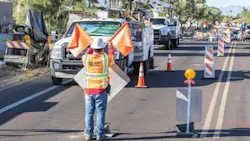
If you work in transmission and distribution, you already know what a planned job looks like. Long before a crew gets there, somebody has thought through the design, the outage window, permitting, equipment and schedule.
Then traffic control often comes in much later.
That is the piece to focus on, because by the time traffic control gets the call, a lot of the decisions that shape roadway exposure have already been made: The outage window may have set the time of day; the design has established where the work has to happen; the schedule is set; the lane geometry is what it is. Now the traffic control plan has to fit around all of that.
So the change is simple: bring traffic management into the planning process while you still have choices. That is what we mean by safety by design: the practice of identifying roadway risks and incorporating traffic-management requirements during project planning, before field work begins.
Start before the crew is on the road
We see the other side of late planning every day. In one AWP Safety business unit, we supported about 400,000 work zones in 2025. Seventy percent of those requests came in with less than 24 hours’ notice. Ten percent came in after 4 p.m. the day before the work. And 99.5% did not come with a site-specific traffic control plan.
Now, on the receiving end of that call, it is 5:30 in the afternoon, and the job starts at 5:30 or 6 the next morning. That means you need the right people, the right trucks, the right devices and a plan for a roadway you may know very little about. At that point, you are just playing catch-up.
Say the request comes in as a shoulder closure, so you send the usual crew and equipment. The next morning, the work unexpectedly extends into the lane, requiring more people, an arrow board and a different taper. Now someone has to find the resources and reinforcements while the utility crew waits.
You can have the opposite problem too. When there is not enough information, you may send more people and more equipment than the job requires.
The bottom line is that earlier planning is about getting the right traffic control in place for the work and conditions crews will actually face.
Widen the job site you are planning for
Utilities already do a tremendous amount of pre-job planning, from where trucks will be positioned to where drop zones will be set to how electrical hazards will be controlled. What earlier planning is asking teams to do is widen that picture a little bit:
- What is happening outside the immediate work area?
- What is the speed on that road?
- What is the typical traffic volume during the work window?
- Is there a curve before the driver sees the crew?
- Is there an intersection nearby? A school zone? Business entrance?
- Does the work happen after dark?
- Does the city require something different than the state?
Those questions help you get from a standard setup to one built around the site. At T&D World Live in September, we boiled it down to three steps:
- Know about the job earlier.
- Know the site.
- Then build a compliant or risk-informed plan with controls matched to the exposure.
The roadway is becoming a bigger part of utility work
There is another reason to move this conversation earlier: utility corridors are getting busier.
Grid modernization is putting more crews along the roadside, data center development is adding construction activity and changing traffic patterns, and broadband work is bringing more activity into corridors utilities already use.
Federal data shows 850 people were killed in U.S. work zones in 2024. More than half of fatal work-zone crashes happened at night, 34% involved speeding as a factor and 22% were rear-end collisions.1 BLS data also shows that, on average from 2022 through 2024, more than half of road-worker deaths involved workers on foot being struck by vehicles.2
For utility work, the nighttime figure stands out because crews are often working after dark when the outage window opens. You may not be able to change that window, but you can change how well the work is planned around it by asking:
- Can we assess the road earlier?
- Can we account for traffic volume and patterns?
- Can we plan the setup before the night of the job?
- Can we have the right equipment and crew in place before work begins?
Those are the variables you still control.
Earlier planning also takes surprises out of the field
Permitting is a good example because traffic-control requirements can vary by state—and sometimes by municipality—so a setup that works in one jurisdiction may require different permits, devices or controls just a few miles away.
In one recent case, a telecom provider had work planned across multiple states, but activity in one area was stopped for a couple of months when the state determined that separate traffic-control permits were required. Had traffic control been involved earlier, those requirements could have been identified, submitted and approved before crews were scheduled to mobilize, which is exactly the kind of issue you want to uncover during planning.
Earlier involvement also makes cost visible before work begins. In the utility pilot we shared at T&D World Live, plans were built from project data after design and then verified in the field, giving the utility a compliant plan, cost visibility and a documented record of risk before mobilization. In a separate high-speed fiber program, the same upstream approach helped reduce traffic-control costs from 10% to 2% of the total construction spend in three months.
Ultimately, the goal is to take as many assumptions out of the process as possible.
Then go look at what actually got built
None of this means that the plan is going to predict everything, as anybody who has spent time in the field knows.
The staging area may not work the way it looked on paper, traffic may be heavier than expected or a driveway may be blocked. That’s where crews need to speak up, leaders need to be in the field—and somebody needs to confirm that what was built matches what was planned.
This is probably the piece utilities have the biggest opportunity to build out. A lot of organizations plan the job, prepare the crew, execute the work and move on to the next one—but what was learned?
- Did drivers keep entering the taper at the same location?
- Did the setup have to change once the crew got there?
- Are the same intersections showing up over and over?
- Are crews routinely asking for the same added protection?
If you only look at one work order at a time, those can look like separate events.
Take the same intersection showing up on three jobs in two regions. Each job by itself may look ordinary but put them beside each other, and now you may have a location you want to look at differently the next time work comes through. That is just one example of the loop we want to close:
Plan > Prepare > Execute > Verify > Measure > Improve
Then feed what you learned back into the next plan.
And that is really what safety by design comes down to: use the choices you have, while you still have them. Look at the roadway earlier, bring the right people into the conversation sooner and build the setup around specific conditions.
The field will always require judgment and adjustment, but planning can give crews a better starting point. Then, when something does change, capture what happened and carry that lesson forward.
If every work zone can help make the next one safer, that is safety by design working the way it should.
About the Author
Don Pitalo
Don Pitalo is Vice President, Strategic Accounts of AWP Safety.
Related

 Dreamstime M 43978