Can the Grid Keep Up With Megawatt-Scale Truck Charging?
Key Highlights
- Virtual distribution feeders aggregate and control distributed energy resources to provide location-specific support for constrained feeders.
- Megawatt charging systems for heavy-duty EVs can create short, intense loads that risk overloading local grid assets.
- Battery energy storage can buffer charging demand, supplying power during peaks and reducing stress on the distribution network.
- The article presents virtual feeders and battery-buffered chargers as commercially available tools for scaling heavy-duty EV charging.
There’s been a lot written about the next-generation of the power delivery system and the advanced grid modernization pushing us there. Its shifting dynamics is moving the power grid from a mono-directional, mechanical network to a highly interactive system that’s interrelated, bidirectional, and data-driven. One theme that continues to grow is how that “last mile” is radically changing especially where increasing numbers of DERs (distributed energy resources) are concerned. Strategists recognize that the gap between the transmission and distribution systems is narrowing as more enhanced digital technologies are being deployed on the distribution network.
Last month “Charging Ahead” featured virtual transmission line technology as a non-wire alternative for adding capacity to the transmission grid. While researching that topic an equivalent for the distribution system turned up in the form of the virtual distribution feeder (VDF) technology. VDF is also being referred to as the “feeder-first virtual power plant (VPP),” and of course there are several other names vying for attention. Essentially, a VPP aggregates DERs from a wide area of the power grid whereas the feeder-first VPP focuses heavily on the local feeder, but we’ll use VDF to avoid confusion.
There’s a strategy shift happening lately toward a more “locational feeder value” concept. It’s driven by rapidly growing electricity demand, which for the distribution system focuses on “location-specific” constraints, adding credence to the strategist’s view that the distribution and transmission systems have a great deal in common. Both have an aging infrastructure, insufficient capacity, congestion, etc., which is where VDF comes in. VDF applications are non-disruptive, quickly deployed, and cost effective, which is critical for modernizing the distribution network.
Tangible Innovation
Being a software-defined non-wire alternative, VFDs take advantage of existing connected assets with distribution automation VDF tech replicating the electrical behavior of physical distribution feeders. Central to this application is the advanced control of the wide array of DERs found on the distribution system with a healthy dash of sophisticated AI (artificial intelligence). AI pulls everything together by bridging the variety of siloed data sources giving the operators a real-time visual representation of what is taking place to be used for simulations, optimizations, and management of the distribution feeders.
VDF applications aggregate and manage DERs as if they were a single asset avoiding costly large-scale upgrades needed for traditional methods. In effect, utilizing VDFs allows feeder-level resources to work together instantaneously with the main power grid. It shifts the distribution feeder from a generalized system centered on peak-demand response toward a real-time, location-specific tool for better optimization of the distribution network’s assets. VDF applications offer utilities a variety of features for disputes that can impact their distribution networks. Let’s zero in on one situation that is poised to move to the forefront of modernization concerns, charging electric vehicles (EVs).
Globally, residential customers have adopted EVs at an astounding rate and now the next wave is starting to pick up speed. It’s the growing medium- and heavy-duty EV (MHD-EV) fleets, and they represent real problems for distribution feeders. The National Laboratory of the Rockies (NRL) reports that “to charge more than one heavy-duty truck at a time, and get them all back on the road quickly, a charging station may need to pump out 20 megawatts of power or more.” According to the International Council on Clean Transportation there were over 520,000 MHD-EVs on the world’s roads at the end of 2025 and there’s every reason that will accelerate. What makes this segment an attention grabber is the sheer size of the charging equipment needed for them.
The Fleet is Here
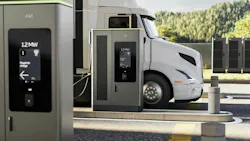
MHD-EVs trucks require large megawatt-scale charging systems (MCS) and the power grid’s infrastructure isn’t ready for them. A recent Endeavor Business Intelligence survey, “Can the Grid Keep Up With Heavy-Duty EVs?” explores the readiness of local electrical infrastructure to support widespread heavy-duty EV charging. Interestingly, 65% of the respondents said that limited grid capacity is the top barrier to MCS deployment. It went on to say that 28% expected it to be the biggest limitation to heavy-duty EV adoption over the next 5 years. The full report can be downloaded at https://www.tdworld.com/heavy-duty-ev-report.
The driving force here is the need to charge Class 8 heavy-duty electric trucks in 30 minutes or less to minimize their downtime. That represents a significant power grid infrastructure challenge. One last item from the survey, “only 9% are confident local infrastructure could support charging for 50 Class 8 electric trucks within their desired timeline. 58% are not at all confident.” Fifty Class 8 electric trucks isn’t a very big number especially considering it’s estimated that there were over 38,000 MHD-EV trucks on the U.S. road by the end of 2025.
It could be argued that the MHD-EV fleet owners have their own charging facilities, but they’re on the highways as well. As more Class 8 electric trucks hit the road, we’re seeing truck depots with facilities for MHDEVs popping up, and the experts say they’re just getting started. Extensive numbers of MHD-EV truck service areas are expected in the distribution network’s future. They will be well away from populated areas, which is another wrinkle as more long-haul, heavy-duty EVs hit the road. It’s a very real scenario that has distribution planners concerned. How can they provide the capacity for this growing need for MCSs at these scattered MHD-EV service facilities?
Infrastructue Expansion
Why are the planners concerned, and how is an MCS an obstacle? According to ABB E-mobility, “a MCS is a high-power, distributed charging platform designed for sustained, continuous-duty operation at megawatt-scale sites, such as transit depots, logistics hubs, and public fast-charging corridors.” A major reservation is the variableness of an MCS’s charging-cycle. A single stall can have a rating of 1.2 megawatts and depot platforms can run 20 megawatts. MCSs can push the limits of the local distribution network. On the average, a single MHD-EV charging-cycle is short-duration that produces high-current spikes.
This type of charging-cycle has the ability of overloading feeder assets creating significant grid-level impacts. They need high-capacity, dispatchable DERs that are flexible to handle the fluctuating loads. By paring VDFs with battery energy storage systems (BESS) they can balance the megawatt charging loads and reduce the strain on the distribution system. This combination is being called a hybrid mode BESS MCS. It’s considered a battery buffered charger. The BESS tech provides the ability to supply and absorb power, operating in parallel with other energy sources. Some analysts are saying, “these hybrid mode BESS MCS systems have the potential of being the backbone of next-generation heavy-duty EV charging.”
This technology is available from many suppliers like ABB E-mobile, Siemens, i-charging, Kempower, and others. They can offer a wide variety of features and options for MCS MHD-EV chargers. ABB E-mobile has been supplying EV chargers for over 15 years. One of their publications point out that “fast public charging is a key component in the successful roll-out of EVs to reduce range anxiety.” They continued saying “fleets of all sizes and vehicle types are able to implement various fast charging technologies tailored to their routes and business demands.” ABB E-mobile notes, “It’s clear that open standards and vehicle interoperability are a key ingredient to the EV industry’s ability to scale and grow charging infrastructure while meeting the needs of the most vehicles and their drivers.”
Operational Technology
The charging infrastructure is being encouraged by growing numbers of commercial electric truck charging centers in operation like WattEV’s San Bernardina depot. It’s located adjacent to I-215, one of Southern California’s busiest freight corridors between Long Beach and Los Angeles. When it opened two years ago, it powered it’s chargers with on-site solar and battery backup. Today it’s one of the largest commercial electric truck charging depots in the U.S. and has recently expanded and can charge up to 200 electric trucks per day. The facility is currently averaging approximately 700 megawatt-hours per month.
These hybrid mode BESS MCSs are being utilized and deployed worldwide. They are no longer a concept consigned to pilot projects and limited distribution. It’s a proven commercial technology with multiple suppliers delivering a wide variety of these devices optimized for MHD-EV fleet and commercial operations. Experts note that the technology is in the early stages of deployment. But they see it as a “key enabler for faster response without overburdening the distribution system as more heavy-duty Class 8 hit the road.
After all, Tesla opened its new heavy-duty truck factory in Nevada this year. It’s expected to produce 50,000 “Tesla Semis” each year, which will challenge the power delivery system to keep charged and that’s only one factory. There are others! It appears that VDF applications are going to be a very trending item for power grid modernization. Globally, MHD-EVs are replacing diesel at an amazing rate. It’s no wonder because diesel fuel has become unaffordable compared to EVs powered by sustainable electricity from renewable generation!
About the Author
Gene Wolf
Technical Editor
Gene Wolf has been designing and building substations and other high technology facilities for over 32 years. He received his BSEE from Wichita State University. He received his MSEE from New Mexico State University. He is a registered professional engineer in the states of California and New Mexico. He started his career as a substation engineer for Kansas Gas and Electric, retired as the Principal Engineer of Stations for Public Service Company of New Mexico recently, and founded Lone Wolf Engineering, LLC an engineering consulting company.
Gene is widely recognized as a technical leader in the electric power industry. Gene is a fellow of the IEEE. He is the former Chairman of the IEEE PES T&D Committee. He has held the position of the Chairman of the HVDC & FACTS Subcommittee and membership in many T&D working groups. Gene is also active in renewable energy. He sponsored the formation of the “Integration of Renewable Energy into the Transmission & Distribution Grids” subcommittee and the “Intelligent Grid Transmission and Distribution” subcommittee within the Transmission and Distribution committee.
Related

 gettyimages2100760626

