How Hawaiian Electric Turned Microclimate Data Into Wildfire Defense
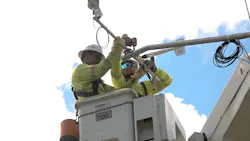
When wind speeds spike and humidity drops across a single Hawaiian ridge, operators may have minutes, not hours, to decide whether to shut off power. Realities from microclimates like these are what drove Hawaiian Electric to rethink its approach to weather monitoring. The objective was not simply to improve forecasts; the utility needed a system that could support real-time operational decisions, along with reducing wildfire risk, protecting communities, and strengthening grid resilience across a landscape defined by extreme variability.
Hawaii’s terrain creates one of the most complex meteorological environments in the United States. Within just a few miles, conditions can shift dramatically between dry valleys, humid forests, and high-elevation ridgelines. These microclimates directly influence wildfire behavior, making broad regional forecasts insufficient for operational use.
For Hawaiian Electric, this challenge became a catalyst for change.
From Forecasting to Field-Level Decision Making
Prior to 2024, the utility’s weather monitoring strategy was largely centered on renewable energy forecasting, with stations positioned at substations or generation sites.
As wildfire risk intensified, particularly following the Lahaina disaster, it became clear that this approach did not provide the level of visibility required for critical decision-making. Hawaiian Electric needed data that reflected real conditions at the circuit level where decisions to de-energize or restore power would ultimately be made.
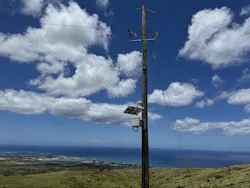
This realization led to a fundamental shift: weather stations would need to be deployed closer to the grid itself, mounted on poles and aligned with transmission and distribution circuits. Data would need to be captured more frequently, integrated directly into operational systems, and accessible in near real time.
Achieving this transformation required more than new equipment. It required the right combination of technology, expertise, and execution.
Speed, Scale, and the Right Partnership
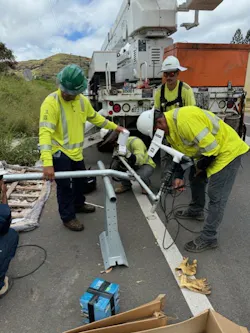
Hawaiian Electric worked with Western Weather Group to design and deploy the system. Western Weather Group, which has supported utilities across the western United States for over 20 years, specified R.M. Young wind sensors as the core instrumentation.
Nathan Todaro, a consultant with Hawaiian Electric, said that Western Weather Group had a solution that would meet requirements “out of the box.” “The instrumentation has been exactly what we needed: durable, accurate, and reliable in the field,” Todaro said
At the same time, the selection of instrumentation became a critical decision point. After evaluating multiple providers, R.M. Young Company was selected based on its experience in demanding environments and ability to deliver consistent, quality measurements without extensive customization.
The effort was defined not only by equipment performance, but by the ability to deploy quickly under tight timelines. Hawaiian Electric moved from vendor selection to operational readiness in a matter of months, an accelerated schedule that required close coordination between all parties involved.
Nathan Lohse, CEO of Western Weather Group, said that the success of the project was rooted in both technology and collaboration. Western Weather Group has worked with provider R.M. Young for more than 20 years, as the instrumentation has continually performed under demanding conditions.
Instrumentation Designed for the Field
At the core of Hawaiian Electric’s network are wind sensors from R.M. Young, selected for their ability to operate continuously in extreme conditions. Across Hawaii’s service territory, instruments are exposed to high humidity, salt-laden air, and severe wind events, all of which can degrade performance in less robust capable systems.
In this environment, durability is not a secondary consideration, it is essential.Field performance has reinforced that decision. Routine calibration has shown minimal drift, and only a small number of sensors have required replacement over time. The majority continue to deliver consistent measurements despite prolonged exposure to harsh conditions.
From an operational perspective, this reliability translates directly into confidence. Decisions around Public Safety Power Shutoffs (PSPS) carry significant consequences, and they depend on the integrity of the data being used. When wind speeds rise rapidly or humidity drops below critical thresholds, operators must be able to trust that the measurements reflect reality. The instrumentation provides that foundation and is a key component of Western Weather Group’s networks.
Turning Measurements, Data into Real-Time Action
Today, Hawaiian Electric operates a network of more than 100 weather stations deployed across high- and medium-risk wildfire areas with many more installs coming for 2026.
Each station is tied to a specific transmission or distribution circuit, ensuring that the data being collected is directly relevant to operational decisions. When conditions reach defined thresholds, such as elevated wind speeds combined with low relative humidity, the system supports rapid, informed decisions about whether to de-energize portions of the grid.
Equally important, the same data supports restoration decisions, helping operators determine when it is safe to bring circuits back online.
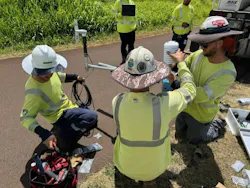
Western Weather Group supported the capability by helping to deploy and integrate the system. Data is delivered through APIs and incorporated into Hawaiian Electric’s internal dashboards, allowing teams to monitor conditions in real time without relying on external systems or experiencing delayed reporting.
The result is a system where measurement and action are closely aligned, reducing the gap between observation and response.
From Data Interpolation to Decision Making
While instrumentation provides the data, interpretation remains critical, particularly in Hawaii’s complex environment.
Western Weather Group’s in-house forecast team has become an extension of Hawaiian Electric’s operational capabilities, offering insight into unusual or rapidly changing conditions. In cases where data may appear inconsistent or unexpected, this expertise helps validate and explain what is occurring in the field.
“It’s not just the equipment, it’s the expertise behind it,” Todaro said. “Having a team of meteorologists we can call and talk through real-world conditions has been incredibly valuable.” This combination of reliable measurement and interpretation has proven valuable in understanding how microclimates influence risk across short distances. It has also helped Hawaiian Electric refine its long-term approach to system planning and resilience.
Transparency and Long-Term Impact
Beyond immediate operations, the weather monitoring network serves a broader purpose. Data collected from the system is shared through third parties, making it accessible to meteorologists, emergency responders, and local communities.
This transparency supports more coordinated decision-making and contributes to improved forecasting over time. According to the National Weather Service, long-term datasets, often spanning a decade, are essential for refining predictive models and understanding regional weather patterns.
In this way, Hawaiian Electric’s investment is not only improving current operations but also contributing to the broader understanding of weather and wildfire risk across the region.
A Blueprint for Wildfire Resilience
The collaboration between Hawaiian Electric and its project partners demonstrates what is possible when instrumentation, expertise, and operational strategy are aligned.
Rather than relying on generalized forecasts, the utility now operates with precise, localized insight into conditions across its grid. Hawaiian Electric operates proactively instead of reactionary, with the help of real-time data.
For utilities facing increasing wildfire and other environmental risks, the implications are clear: resilience depends not only on infrastructure, but on the ability to understand, and respond to, the environment in which that infrastructure operates. That capability begins with confidently knowing what is happening in the field.
Hawaiian Electric’s Wildfire Strategy by the Numbers
By Marc Asano, Hawaiian Electric
Hawaiian Electric has taken critical steps toward reducing wildfire risk by anchoring its efforts around four guiding pillars:
- Hardening and redesigning its island grids
- Enhancing situational awareness
- Improving operational practices
- Strengthening partnerships with stakeholders and communities
In December 2025, regulators approved Hawaiian Electric’s three-year expanded Wildfire Safety Strategy (WSS), paving the way for deploying new technology, fortifying infrastructure, minimizing fire hazards , and expanding community partnerships to significantly reduce the risk of utility-caused wildfires.
Work in 2025 to implement the WSS across the five islands Hawaiian Electric serves included:
- More than 11,000 pieces of critical equipment replaced or upgraded, including lightning arresters, sparkless fuses and smart reclosers
- More than 2,000 wooden poles replaced or upgraded
- 18 miles of power lines upgraded with stronger conductors
- 48 new weather stations installed
- 91 new AI-assisted video cameras installed
- More than 4,900 fault current indicators installed to speed outage detection and resolution
- 100% of vegetation trimming completed on high-risk circuits
- 100% of high- and medium-risk circuits with enhanced fast-trip protection settings
- 1 meteorologist hired
A major component part of Hawaiian Electric’s WSS is its Public Safety Power Shutoff program, or PSPS, which the company continues to refine. Hawaiian Electric implemented two PSPS events in 2025: one on Maui in July and one on Hawaiʻi Island in November.
In July, high winds and dry conditions on Maui prompted the U.S. National Weather Service to issue a wind advisory. On July 6, 2025, a weather station in Upcountry Maui met PSPS threshold criteria of wind gusts over 45 mph, humidity below 45% and drought conditions. The outage lasted approximately 19.5 hours and affected 332 customers.
On Nov. 12, 2025, Hawaiian Electric implemented a PSPS event in the South Kohala area of Hawaiʻi Island when wind gusts exceeded 50 mph and humidity dropped below 45%. About 1,175 customers were initially impacted. Hawaiian Electric re-energized all circuits the morning of Nov. 13 and continued to monitor conditions with a PSPS watch through Nov. 14.
Hawaiian Electric understands that wildfire safety is a shared responsibility. In 2025, it strengthened community partnerships by participating in more than 90 in-person and virtual outreach events; developing more than 100 partnerships with emergency responders and local organizations; and holding five Wildfire Safety Working Group sessions.
Here’s what Hawaiian Electric is prioritizing in 2026:
- Continuing to harden the grid in medium- and high-risk areas
- Reducing customer impacts during Public Safety Power Shutoffs
- Launching targeted undergrounding in critical safety areas of Lahaina
- Expanding weather monitoring and hazard-detection cameras, including AI-assisted systems
- Strengthening real-time wildfire monitoring and decision-making
- Refining wildfire risk modeling
- Continuing community engagement and partnerships
The Hawaiʻi Public Utilities Commission, in a separate docket, is considering the overall $480 million cost of the three-year WSS, about one-third of which is already funded through existing programs, including a federal grid resilience grant received in 2024.
Approximately two-thirds of the cost will go toward capital investments in upgraded infrastructure, with one-third for operations and maintenance, such as inspections and vegetation management.
Marc Asano is director of wildfire strategy and has more than 18 years of utility experience. He has led Hawaiian Electric’s development of long-range plans and strategies, including its grid modernization strategy and its 2025–2027 Wildfire Safety Strategy.
About the Author
Samantha Peterson
Samantha Peterson, marketing manager at R.M. Young Company, brings over 15 years of experience in writing and marketing. She combines her knowledge of the meteorological industry with technical expertise in weather instrumentation. Her work focuses on shaping messaging that connects real-world applications to the engineering behind environmental measurement.