High-Tech Vs Red Flag Days: Strategies in Wildfire Mitigation
Key Highlights
- Power utilities are adopting strategies like insulated conductors and undergrounding to reduce wildfire ignition risks in high-risk areas.
- Advanced technologies such as REFCLs, AI-based fire detection systems, and firefighting robots are transforming wildfire mitigation efforts.
- Systemic challenges, including bureaucratic fragmentation and siloed programs, hinder the widespread adoption of innovative wildfire management solutions.
- Early fire detection through AI-powered cameras and supercomputers enables quicker response and containment, minimizing damage.
- A holistic wildfire management approach requires unified leadership and resource realignment across prevention, response, and recovery.
The term “red flag day” means a variety of things to many groups. For the power delivery system, however, it’s all about the National Weather Service’s (NWS) definition. NWS says when a combination of drought conditions, fierce winds, and low humidity reaches a predefined criteria they issue a red flag alert. Basically the situation creates an environment where a simple spark can cause a massive fast-moving wildfire. When the NWS issues such a warning in a utility’s service territory, distribution and transmission operators shift into mitigation mode.
Reclosures are disabled and patrols are stepped up, looking for hazards like damaged power lines or vegetation clearance issues. Announcements are sent out warning customers to prepare for public safety power shutoffs (PSPS). The PSPS strategy has proven to be an effective tactic. The practice has spread within the United States, and similar de-energization schemes have found their way to Europe, Asia, Australia, and beyond. But it’s not popular with customers.
In societies that rely on electricity to function, there has been pushback for electric utilities to use another plan. Customers say there has to be a better way than turning off the power grid for days on end. That’s where wildfire mitigation technologies are poised to manage the risks. These applications can actually reduce grid-ignited wildfires, but utilities are still studying them, which results in fragmented deployments. Still, the benefits of shifting from reactive firefighting to preemptive wildfire management outweigh the drawbacks of being uncomfortable with new technologies.
Fire-Resistant High-Performance Solutions
Let’s start out with a few simple approaches that are gaining traction, like replacing bare conductor with insulated conductor in high-risk areas. It’s one of those grid hardening strategies that makes the grid safer in fire-prone areas. It substantially reduces risks of arcs and sparks when vegetation and/or critters come in contact with the powerline, plus it’s fairly quick to apply.
Undergrounding is another expanding stratagem being adopted by utilities for risk management in severe-risk zones. It may be expensive, but there are times when safety overrides cost like areas where quick evacuation is extremely difficult should a wildfire breakout. There’re also resilience and reliability issues to consider. Bottom line, undergrounding drastically reduces ignition risks.
There’s one last conductor development that can’t be overlooked. About a year ago, “Charging Ahead” looked at reconductoring powerlines with high-performance advanced conductors. It’s one of those grid-enhancing technologies (GETs) for quickly addressing the need for increasing the power capacity of existing transmission lines. GETs are also finding their way into wildfire mitigation, but we didn’t include that aspect in the article. Their low-sag properties (i.e., up to 50% less thermal sag) keep them from sagging into vegetation as loads increase, which prevents sparking. Their tolerance to blazing-high temperatures is of particular interest. It means exposure to a wildfire’s flames doesn’t change their properties. In plain terms, their performance characteristics are retained and in most cases are likely to be returned to service unlike conventional conductors that need replacement.
Sparking Change
Let’s get into a more complicated wildfire mitigation technology. There’s an application that’s more of a surgical shutoff rather than removing whole sections of the grid at a time. It’s called Rapid Earth Fault Current Limiters (REFCLs), and it is getting attention worldwide. It was developed over 15 years ago in Australia after they experienced deadly bushfires in the state of Victoria. The REFCL technology has been compared to ground fault circuit interrupters (GFCIs) found in bathrooms and wet areas around the world.
GFCIs quickly cuts power off when it detects a current imbalance in the circuit preventing electrocution. REFCLs are a lot more complicated, but a GFCI example gets the point across. Essentially, when REFCL detects a current surge caused by a powerline fault, it collapses the faulted phase’s voltage near zero. In short, there’s no arc so there’s no ignition, which means no fire. REFCLs pilot projects are taking place at several west coast utilities as part of their wildfire mitigation process.
In addition to these REFCLs, SEL (Schweitzer Engineering Laboratories) has introduced a falling conductor mitigation solution. It detects and de-energizes a falling conductor before it hits the ground. SEL said, “When an overhead distribution line breaks and the energized conductor falls, it often creates a high impedance ground fault, which can be difficult or even impossible to detect.” SEL uses data from synchrophasor units with specialized algorithms in their RTACs (real-time automated controllers) to identify falling conductors within milliseconds of a break. The technology provides the location of the broken conductor and notifies the utility making restoration faster.
It's All About Accuracy
Early detection of fires while they are small and can be extinguished easily is a critical objective of wildfire management. Back in the day, dedicated fire spotters with binoculars watched from sunrise to sunset from fire lookout towers. By time they saw smoke, the fire had a headstart and then it was too late. Modern high-tech imaging with round-the-clock AI (artificial intelligence) real-time analytics are detecting smaller fires earlier making possible quick containment. One of the prominent examples is the statewide network of AI-powered cameras and sensors known as ALERTCalifornia camera system.
ALERTCalifornia started out as a research project at UC San Diego over 25 years ago and has grown into a statewide network of over 1,200 high-definition cameras and sensors. The devices are located on mountain peaks and hilltops across the state and perform 360-degree sweeps. They have night vision and use AI to autonomously detect smoke or other irregularities and alert dispatchers. One report noted that “ALERTCalifornia network last year detected 1,668 fires, including 636 before any 911 call.” The live camara feeds can be viewed at alertcalifornia.org for anyone interested.
Recently Xcel Energy and Pano AI expanded their partnership to deploy Pano AI’s wildfire detection system across more of Xcel’s service territories in Texas, Colorado, and Minnesota. The detection system uses a network of high-definition cameras to deliver 24/7 monitoring of high-risk areas. The cameras are installed on tall structures like cell phone towers providing a panoramic, 360-degree view in the areas of interest. AI analytics continuously scan the imagery for signs of smoke and can notify emergency responders with precise GPS locations after confirmation of wildfire incidents. News releases say that Xcel plans to expand the AI cameras across their service territories and extend into New Mexico.
It's All About Innovation
When it comes to moving wildfire mitigation to the proactive side of the equation it’s hard to beat the combination of sophisticated computers with ultramodern software for wildfire modeling. Technosylva’s announcement about launching the world’s largest dedicated supercomputer for wildfire modeling fits this scenario. According to Technosylva, “The system simulates more than one billion fire scenarios each day, applies artificial intelligence to decades of fire weather data, and can more accurately identify which communities and electric lines may be threatened up to five days in advance.”
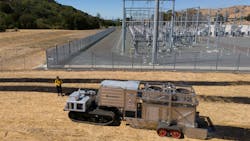
Innovative apps are also found with the firefighting robots that are hot news. The BurnBot system is stirring up interest. It’s being evaluated across California by CAL FIRE, Caltrans, PG&E, and other agencies. It has been referred to as a “Roomba for the forest.” Others describe it as a “Zamboni-like” machine for reducing wildfire fuel. Basically, it’s a giant remote-controlled vehicle that moves about a half mile-per-hour creating firebreaks by burning the flammable grasses under it. The fire is contained within its metal enclosed undercarriage. BurnBot can produce “lines of charred land” over open-terrain or within a few feet of buildings or highways.
There are several other high-performance firefighting robots available like the TrackReitar FFL from LeoTroncs. The TrackReitar is equipped with thermal cameras and gas sensors. It’s capable of autonomous AI operation and/or remote-control abilities. TrackReitar can manage rugged terrain and extreme heat while extinguishing flames without endangering lives. Don’t forget the autonomous drones that are also supporting firefighting efforts in high-risk and hard-to-reach areas too. These are only a sampling of the tech-tools out there, but there seems to be issues adopting these advanced tech-tools.
Tapping Into Tech
In early January 2026, the Rand Corp., a research organization, published its “Accelerating Technological Innovation Across the U.S. Wildfire Management System” study. It’s an absorbing report and quite thought-provoking. It states that “wildfire losses are rising faster than the United States' capacity to prevent, detect, and respond.” Rand indicated that systemic bureaucracy is impeding the adoption of high-impact technologies.
Digging deeper, Rand observed that today’s wildfire management systems “favor suppression over prevention.” Compounding the difficulty they noted that the game plan is fragmented by its siloed, disjointed programs with no clear unified leadership. They emphasize there is a necessity for an all-encompassing strategy to wildfire management including consolidated decision making. Additionally, a realigning of resources is desired that spans prevention, preparedness, response, suppression, and recovery, rather than utilized chiefly on suppression. Those who take advantage of proactive mitigation will benefit. Those who stay with legacy thinking will not!
About the Author
Gene Wolf
Technical Editor
Gene Wolf has been designing and building substations and other high technology facilities for over 32 years. He received his BSEE from Wichita State University. He received his MSEE from New Mexico State University. He is a registered professional engineer in the states of California and New Mexico. He started his career as a substation engineer for Kansas Gas and Electric, retired as the Principal Engineer of Stations for Public Service Company of New Mexico recently, and founded Lone Wolf Engineering, LLC an engineering consulting company.
Gene is widely recognized as a technical leader in the electric power industry. Gene is a fellow of the IEEE. He is the former Chairman of the IEEE PES T&D Committee. He has held the position of the Chairman of the HVDC & FACTS Subcommittee and membership in many T&D working groups. Gene is also active in renewable energy. He sponsored the formation of the “Integration of Renewable Energy into the Transmission & Distribution Grids” subcommittee and the “Intelligent Grid Transmission and Distribution” subcommittee within the Transmission and Distribution committee.