Assessing Ecological Health in San Francisco’s Utility Rights-of-Way
Key Highlights
- The BIOaudit assessment establishes a scientific baseline of ecological conditions within utility corridors to inform habitat enhancement efforts.
- Regular transect-based surveys document plant species, wildlife activity, and habitat quality, enabling long-term ecological monitoring.
- Field teams, including specialized natural resources technicians, collect consistent data despite operational challenges like dense vegetation and exposure risks.
- Participation in conservation agreements like the CCAA allows utilities to proactively support at-risk pollinators such as monarch butterflies and native bumblebees.
- Long-term data from the project will guide adaptive vegetation management, promoting biodiversity while ensuring reliable power delivery.
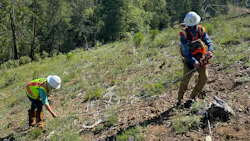
Urban and rural utility rights-of-way (ROW) comprise thousands of miles of linear landscapes spanning diverse ecosystems. Traditionally, these corridors have been managed primarily to maintain safe and reliable electric service. Increasingly, however, utilities are recognizing that ROWs can also provide valuable habitat for plants, pollinators and wildlife when vegetation management practices are informed by ecological data.
The San Francisco Public Utilities Commission (SFPUC) is exploring that opportunity through a multi-year BIOaudit assessment of its electric transmission system. The project brings together the SFPUC’s Hetch Hetchy Water & Power division, field operations teams from ACRT Pacific, and ecologists from EnviroScience to better understand the ecological conditions within the utility’s ROW and identify opportunities to enhance habitat while maintaining system reliability.
The BIOaudit initiative establishes a repeatable monitoring framework that documents vegetation composition, wildlife presence, and habitat conditions across the transmission network. By establishing a scientifically robust ecological baseline, the project enables the utility to evaluate how vegetation management practices influence habitat conditions over time and to identify opportunities to support conservation goals, particularly for pollinator species.
Aligning Utility Operations with Conservation Goals
For the SFPUC, integrating ecological considerations into vegetation management has been a multi-year effort. The ROW manager for the SFPUC’s HHWP division has been working on the project for nearly five years as the utility explored ways to align operational practices with broader environmental stewardship initiatives.
The SFPUC provides water, wastewater, and electric power services to communities throughout the San Francisco Bay Area. Within the agency, the HHWP division operates the City’s municipal electric utility, delivering hydroelectric power generated in the Sierra Nevada to customers through an extensive transmission network spanning both urban and remote landscapes.
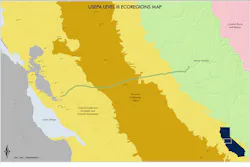
These transmission corridors pass through a variety of ecosystems, including grasslands, forested terrain and riparian habitats. As SFPUC staff evaluated the ecological potential of these landscapes, they recognized that the ROW could serve not only as infrastructure corridors but also as contributors to regional conservation efforts.
One key factor shaping the BIOaudit initiative was the utility’s decision to participate in a Candidate Conservation Agreement with Assurances (CCAA) focused on monarch butterfly (Danaus plexippus) habitat. The voluntary agreement framework allows utilities and other infrastructure managers to implement proactive conservation measures that support the monarch and other at-risk pollinator species while maintaining operational flexibility.
Within SFPUC, the HHWP division has taken the lead on the program. Through the agreement, HHWP enrolled about 10,000 acres of transmission ROW into the CCAA and committed to actively conserving roughly 1,000 acres within portions of its upcountry distribution system.
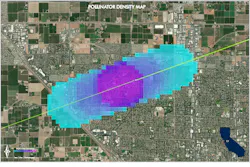
These conservation commitments focus on improving habitat conditions for pollinators and other wildlife species that depend on early-successional plant communities commonly found within utility corridors. Participation in the program also positions the utility to support emerging conservation efforts for species of concern, including several native bumblebee species currently under consideration for federal protection.
However, the team at HHWP quickly recognized that implementing conservation strategies at a system-wide scale required more detailed ecological information about the corridors themselves. While they knew that the ROW had ecological value, they needed a consistent way to measure what was actually present across the landscape. Additionally, they wanted to consider how management practices might influence those conditions over time.
To address that need, the SFPUC partnered with EnviroScience and ACRT Pacific to develop a structured ecological assessment program that could provide the data needed to guide long-term management decisions.
Building a Scientific Framework for Corridor Ecology
Designing the BIOaudit assessment required developing a scientifically rigorous methodology capable of producing consistent and repeatable ecological data across the transmission system.
The senior ecologist with EnviroScience helped develop the sampling framework used in the project. The primary goal of the assessment is to establish a baseline understanding of ecological conditions within the ROW so that changes in habitat quality can be tracked over time.
The overall objective is to provide scientifically valid information that can be repeated over time to determine the ecological health of the ROW. This baseline allows the utility to evaluate habitat conditions, identify high-quality areas and sensitive species locations, document invasive or undesirable species and measure how management practices improve the corridor in the future.
The BIOaudit methodology relies on a structured sampling design in which transects are distributed at regular intervals across the transmission system. Each transect provides a representative cross-section of vegetation and habitat conditions within the corridor.
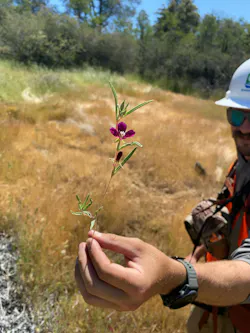
At each location, field teams collect standardized data on plant species composition and vegetation abundance using fixed-area sampling plots. Technicians identify and document every plant species present within the plots, along with information about growth stage, flowering condition, and relative abundance.
In addition to vegetation surveys, the BIOaudit also captures information about wildlife use within the corridor. Field crews document bird activity during surveys and record incidental observations of mammals, insects, amphibians and reptiles encountered in the field. Remote trail cameras are deployed at select locations to capture wildlife movement when crews are not present.
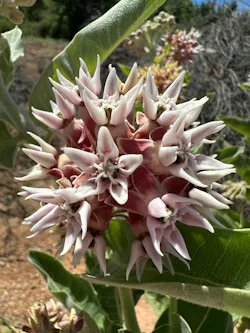
These combined data sources provide a more comprehensive picture of how the transmission corridor functions as habitat within the surrounding landscape.
By analyzing these data over time, researchers can identify areas where ecological conditions are strong and locations where habitat improvements may be possible. The information can also help determine where vegetation management practices might be adjusted to encourage beneficial plant communities that support pollinators and other wildlife.
While the first year of the project focused primarily on collecting baseline information, the BIOaudit's long-term value lies in its repeatability. Using the same sampling methods in future survey cycles will allow scientists and utility managers to track ecological trends and evaluate whether management strategies are producing measurable improvements in habitat quality.
Equally important to the project's scientific design has been the close collaboration between EnviroScience and the ACRT Pacific field teams responsible for implementing the surveys.
Teams can design what they think is the best ecological study from an office, but if the methods don’t work for the field crews collecting the data, then it won’t produce the results they need. The goal is to create a rigorous, repeatable process that generates high-quality ecological data that the utility can use for years to come.
Translating Ecological Design into Field Operations
While the BIOaudit framework provides the scientific structure for the assessment, implementing the program across a large transmission system requires careful field coordination and operational planning.
ACRT Pacific’s role in the project is to serve as the operational component of the collaboration — translating ecological methodology into consistent data collection across the utility’s ROW.
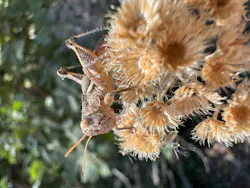
According to Dan Brackney, operations manager at ACRT Pacific, the company’s field crews serve as the “boots on the ground” for the assessment, gathering observations that ultimately form the foundation of the ecological dataset.
Because the BIOaudit required a different set of skills than traditional vegetation management work, ACRT Pacific established a new role within its organization for the project: Natural Resources Field Technicians.
These technicians were recruited for their environmental backgrounds and complementary skill sets. Team members brought experience in areas such as plant identification, water quality monitoring, ornithology, herpetology and geographic information systems (GIS).
The interdisciplinary makeup of the team proved valuable in the field. Plant specialists supported vegetation identification, while team members with GIS expertise helped manage digital data collection and mapping. This collaborative approach helped ensure that field observations were recorded accurately and consistently.
Training from EnviroScience ecologists also played an important role in preparing the teams for the work. Scientists provided guidance on sampling procedures, species documentation, and photographic records, ensuring that field observations could later be verified during data analysis.
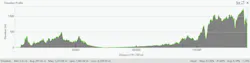
Field sampling itself is conducted using the transect-based methodology developed for the BIOaudit. At each location, technicians establish a transect across the ROW and use three 10m2 subplots to document vegetation within the corridor.
Every plant species present within the subplot is identified and recorded, along with additional information such as flowering status and growth stage. Although individual sampling plots can be completed relatively quickly, the full transect process, including setup, data collection and documentation, can take up to two hours.
In addition to vegetation surveys, the teams conduct bird observations at the beginning of each survey day and record incidental wildlife encounters throughout the sampling process. Raptors such as red-tailed hawks, bald eagles and osprey have all been observed using the corridor during the surveys.
Working conditions within the transmission corridor can present unique challenges. Unlike typical vegetation management tasks that involve frequent vehicle movement and intermittent field measurements, BIOaudit surveys often require technicians to remain within the corridor for extended periods to lay out transects and document vegetation.
In many areas, crews spend long hours in open ROW environments with limited shade while navigating dense brush and uneven terrain. Exposure to poison oak, ticks and prolonged sun exposure becomes a more prominent consideration when crews work continuously within unmanaged vegetation along the corridor edges.
To manage these conditions, field technicians work in pairs, allowing team members to monitor one another’s safety and maintain situational awareness throughout the workday.
Despite these operational challenges, the first year of implementation demonstrated that large-scale ecological monitoring can be successfully integrated into utility corridor environments when field operations and scientific methodology are carefully aligned.
Looking Ahead
As the BIOaudit program continues, the dataset generated by these surveys will provide the SFPUC with an increasingly detailed understanding of ecological conditions across its transmission system.
Future survey cycles will allow the utility to track changes in plant communities and wildlife activity over time and to evaluate how vegetation management practices influence habitat quality within the corridor.
For utilities across the industry, this project demonstrates how infrastructure corridors can serve both operational and ecological purposes when management decisions are supported by reliable environmental data.
Transmission ROW will always play a critical role in delivering safe and reliable power. With the right information and thoughtful management strategies, these same corridors can also contribute to broader conservation goals by creating landscapes that support both infrastructure and biodiversity.
About the Author
Joy Mellera
Joy Mellera is a ROW manager at Hetch Hetchy Water & Power, a division of San Francisco Public Utilities Commission and has been with the organization since 2020. She has nearly 15 years of industry experience and has previously served as a senior consulting utility forester and operations manager. Mellera is ISA Tree Risk Assessment Qualification-certified, an ISA Utility Specialist, and a California Licensed Landscape Contractor. She holds an associate’s degree in environmental science and fine arts from Columbia College and a bachelor’s degree in sustainable horticulture from Oregon State University.
Dan Brackney
Dan Brackney is an operations manager at ACRT Pacific and has 10 years of industry experience. Since joining ACRT Pacific in 2016, Brackney has worked his way up from a consulting utility forester to, most recently, an operations manager. He is an ISA Certified Arborist and ISA Utility Specialist, holds an ISA Tree Risk Assessment Qualification, and is FAA Part 107 sUAS-certified. Brackney also holds a degree in biology from Oakhurst Community College.
Michael Liptak
Michael Liptak, Ph.D., is a senior ecologist at EnviroScience and has been with the organization since 2004. He has decades of experience in wetlands research and ecological consulting and is a Certified Senior Ecologist. Dr. Liptak is a member of the Society of Wetlands Scientists and the Ecological Society of America. He holds a Bachelor of Science in Biology from the University of Toledo and a Ph.D. in Environmental Science from The Ohio State University.