Report: Utility Costs Flat in Q1 2026 for Average Household Despite Gas Surging
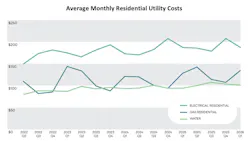
Market research firm J.D. Power released its latest Q1 2026 data, highlighting that residential costs for electric, gas, and water utilities have largely been flat overall. The Quarterly Share of Wallet Tracker report from J.D. Power’s utilities team revealed that utility costs are up just half a percent (0.5%) compared to Q4 2025.
J.D. Power highlighted that gas bills are up 23.4% in Q1 2026, while electric and water utility bills have declined. This was despite electric utilities accounting for the largest share of the wallet ($186 monthly average). These three utilities combined nationally (at $418 per month) reportedly accounted for 6.2% of customers’ median annual household income ($80,610).
The rise in gas prices has mainly been contributed to by global supply chain pressures and an increase in power generation. The Intentional Energy Agency (IEA) expects gas power generation to increase by another 17% this year to meet electrification demand, adding costs to residential consumers.
According to J.D. Power’s April 30 report, roughly 70% of U.S. consumers are considered financially unhealthy amid rising costs and inflation. To help adjust, more than half (53%) of the 4,000 U.S. consumers surveyed reported turning to artificial intelligence for financial guidance.
Consumers are using various AI chatbot applications for daily budget-saving strategies, credit management, and financial information summarizing practices. But J.D. Power urges that this is where banks need to step in to integrate more tailored personalized AI solutions to prevent random online vulnerabilities.
Some consumers have also taken AI measures through smart home devices such as solar panels, EV chargers, smart thermostats, and residential battery energy storage systems (BESS) that communicate with the energy grid and help regulate utility usage. These options can help consumers with verified household savings ranging from 8% to over 15%, according to the U.S. Department of Energy (DOE).
States like Oregon have taken measures to ensure data centers pay for their infrastructure-related electricity needs more directly, while ensuring utility customers do not foot the bill. Portland General Electric's new framework is one example of utility companies and state officials working together to continue this trend of utility costs flattening while still pursuing innovation.