Next-Gen Fault Location: Transforming Grid Reliability with Hardware-in-the-Loop Evaluation
At any given second, during any given day, an electrical outage at a utility is going to happen. For example, a feeder is down, customers are in the dark, and the only thing the control room knows for certain is that the fault is somewhere out there — somewhere along miles of wire strung between thousands of poles. Crews must then begin the process of patrolling the line to locate the source of the problem before repairs can begin.
For an industry where two-thirds of every outage is spent locating the fault rather than repairing it, achieving this goal has direct implications for grid reliability, affordability, and utility operations. EGM partnered with the Israel Electric Corporation (IEC) to evaluate the distribution fault location performance of its Meta-Alert system through hardware-in-the-loop (HIL) simulations at the National Laboratory of the Rockies (NLR).
Reliability and Affordability: The Central Challenge
Grid reliability is a national policy priority. Reliability and affordability continue to be key concerns for utilities as they modernize aging infrastructure and integrate new resources onto the grid. A recent 2025 Department of Energy forecast warned that the U.S. could face a significant increase in power outages with customer outages rising to 800+ hours per year in certain regions. Meanwhile, customers are paying more and expecting more. Regulators are tightening performance benchmarks. And the single largest controllable variable in outage duration — the time it takes to locate the fault — has remained effectively unchanged for a generation.
These are not storm-driven challenges. This is “blue sky” reliability — the worsening of performance under normal operating conditions. Underinvestment in distribution infrastructure, aging equipment, and increasing system complexity from distributed energy resources are compounding the problem. And while catastrophic weather events dominate headlines, it is the everyday fault — such as a tree branch on a lateral, the insulator failure at midnight — that drives the vast majority of customer-affecting outages.
Reliability is as much about metrics as it is about customer service and satisfaction. Two key industry reliability statistics are SAIDI (System Average Interruption Duration) and CAIDI (Customer Average Interruption Duration) calculations, but short duration faults are often omitted from these metrics. But a momentary fault is still a fault event that disrupts customers and any one of them may signal a developing permanent fault.
The U.S. electric distribution network is deceptively complex: multi-source, heavily branched, and increasingly populated with customer-owned generation that introduces two-way power flow. Recloser and switch states change the topology in real time. Conventional impedance-based fault location — which calculates a single distance-to-fault value — often returns multiple possible locations on branching feeders.
The alternatives are familiar but limited. Faulted circuit indicators (FCIs) are inexpensive and widely deployed, but they are binary: they tell dispatchers which lateral experienced a fault, not where on that lateral the fault occurred. Intelligent reclosers can narrow the window but more expensive to deploy at scale, particularly when installation costs are included.
The operational consequence: Over 50% of outage hours are typically spent locating the fault, with line crews patrolling lines looking for faults that may not even be visible to the naked eye. For customers, that search time isn’t just embedded in the SAIDI and CAIDI metrics that regulators use to benchmark utility performance – it manifests as frustration with utility providers and anger at rising bills for perceived worse service.
Putting the Technology to the Test
EGM’s collaboration with NLR began when EGM was selected as a participant in the Shell Game Changer Accelerator grid integration innovation program. Following the completion of the Accelerator project, EGM and the Israel Electric Corporation (IEC) were awarded a project through NLR’s Advanced Research on Integrated Energy Systems (ARIES) User Call for Advanced Distribution Management System (ADMS) Test Bed Use Cases. The ADMS Test Bed is a national, vendor-neutral effort to accelerate industry development and the adoption of ADMS capabilities.
EGM proposed that NLR perform independent testing of the Meta-Alert fault location technology, allowing researchers to evaluate how the technology could support advanced distribution management system (ADMS) applications.IEC provided co-funding for NLR researchers to use NLR’s laboratorytesting facilities, and EGM provided in-kind contributions.
For the test configuration, IEC provided three real-world feeder topologies from its distribution network in Israel. One was selected and its characteristics were recreated in NLR’s ADMS Test Bed and then modified to match common grounding practices in the United States.
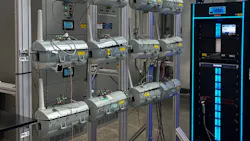
A Digital Real-Time Simulator (DRTS) was used within the ADMS Test Bed to compute electromagnetic power system states in real time to match real-world transient dynamics and convert those simulated states to real analog voltage and current outputs that were provided as inputs to the EGM hardware under test. The EGM sensors connected in the test bed were modified to introduce the low-voltage analog outputs from the DRTS after the high-to-low voltage and current conversion that would be required for a sensor installed in the field. The test setup was designed to replicate the electrical signals that the sensors would experience in a field deployment. The sensors measure, process, and respond exactly as they would in the field.
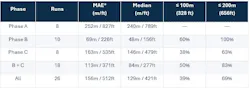
After EGM’s fault location algorithm in the system was calibrated with simulation data from faults at known locations on the feeder, the test program comprised 26 independently executed blind scenarios across three phases (A, B, and C) and four feeder segments. EGM had no advance knowledge of the fault locations or feeder segments selected by NLR. All scenarios were solid single-phase-to-ground faults - a controlled baseline that establishes the technology’s core accuracy under well-defined conditions. The preliminary test results showed that the systems’ aggregated accuracy across 26 scenarios was within 156m / 512ft, of which ~70% were within 200m / 656 ft and ~40% within 100m / 328ft from the fault. The lower accuracy on phase A is thought to be a result of an error introduced on that phase in the changes made to connect the low voltage outputs from the DRTS directly to the sensors, but needs further investigation to confirm.
On phases B and C, over 80% were within 200m / 656 ft and 50% were within 100m / 328ft from the fault.
The Deployment Economics
For utility executives evaluating capital investment in reliability, the question is not just accuracy — it is accuracy per dollar deployed. The distribution network of a major U.S. utility can include well over a million poles. Solutions that require a sensor on every pole may be difficult to scale across an entire network. EGM’s system uses a cluster-based deployment model: a small number of strategically placed sensors covering an entire feeder. A typical deployment such as that run in this test, uses 12 sensors in 4 clusters. For comparison, a pole-mounted solution to the equivalent IEC feeder would require up to 80 sensors.
EGM’s sensors install without heavy-lift equipment and without the need for external voltage transformers, which may simplify installation compared to some alternative approaches. Sensor calibration is conducted in the factory and on the first cluster installation with any subsequent tuning conducted with remote Over The Air Programming (OTAP).
Faster fault location has the potential to reduce outage restoration times and improve crew efficiency. With well over ~10 million annual US truck rolls at an estimated $1,000 cost for each, the accruing cost to consumers through rates comfortably runs into double digit billions, according to EGM calculations. Eliminating even one hour of search time per outage can provide value for both utility and customer.
Challenges in Distribution Fault Location
Pole-mounted sensor solutions face fundamental scaling challenges. Instrumenting every pole on a large distribution network is challenging and costly. But the limitations go deeper: because pole-mounted sensors sit outside the conductor and therefore they cannot measure electrical parameters. This can limit their ability to detect transient and momentary faults — the very events that are not factored into reliability statistics but signal developing permanent failures.
FCIs do measure current and sit on the wire, however, they only provide a binary “yes/no” signal of whether current is flowing. This can help narrow patrol areas for line crews but provides limited location informationand is only as precise as the density of lateral lines on which FCIs are installed. Intelligent reclosers provide better granularity than FCIs but cannot distinguish between taps unless installed at every branch point. The hardware cost alone is approximately $20,000 per unit, with installation potentially doubling or tripling that figure, according to EGM calculations.
EGM’s sensors are on the conductor — not mounted externally on the pole. They capture the full electrical signature of fault events, measuring over 20 parameters including voltage, current waveforms. With high sampling rates and GPS-timestamped data logging, the same sensor platform is suitable for phasor measurement, power quality monitoring, and disturbance analysis.
Investing in a Long-Term Reliability Platform
The distinction matters for a utility’s investment strategy. Different monitoring approaches offer utilities varying levels of visibility, scalability, and potential applications depending on system needs.
NLR and EGM plan to participate in the follow-on Solar-HERO project that focuses specifically on autonomous optimized outage recovery with data orchestration. The project will examine how sensor data could support additional applications related to outage recovery and grid operations..
EGM is working with the Israel Electric Corporation and several U.S. investor-owned utilities and cooperatives to deploy the technology on live distribution networks. The testing of EGM’s Accurate Fault Location and Detection technology at the National Laboratory of the Rockies generates additional performance data as the company continues to advance and refine its fault location capabilities. By reducing the time utilities spend searching for faults with actionable operational intelligence, technologies that improve fault visibility may help utilities reduce outage response times, improve operational efficiency, and support reliability goals.
NLR will be presenting more detailed results from the laboratory evaluation later this year at a workshop on ADMS Test Bed projects for industry professionals.
About the Author
Natti Hugi
Natti Hugi is Vice President of R&D at Electrical Grid Monitoring, where he leads the development of advanced grid monitoring, analytics, and fault location solutions. He brings more than 20 years of engineering and leadership experience in complex infrastructure and multidisciplinary product development teams.
Alex Levran
Alex Levran is CEO of Electrical Grid Monitoring. He brings nearly 40 years of executive leadership in renewable energy, utility systems, and power technologies. He holds six U.S. patents and has held senior leadership roles at ABB and SUMEC Group.