Data-Driven Strategies for Utility Pole Infrastructure
Key Highlights
- Distribution poles are critical yet often overlooked components that support power lines, communications, and grid devices, making their resilience vital for overall grid security.
- Modern asset management uses assessment tools and structural modeling to determine whether poles can be reinforced or need replacement, extending their operational life and reducing costs.
- Strengthening poles against environmental stresses like high winds and ice storms helps prevent cascading failures and widespread outages, especially for critical infrastructure like hospitals and emergency services.
- Growing demands from data centers, EV charging, and distributed energy resources increase loads on poles, requiring utilities to evaluate and upgrade infrastructure proactively.
- Restoration-based reinforcement is faster, less disruptive, and more cost-effective than full replacement, enabling utilities to address vulnerabilities quickly and efficiently.
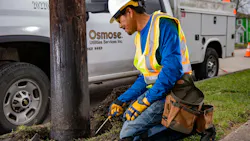
When a storm rolls through an electric utility’s service territory, most customers think about power outages and downed wires. Utilities understand the real vulnerability often lies with the structures supporting it all. With millions of distribution poles supporting conductors, communications equipment, and modern grid devices, these structures represent one of the most critical and frequently overlooked components of grid security.
Across the United States, utilities are confronting the challenge of maintaining aging pole infrastructure while responding to new demands on the grid. Electrification initiatives, distributed energy resources, and the expansion of telecommunications attachments are increasing mechanical loads on poles that may have been installed decades ago. At the same time, utilities must prepare their networks to withstand increasingly severe weather events, from hurricanes and ice storms to high-wind events and wildfires.
These pressures are driving a shift in how utilities manage overhead infrastructure. Historically, pole replacement programs were the primary response to ageing structures. While replacement remains necessary in some cases, replacing every ageing pole across a large service territory can be cost-prohibitive and operationally difficult to scale.
Instead, many utilities are adopting targeted distribution resiliency programs that combine assessment data, structural modeling, and analytics to guide in-service strengthening or replacement decisions. These programs allow utilities to evaluate pole populations across circuits and prioritize interventions where they will have the greatest impact on reliability and grid security while maintaining affordability.
Moving Toward Data-Driven Infrastructure Decisions
Modern asset management strategies rely on a growing set of assessment technologies and analytical tools. Detailed pole assessment, loading calculations, and structural modeling provide utilities with a clearer understanding of how individual poles perform under current and projected loading conditions.
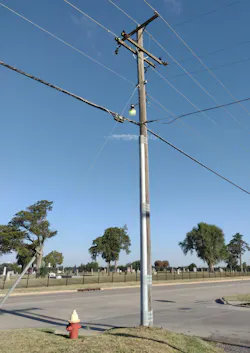
Restoration and reinforcement technologies can be used to strengthen these structures and extend their operational life. Engineered reinforcement systems can improve bending strength and load-bearing capacity, enabling poles to support modern grid equipment and attachments while maintaining safe structural margins.
For utilities managing millions of poles across thousands of circuit miles, this approach provides an important advantage: the ability to address infrastructure risk at scale without relying exclusively on full replacements, while also keeping their customers safe and keeping electric rate affordability in view.
Strengthening Infrastructure to Improve Grid Security
From a grid security perspective, pole resiliency plays a critical role in preventing widespread outages. Distribution poles must withstand mechanical loads from conductors, transformers, communications cables, and other attachments while also enduring environmental stresses such as wind, ice accumulation, and soil degradation.
From a grid security perspective, pole resiliency plays a critical role in preventing widespread outages.
High-wind events illustrate the importance of structural resiliency. Wind speeds exceeding 60 mph (97 km/h) can impose significant lateral forces on poles and attachments. If multiple poles fail along a circuit, the resulting outages can impact thousands of customers and require extensive restoration efforts.
Targeted resiliency programs help utilities identify where structural reinforcement can reduce the likelihood of these cascading failures. By strengthening poles on critical circuits — particularly those serving hospitals, emergency services, and major industrial loads — utilities can improve system reliability and protect essential infrastructure.
Preparing for New Grid Demands
Distribution networks are also experiencing new loading pressures as the energy landscape evolves. The rapid growth of hyperscale data centers across the United States is placing substantial demand on local power systems. These facilities require highly reliable power delivery and minimal service interruptions.
At the same time, utilities are integrating distributed energy resources, installing advanced sensors and communications equipment, and expanding electric vehicle charging infrastructure. Each of these developments can increase the structural loading on pole assets.
Understanding how these additional loads affect pole performance is critical. Data-driven resiliency programs allow utilities to evaluate pole capacity under both current and future conditions, ensuring that infrastructure upgrades are aligned with long-term system needs.
Faster Deployment and Reduced System Disruption
Another advantage of restoration-based strategies is speed of deployment. Installing pole strengthening systems typically requires less time and fewer resources than full pole replacement. This enables utilities to address large numbers of vulnerable structures within shorter timeframes.
For example, reinforcing an existing pole may take an hour or less in the field, compared with the time required to remove and replace a structure, which often involves excavation, new pole setting, conductor transfers, and coordination with telecommunications providers.
Pole replacement is sometimes necessary, but it comes with several operational challenges. Work must be performed in the energized zone, requiring strict safety procedures and careful coordination. Replacement projects often involve longer planning and execution timelines, and they can create “double wood,” where the old pole remains in place until telecommunications attachers move their equipment — a process that can take years. Pole replacement is also significantly more expensive than restoration or strengthening and may require momentary or extended outages to safely transfer electrical facilities to the new structure.
Accelerating these upgrades allows utilities to improve network resilience more quickly, an increasingly important factor as regulators and customers expect measurable improvements in reliability metrics such as System Average Interruption Duration Index (SAIDI) and System Average Interruption Frequency Index (SAIFI).
Restoration and Replacement: A Balanced Strategy
Importantly, in-service strengthening or replacement should not be viewed as mutually exclusive strategies. Some poles will require full replacement due to structural deterioration, foundation instability, or excessive loading. Others may be strong candidates for reinforcement and life extension.
The most effective asset management programs use data analytics to determine the appropriate intervention for each structure. By combining targeted restoration with strategic replacement, utilities can maximize the impact of capital investments while improving overall system resilience.
Delivering Measurable Resilience Improvements for Utilities
Utilities implementing targeted distribution resiliency programs have reported several key benefits. These include extending the service life of pole assets by decades, accelerating infrastructure hardening efforts, and reducing capital expenditures compared with replacement-only programs. Restoration strategies also minimize construction disruption and reduce the volume of new materials required for large-scale infrastructure upgrades.
Perhaps most importantly, these programs provide utilities with better visibility into the structural health of their pole populations. This improved understanding supports long-term planning and allows utilities to proactively address infrastructure risks before they result in service interruptions.
As the U.S. electric grid continues to evolve, strengthening the foundational components of the distribution system will remain essential. Data-driven pole restoration and targeted resiliency programs offer utilities a practical and affordable pathway to improve grid security, enhance reliability, and ensure their distribution infrastructure is prepared to support the energy demands of the future.
About the Author
Chad Newton
Chad Newton is the Senior Director, Wood Infrastructure Portfolio, at Osmose.