The Rise of Next-Gen Solar and Ocean-Based Power Systems
Key Highlights
- Bifacial solar panels can produce 10%-30% more electricity by capturing reflected sunlight on both sides, offering a longer lifespan despite higher costs.
- The world's largest iron-air battery project provides 100 hours of steady power, using reversible rusting to store energy more cost-effectively than lithium-ion batteries.
- Panthalassa's ocean wave energy nodes convert wave motion into electricity and AI computing power, opening new frontiers in offshore renewable energy deployment.
There have been some really unusual and attention-grabbing news items moving across my virtual desk from the realm of clean energy. At the top of the list were some media releases focused on tackling the growing power requirements of hyper-scale data centers. One press release that got my attention featured bifacial solar panels. Traditional panels are monofacial, which means that only the side of the panel facing the sun converts the sunlight to electricity. The bifacial, however, allows both sides of a solar panel to generate electricity. This breakthrough uses glass like transparent materials allowing both the front and back to capture light, but not directly for the backside. It uses reflected light off the ground or surrounding surfaces. Suppliers say they’re a little more expensive but have a longer life. They do produce anywhere from 10%-30% more electricity output.
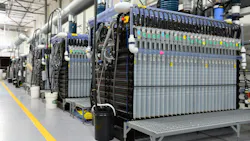
There was also an announcement with a link about the world’s largest iron-air battery storage project. I had read about the technology before, but this headline was intriguing, so I clicked on the link. It started off about Google, Form Energy and Xcel Energy forming a partnership to build a hyper-scale data center and quickly moved to the meat of the story. This data center project will be powered by 1.9 gigawatts of wind and solar coupled with a 30 gigawatt, 100-hour iron-air battery. The iron-air battery technology being utilized was developed by Form Energy. It has extremely long discharge durations employing a “reversible rusting” method. This electrochemical process is the reason they can discharge for up to 100 hours and last for thousands of cycles.
Iron-air storage batteries not only smooth the hourly power fluctuations common with wind and solar power, but they also deliver power for the multiday weather events. Basically it’s a simple process: during discharging the iron reacts with the oxygen in the air to produce rust, which releases electrical energy. Applying an electric current reverses the process converting the rust back to metallic iron. For long duration storage applications iron-air is more cost effective than Lithium-ion batteries. The Google data center’s iron-air battery provides steady clean power for up to 100 hours at full rated output. This technology has the potential of allowing intermittent renewable generation to be available every hour of every day without interruption.
Ocean of Power
One last bit of eye-catching technology came from Panthalassa a Portland, Oregon-based renewable energy company. The company’s communications said they are “transforming the ocean’s untapped energy into clean power at terawatt scale.” That captured my interest! Diving deeper, they developed an autonomous, free-floating, ocean-going node that converts wave motion into continuous electricity, but that’s not all. These wave-riding nodes are self-propelled and are intended for long-term deployment in the ocean to power AI data centers.
Basically, the plan calls for a network of these nodes to be deployed on the ocean, and AI computing happens within the nodes. They are in constant communication via satellite, and the AI computing work is sent directly to Panthalassa, which makes them an alternative to land-based datacenters. Panthalassa is currently ocean testing their second-generation Ocean-2 device. Ocean-3 is under construction and is expected to begin ocean testing this year. This technology is referred to as “an overtopping wave energy converter.” Ocean-2 is rated 500-kilowatts and is approximately 280 feet (80 m) in length with about 230 feet (70 m) below the surface of the sea. It’s the bobbing motion from the waves that forces pressurized seawater through its water turbine, which is it’s only moving part. The wave motion generates electricity that powers the onboard AI computing hardware, and the sea water provides the cooling needed for its AI computing. Going back to the media release, “Panthalassa is not merely deploying a new technology, it’s opening a new frontier.”
The common thread in all these items is that clean energy is not going away despite government intervention. A report from the U.S. Energy Information Administration (EIA) said that the U.S. set a record for wind, solar, and battery storage in 2025 when 53 gigawatts of new utility-scale capacity came online. EIA’s news release continued, “This was the largest capacity installation in a single year since 2002.” They also projected that 86 gigawatts of new utility-scale electric generating capacity will be added to the grid in 2026. Proving once again that after the clean energy technology genie is out of its bottle it’s proving impossible to push it back in!
About the Author
Gene Wolf
Technical Editor
Gene Wolf has been designing and building substations and other high technology facilities for over 32 years. He received his BSEE from Wichita State University. He received his MSEE from New Mexico State University. He is a registered professional engineer in the states of California and New Mexico. He started his career as a substation engineer for Kansas Gas and Electric, retired as the Principal Engineer of Stations for Public Service Company of New Mexico recently, and founded Lone Wolf Engineering, LLC an engineering consulting company.
Gene is widely recognized as a technical leader in the electric power industry. Gene is a fellow of the IEEE. He is the former Chairman of the IEEE PES T&D Committee. He has held the position of the Chairman of the HVDC & FACTS Subcommittee and membership in many T&D working groups. Gene is also active in renewable energy. He sponsored the formation of the “Integration of Renewable Energy into the Transmission & Distribution Grids” subcommittee and the “Intelligent Grid Transmission and Distribution” subcommittee within the Transmission and Distribution committee.