Jersey Ready: What It Takes to Weather a Historic Storm
Key Highlights
- Superstorm Sandy left about 2.7 million New Jerseyans without power and prompted major investments in grid resilience.
- PSE&G upgraded substations, installed more than 1,500 smart switching devices and integrated outage and metering systems.
- During Hernando, crews worked through blizzard conditions to complete more than 56,000 outage repairs in 24 hours.
- The utility’s storm readiness depends on year-round preparation, vegetation management and coordination with local and state partners.
- PSE&G reports outages have fallen about 22%, with roughly 23% fewer customers affected when outages occur.
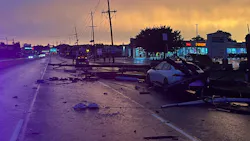
There was no mistaking Hernando as it barreled up the East Coast in February. This was a monster: a fast-moving coastal winter storm that strengthened into a historic bomb cyclone Nor’easter as it slammed into New Jersey.
PSE&G had faced monsters before. Back in 2012, Superstorm Sandy knocked down or damaged more than 113,000 trees across the state, leaving about 2.7 million New Jerseyans without power, many of them for weeks.
Sandy was a defining moment for the company and the state. “I never thought I’d see what I saw today,” New Jersey Gov. Chris Christie said, adding that the sight of houses sitting in the middle of a major roadway was “unfathomable.”
Over the decade that followed, with nearly three-quarters of that work focused specifically on improving reliability and resilience. The utility raised and rebuilt substations to elevate them above flood level. The utility installed more than 1,500 smart switching devices, allowing operators to reroute power automatically around damaged equipment. The utility implemented a new Outage Management System (OMS), integrated with a new Advanced Metering Infrastructure (AMI) system. This provided visibility down to the customer meter level and allowed faster pinpointing of outage locations, better communication with customers, and faster response time.
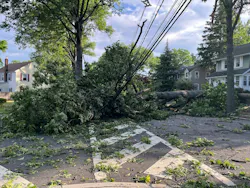
Moreover, PSE&G enhanced its storm response through the company’s Newark-based Utility Emergency Operations Center, enhancing staging areas and making arrangements with other utilities for mutual aid. In addition, the utility honed its enhanced emergency response capabilities during other big storms.
As a result, outages have since dropped by about 22%, with about 23% fewer customers impacted when outages do occur. The past three years have seen some of the best reliability performance on record, and when outages do happen, PSE&G is restoring power faster than the national average.
In commemorating the tenth anniversary of Sandy, PSE&G President and Chief Operating Officer Kim Hanemann wrote: “ PSE&G’s proactive action and significant infrastructure investments have spared customers from the devastating power losses they experienced during Superstorm Sandy. Critical community facilities like hospitals, nursing homes, police and fire stations now experience power restoration faster than ever before. For first responders, sustained power loss can be the difference between life and death.”
All of the company’s preparations would be tested by Hernando.
Preparing for the Worst
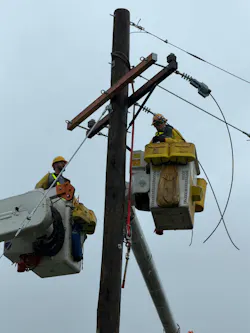
While the storm was still forming off the Southeast coast, PSE&G was already moving. The utility activated additional personnel and set up staging areas at strategic locations to fortify timely storm response.
PSE&G tested backup generators, and operators were on the phone with county Offices of Emergency Management and coordinating directly with hospitals, airports and other critical customers.
New Jersey Governor Mikie Sherrill warned, “This is likely to be the worst storm we have seen since 1996. It is a serious storm. Please take it seriously. Stay inside. Don’t travel tonight.”
The Storm Arrives
Snow began falling across New Jersey on the afternoon of February 22, and by the morning of February 23 — in roughly 18 hours — the storm had buried much of the state under two to three feet of snow, with rates reaching three inches per hour at its peak, wind gusts of up to 50 mph, and blizzard conditions that brought the entire state to a standstill.
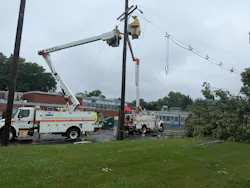
The utility was ready. More than 3,000 PSE&G employees mobilized across the service territory and worked around the clock in those brutal conditions. They included over 1,150-line workers, 400 tree trimmers, 472 mutual aid contractors and hundreds of other field personnel. Before a single repair could begin, crews had to physically deal with the massive amount of accumulated snow.
For example, when a snowplow accidentally struck a transformer in a Watchung neighborhood, causing a power outage for nearby homes, the PSE&G crew arrived on the scene and immediately cleared a safe path to the equipment to ensure stable footing and safe access.
Within 24 hours, the utility had restored power to virtually all customers, completing more than 56,000 outage repairs during one of the most severe winter storms the region had seen in 30 years. PSE&G answered nearly 13,000 customer calls within seconds, pushed the more than 200,000 proactive outage notifications, and handled 327 gas emergency calls and 1,259 no-heat calls — all while the storm was still raging.
What We’ve Learned
Thirteen years separate Sandy from Hernando. In that time, PSE&G has learned things about grid resilience, coordination with local, county and state partners, and the nature of extreme weather that are worth sharing.
First, you don’t know where your system is truly vulnerable until a catastrophic storm shows you. When Sandy hit, nearly half of the outages affecting two million customers were due to switching stations or substations flooded by Sandy’s historic storm surge.
The second lesson is that the work we do to harden our systems delivers measurable benefits across every storm that follows — not just the one that prompted it. When Hurricane Ida’s remnants hit New Jersey in 2021 with deadly flash floods and a rare Category 3 tornado, not one of our substations experienced service interruptions due to flooding. In addition, Hernando confirmed that preventative vegetation management helps avoid problems like downed trees on wires. The return on that work is real and measurable.
The third lesson is about the relationship between utilities and municipalities, elected officials and leaders across government and in service communities — and how much these relationships matter before anyone loses power. During Hernando, working closely with state and municipal partners to coordinate snow removal so roads could be cleared was essential to keeping conditions safe for our teams to reach affected areas.
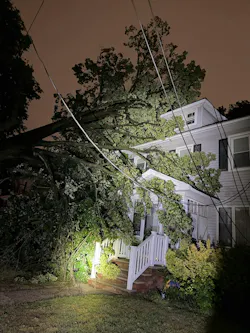
That coordination worked because PSE&G had built those relationships in advance. Waiting until a storm is bearing down to establish communication protocols with public works departments, emergency managers and first responders is too late. The conversation about which roads get cleared first — and in what sequence to support grid access — needs to happen on a good-weather day.
The fourth lesson is there’s no substitute for preparation. At PSE&G, storm preparedness is a year-round discipline. Crews conduct regular storm drills and emergency response exercises to make sure they are ready when conditions deteriorate fast. We analyze the performance data from every major weather event we face, identifying gaps and refining our protocols before the next one arrives.
The final lesson is perhaps the simplest: the work is never finished. While utilities across the country are now setting new records in infrastructure investment — an estimated $208 billion in 2025 — PSE&G began its work a decade ago, giving the utility a valuable head start. For utilities still in early stages of that journey, the most important thing we can say is this: start now, stay consistent and treat every post-storm analysis as a valuable learning experience — because the next test is coming.
The company has seen the results firsthand. As one Hoboken public safety official noted: “PSE&G has been an invaluable partner in making our community safer and more resilient. PSE&G’s commitment to working with our city government brought Hoboken to a place where there was not one power outage during either Ida or Hurricane Henri. When major storms bring little negative impact, residents stay safe and get back to their normal routines much sooner.”
About the Author
Paul Toscarelli
Paul Toscarelli is vice president of electric operations for Public Service Electric and Gas Company. He is responsible for all electric field operations, including safety and emergency preparedness. A licensed engineer, he has held numerous leadership positions at PSE&G and has more than 25 years of experience in a diverse range of managerial, technical and financial fields.