Resilience and Recovery: Inside Entergy's Response to Winter Storm Fern
Key Highlights
- Over 65,000 mutual assistance workers from 44 states supported Entergy in restoring power after Winter Storm Fern, which impacted over 220 million people.
- Entergy mobilized more than 9,400 workers, including international resources, deploying specialized equipment to access remote and icy areas for efficient restoration.
- The utility developed the Damage Assessment Collection Tool (DACT), a mobile app that streamlines damage data collection and prioritization in real time, speeding up repairs.
- Heavy ice accumulation, with up to 1 inch in some areas, caused severe damage to power lines and trees, complicating restoration efforts and increasing safety risks for crews.
- Entergy prioritized safety by enforcing strict work protocols, equipping crews with ice cleats and snow chains, and deploying experienced mentors to guide field operations under hazardous conditions.
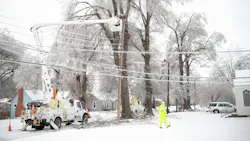
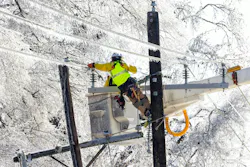
As temperatures plunged, line crews navigated their bucket trucks on icy, snow-packed roads in the wake of Winter Storm Fern. Ice-covered trees crashed onto power lines, knocking out power and blocking roads for lineworkers on patrol.
More than 65,000 mutual assistance workers from 44 states packed their bags and hit the road to help the 24 utilities requiring emergency assistance after the storm cast more than 220 million people in the dark.
Fern, the second deadliest winter storm in North America next to Winter Storm Uri, inflicted widespread power outages and destruction in the South, Midwest and Northeast. Entergy’s service territories in northern Louisiana and Mississippi were among the hardest hit areas.
Winter Storm Fern’s wrath exceeded the damage Entergy incurred by both Hurricanes Beryl and Francine, which made landfall in 2024. By the end of the restoration, Energy’s lineworkers and mutual assistance crews changed out 4,180 poles and 8,580 spans of wire, repaired 52 substations and swapped out 2,210 transformers.
“It was a marathon restoration with harsh conditions, and it brought more than its fair share of challenges to our customers and the communities we serve,” said Dakin DuBroc, vice president of incident response for Entergy. “Damage from this winter storm resembled a strong hurricane but with more dangerous, icy restoration conditions.”
Mobilizing Workers and Resources
In Entergy’s service territory, the storm affected 35 de-energized transmission lines, and at the storm’s peak, 167,540 customers were impacted. Line crews ultimately restored more than 360,000 cumulative outages. Heavy sleet of up to 6 to 7 inches also contributed to the collapse of carports, sheds and gas station awnings, according to the National Weather Service.
“It was a historic storm in our hardest hit areas,” DuBroc said.
Before the first snowflake even fell in Entergy’s service territory, Entergy’s logistics team was already ramping up preparations for Winter Storm Fern. Workforce mobilization kicked off with the pre-deployment of more than 4,000 workers on Jan. 23, a day before the storm was expected to hit its service area.
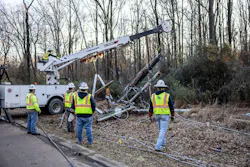
“Pre-mobilization in areas expecting damage was critical to enable quick-on-the-ground deployment as soon as the weather had passed through and road conditions permitted safe travel,” DuBroc said. “At peak, we mobilized over 9,400 workers, including 5,700 mutual assistance and contract resources coming from more than 20 states and Canada.”
After the storm passed through Entergy’s service territory, Entergy focused on restoring power to customers as safely and quickly as possible.
“Our restoration process is done in an orderly, deliberate manner,” DuBroc said. “This starts with clearing vegetation that can impede access to damaged assets, assessing the damage, then repairing power plants, transmission lines and substations and then finally the distribution poles and wires in the communities we serve.”
To expedite restoration, Entergy developed the Damage Assessment Collection Tool (DACT), a mobile application that enables efficient and accurate damage collection in the field. Using this app, internal and external resources can ensure a timely, more precise and consistent collection of damage data that can be uploaded back to prioritization teams in real time.
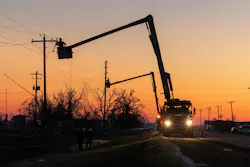
Preparing for the Storm
During Winter Storm Fern, temperatures dipped as low as 12° to 15° across much of Mississippi and Louisiana, and line crews worked consecutive days of persistent freezing temperatures. Despite the extreme winter weather, the utility’s generating facilities were prepared and delivered power to customers who could receive it, thanks in part to lessons learned from past winter storms, such as Winter Storm Uri in 2021.
Each power generation facility completes its own winter preparedness plan in accordance with fleet standards. Entergy developed these standards based on industry best practices and prior operating experience during winter weather incidents. Entergy also helped manage the unprecedented surge in fuel cost as Henry Hub national gas spot prices spiked to an all-time high of $30.565/MMBtu during the storm.
Unlike other types of storm restoration, cold-weather response is handled differently. When a distribution circuit is re-energized after an extended outage, the system can experience a phenomenon called cold load pickup.
“Entergy uses a methodical and calculated process in bringing customers back online after a power outage in very cold weather, regardless of whether the initial cause of the outage was specifically weather-related,” DuBroc said. “Rather than simply energizing an entire power line all at once, we must bring customers back online one section at a time to avoid damage to our system and make the situation worse.”
The reason for the different processes involves the amount of power being used. For example, during temperature extremes — hot or cold — customers tend to use a lot of electricity to keep the air conditioning or heat on or to run other devices. Energy has devices in place to protect its system during normal day-to-day operations and power demand, as well as most weather and other contingencies.
“During weather extremes, we must change our processes to make sure we protect our system and do the right thing by our customers,” she said. “That means restoring power in a way that best ensures safety and reliability for them as well as our employees.”
Lessons Learned: How to Prepare Power Plants for Extreme Weather
At Entergy, storm preparation occurs year-round through regular procedural reviews and training. Following each storm, the utility examines the storm response across all functions for ways to improve.
For example, Arkansas and Louisiana experienced back-to-back winter storms in December 2000. The first storm (beginning Dec. 13) left about 237,000 customers without power across both states, while the second (the Christmas Day storm) caused 235,000 outages across both states. Entergy was also hit with another severe winter storm in February 2021, which impacted a large portion of the country.
Entergy’s employees applied lessons learned to make substantial improvements to the utility’s winter readiness and to ensure it is following the North American Electric Reliability Corporation’s winter readiness recommendations. On this front, the utility’s power plants have customized plans to support fleetwide winter preparedness efforts that take place well in advance of a storm, including:
- Insulating critical equipment using improved methods and materials to protect it from lower temperatures.
- Insulating all piping, with the potential for standing water during normal operation, to prevent freezing. Workers also install heat tracing on piping where possible to prevent freezing.
- Designing and building permanent windbreaks or enclosures to protect pumps and other critical equipment.
- Exploring the use of wireless instrument line monitoring systems to check temperatures of critical equipment.
Overcoming the Ice Obstacles
While the damage to Entergy’s infrastructure resembled that of a hurricane, the line crews had a different obstacle to overcome during the Fern response — significant ice accumulation. Heavy ice inflicted severe tree damage and structural impacts, created widespread debris and blocked access routes, making it difficult for crews to reach the affected areas.
Continuous tree failures brought down additional poles and spans of wire, resulting in additional outages. Entergy focused the bulk of its restoration efforts on the distribution system due to vegetation issues.
“Winter storms present unique challenges to our restoration efforts,” DuBroc said. “In the most heavily impacted and hard-to-access areas, crews continued to discover additional damage caused by fallen trees. These restorations are extremely time- and labor-intensive, often requiring specialized off-road equipment and replacing multiple poles and spans.
Darren Cox, a lineworker for Entergy Mississippi, said one of the most dangerous parts of the restoration process following Winter Storm Fern was the ice combined with the wind.
“Those conditions can cause trees and limbs to fall while we’re working in the field,” Cox said. “Some of those limbs can weigh hundreds of pounds and can cause severe injury — or worse — if they come down on you.”
While a quarter inch of ice is often enough to strain power lines and cause localized outages, a half inch of ice can add about 500 lbs. to a single power line span, equivalent to the weight of a baby grand piano. One inch of ice — which is what Entergy accumulated in certain areas of its service territory — is equivalent to about 750 lbs. per span and is even more likely to cause widespread power outages.
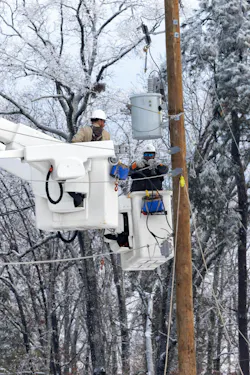
“Ice is particularly harmful to electrical lines,” DuBroc said. “One inch of freezing rain accumulation causes substantial devastation to the overhead distribution system and can cause significant, severe and ongoing tree damage and long power outages.”
Navigating the Frozen Terrain
Due to the adverse weather conditions and ongoing damage, some customers experienced multiple outages. For example, Entergy Louisiana crews had to restore power five times in one area due to damage caused by falling vegetation in areas that had already been restored.
In the aftermath of the storm, just accessing the storm-response zones proved to be challenging. For this event, many distribution and transmission lines crossed rural, secluded areas in the hardest-impacted areas. For example, in the Warden area of Richland Parish, Louisiana, lineworkers replaced 75 utility poles to restore power to a single group of 110 customers.
“This work required about 20 crews working for a day-and-a-half to complete,” DuBroc said. “Situations like this illustrate why restoration in some areas took longer despite significant progress overall. They can extend restoration timelines and lengthen workdays, encroaching on mandatory rest requirements for the safety of restoration workers.”
Snow and ice from the initial downfall and the overnight refreezes also delayed restoration because lineworkers could not safely perform their work. After Winter Storm Fern, line crews relied on specialized equipment to navigate the icy roads and cross saturated ground and standing water. With these machines, they could safely access the off-road terrain and remote locations during the restoration work. For example, crews safely deployed tracked aerial units, tracked digger derricks, backyard buggies, bulldozers and excavators during the winter storm response for damage that extended into remote, rural areas.
“A traditional bucket truck is equipped to handle many off-road scenarios, and it’s still the go-to equipment for most repairs,” DuBroc said. “When terrain is too challenging or unsafe for a bucket truck — due to trees, close-quarter obstacles or extensive mud or ice — crews can use several other pieces of equipment to help restore power to all our customers.”
In the Aftermath of Winter Storm Fern: Helping the Community
To help Entergy’s customers who lost power during Winter Storm Fern, the utility reached out to the community in its service area with funding and supplies. Here are some ways the utility helped those in need.
Entergy awards an annual $250,000 disaster relief grant to the American Red Cross to assist them with providing shelter, food, water, supplies and volunteers where they’re needed most. Entergy Mississippi contributed an additional $25,000 to provide critical storm relief to the hardest-hit communities.
- Entergy Mississippi partnered with Extra Table FEEDS, a statewide nonprofit foodbank, to provide 40,000 meals to communities.
- Entergy Louisiana donated $50,000 to the United Way of Northeast Louisiana’s Family Relief Effort telethon fundraiser.
- Entergy Louisiana and Entergy Mississippi opened customer information centers in heavily impacted areas. Four centers were opened where customers could receive the latest outage and restoration updates, learn about available assistance programs and community resources, charge mobile devices and speak directly with Entergy representatives. From the start, Entergy prioritized affordability and customer assistance by focusing on bill-relief measures, including suspending disconnects for nonpayment for all customers.
- Entergy actively engaged customers, community and government leaders, regulators and the media to share the latest information available. We sent about 6.4 million customer texts, more than 1.9 million customer emails and fielded more than 920,000 customer calls.
Focusing on Safe Work Practices
To safeguard its field crews during Winter Storm Fern and any storm response, Entergy regularly reviews safety procedures with all employees and restores power only when it is safe to do so.
“Safety is a core value and always comes first in all we do,” she said. “Crews are dispatched when environmental conditions allow.”
Before the line crews can start restoring power, they must follow certain safety protocols. For example, Entergy allows bucket-truck work only when sustained winds are below 30 miles per hour. Also, to support safety and avoid fatigue, they should not work more than 16 hours in a 24-hour period or work more than 14 days without a 24-hour rest period.
"This allows our restoration crews to get adequate rest and safely restore power when working,” DuBroc said.
During a winter restoration response like Fern, Entergy equips its workers with additional critical safety items unique to this type of response—including ice cleats, snow chains and salt or ice melt materials for the office or truck walking surfaces.
In addition, the utility prioritizes lineworker safety during restoration by deploying a dedicated team of seasoned mentors. These experienced veterans with decades in the field can actively coach crews on job sites, reinforce strict safety rules, demonstrate proper techniques and share field-proven best practices and tricks of the trade. In addition, they guide both internal and mutual assistance crews in adapting to Entergy’s equipment, process and hazard recognition.
“By providing real-time oversight, translating complex procedures into practical applications and ensuring consistent leadership messaging, they help maintain calm, structured operations, even under emergency conditions,” DuBroc said. “This significantly reduces risks for workers restoring power in challenging winter environments.”
As part of its commitment to safety, Entergy also requires contractors assisting with the storm to complete specific training modules before arriving on-site, ensuring a baseline for readiness.
“Once they arrive, we reinforce safety, switching procedures and operational tasks and adapt them to the environment, ensuring they build with intention, resilience and respect for our customers,” she said.
Rebuilding for Resiliency
Despite the storm’s severity and the conditions that followed, crews restored power to 94% of customers within nine days. One key to its response was its work to rebuild the grid, DuBroc said.
“Entergy has been and is continuing to make proactive resilience investments to help our grid better withstand severe weather, and these investments show their value during subsequent storms and restoration efforts like the January 2026 snowstorm.”
One example of these investments is in Rolling Fork, Mississippi. In March of 2023, an EF-4 tornado destroyed nearly 300 homes and damaged more than 700 power poles in this area. Entergy rebuilt the area’s power grid from the ground up even stronger than before—replacing old wooden poles with modern ones and reinforcing critical infrastructure.
“That investment paid off during the January winter storm,” she said. “While severe conditions caused outages across the state, the improvements helped Rolling Fork’s grid stand up to the severe winter weather better than before, allowing our storm response teams to restore power quickly, safely and efficiently. We know investments in resilience work and intentionally build the grid back stronger when making repairs following severe weather.
Day in the Life: Behind-the-Scenes Look at the Winter Fern Restoration
By Brandon Scardigli, Entergy
Entergy lineworker Derek Mayo wakes at 5 a.m. His bunk is frigid, just a tick below 20-degrees outside his trailer, and his feet are freezing. He wearily loads up his gear, including extra socks for when his first pair gets too wet in the snow and ice, and saunters over to his team’s morning safety briefing. He is one of the more than 4,000 men and women restoring power to North Louisiana following Winter Storm Fern.
“It’s the worst ice storm any of us has ever seen,” Mayo said. “The conditions are so, so harsh. It’s freezing cold and everything just moves more slowly.”
Mayo and his team load their bucket truck before the sun rises with their supplies for the day, including a lunch that will sit for the better part of five hours before they have a chance to take a bite. The doors to the truck are frozen shut, the only access coming via a lighter to melt the ice that settled into the crevasses overnight.
Once the team buckles in, the truck needs a minute before it agrees to move down the road. The brakes and hydraulics are frozen and need to be warmed up to reach their first job site of the day.
Things don’t get quicker from there.
The roads are iced over and traffic bogs down progress, creeping along to their destination with the end goal of restoring power to the nearly 92,000 customers who lost service in Northern Louisiana, a seemingly impossible task from his viewpoint. Chains on the tires, intended to help grip slick roadways, often break in the slurry of mud and ice.
“They’re helpful to a point,” he adds. “But you won’t be getting anywhere fast, and we have to stop every so often to put them back on the tires after they pop off.”
The team almost makes it. The truck hits an impasse in the ice. Luckily, a nearby neighbor sees the issue and has just the ticket: a bulldozer that can give the stuck bucket a little extra encouragement in the right direction.
Donned in heavy, stiff, cold-weather gear, they begin the process of replacing poles, wires and transformers. Truck bins are again frozen shut and the lighter has to make its second appearance of the day so the crew can access the necessary equipment.
They roll off the track machine, a specialized all-terrain vehicle that can access the backyards they need to reach to make repairs.
“Just something simple like turning a wrench takes 10-times longer than it normally would,” Mayo said. “Everything is just ice cold; your fingers are so numb you can barely move, and your feet feel like they’re stuck in blocks.”
Finally done replacing the pole, it’s on to the next one. While the repair is solid, too much ice can impede the flow of electricity, regardless of how carefully the wires are replaced. The day heats up, and the ice begins to melt, bogging down the track machine in thick, rich north-Louisiana mud. But Mayo and his team find a way, just as they did yesterday, and the day before that.
“You just can’t imagine what it looks like unless you’re out here,” he said of the harsh conditions. “You’re in the air and all around you can hear ice breaking and branches snapping. This job is dangerous enough, now there’s this whole other element and a whole new set of overhead hazards we have to keep in mind as we’re working.”
Jobs completed, the group now reverses course and heads back. Traversing the same conditions that gave them fits earlier that morning. Exhausted, joints aching and tire chains breaking.
Back at the staging site, Mayo grabs a dinner, showers, drops off his mud-laden laundry and finally has a chance to rest his feet after a grueling 16-hour shift. His head hits the pillow sometime after 11 p.m., only to wake and begin again the next morning.
About the Author
Amy Fischbach
Electric Utilities Operations
Amy Fischbach is the Head of Content for T&D World magazine and manages the Electric Utility Operations section. She is the host of the Line Life Podcast, which celebrates the grit, courage and inspirational teamwork of the line trade. She also works on the annual Lineworker Supplement and the Vegetation Management Supplement as well as the Lineman Life and Lineman's Rodeo News enewsletters. Amy also covers events such as the Trees & Utilities conference and the International Lineman's Rodeo. She is the past president of the ASBPE Educational Foundation and ASBPE and earned her bachelor's and master's degrees in journalism from Kansas State University. She can be reached at [email protected].