Winter Storm Fern Highlights Vulnerabilities in U.S. Power Grid
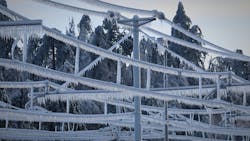
In the waning days of January roughly two-thirds of the U.S. was impacted by Winter Storm Fern. It affected 34 to 40 states with over 220 million people under winter weather alerts and paralyzed a large portion of the country. For the purists, I know naming winter storms is not a formal convention, but it helps communication-wise. The old terms like super-storm, monster-storm or “storm of the century” don’t hack it any more. We have those types of storms several times a year thanks to global climate change and we have to keep up with these changing times!
Fern is a perfect example. Its freezing rain and snow snapped power lines and trees from New Mexico to New England. One news broadcast showed freezing rain coming down on a stand of tall pine trees. Suddenly the accumulation was too much for one tree. Its upper portion started to bend. As I watched that tree almost formed an inverted “U-shape,” but it didn’t quite make it. Abruptly the bending trunk shattered and the top fell to earth. A nearby distribution line went phase-to-phase igniting a menacing arc and another feeder was lost.
That video said it all about the fragility of the power delivery system in general and the distribution system in particular. The distribution system is responsible for the majority of power outages, and its aging infrastructure could be more resilient. Still, the media pointed out that Fern’s impact would have been significantly worse without the preparations made by utilities and grid operators. Interestingly, several news agencies picked up on the bigger challenges facing the power delivery system for the long-term. Probing questions began emerging about the soaring electricity prices during the storm and most importantly, the vulnerability of our interconnected power grid.
It's All Interconnected
That’s another way of saying the power grid is a network and disruptions affect all of it one way or another. Several emphasized that Fern illustrated the compound risk an interconnected power grid represents when confronted by an extreme weather event stressing the entire energy system. The World Resources Institute (WRI), an independent research organization, reported that many eastern power plants operated at reduced capacity due to arctic cold and limited natural gas supplies.
Reuters observed there were “bottlenecks in the transmission system of high-voltage power lines, hindering the transfer from west to east.” They also reported that cheap power from abundant wind energy could not be moved from Illinois eastward, which caused that wind power to “dip into negative prices.” Portions of Virginia saw wholesale electricity prices increase from US$200 per megawatt-hour early Saturday topping US$1,800 per megawatt-hour on Sunday. DOE issued orders telling power plants to run at full capacity “regardless of the emission limits.” In the aftermath, there are groups challenging the cost of doing that and who pay these unaffordable operating costs.
WRI said maximizing grid flexibility is one of the best strategies for preventing extreme weather events disrupting our power supply. but it’s constrained by legacy infrastructure. That got me thinking about the Infrastructure Report Card that the Americal Society of Civil Engineers (ASCE) releases every four years. In 2021 ASCE gave our Energy Infrastructure a grade of C-. Last March, the ASCE 2025 report card came out, and energy was downgraded to a D+. Legacy systems require ongoing modernization. Implementation of additional interregional connections is critical, transmission capacity is lacking, and the distribution system needs to be extensively hardened. Fern proved that ASCE is spot on.
Points to Ponder
ASCE’s D+ grade was assigned before the federal government initiated its widespread cancellations and freezing of funding for major transmission projects, grid modernization upgrades, and renewable energy projects. I wonder how those actions will reflect in the 2029 report card. Stopping these projects adds to the power system’s vulnerability for more than extreme weather events. It also makes for longer-lasting power outages, not to mention how it impacts the affordable electricity.
Several industry groups estimate that keeping antiquated “fossil-fuel power plants operating could cost consumers between US$3 billion - $6 billion per year by 2028,” which isn’t affordable electricity. Rather than cancelling much needed projects, supporting them would improve grid resilience. Using grid-enhancing technologies, building regional and interregional transmission lines, allows cheaper, surplus electricity to reach high-demand areas. Diversification of the energy mix to include various supplies reduces dependence on a single fuel or delivery system and adds much needed flexibility. The times are “A-Changin” and so’s the power grid!
Read More
 report card paper
 gettyimages1339048668
About the Author
Gene Wolf
Technical Editor
Gene Wolf has been designing and building substations and other high technology facilities for over 32 years. He received his BSEE from Wichita State University. He received his MSEE from New Mexico State University. He is a registered professional engineer in the states of California and New Mexico. He started his career as a substation engineer for Kansas Gas and Electric, retired as the Principal Engineer of Stations for Public Service Company of New Mexico recently, and founded Lone Wolf Engineering, LLC an engineering consulting company.
Gene is widely recognized as a technical leader in the electric power industry. Gene is a fellow of the IEEE. He is the former Chairman of the IEEE PES T&D Committee. He has held the position of the Chairman of the HVDC & FACTS Subcommittee and membership in many T&D working groups. Gene is also active in renewable energy. He sponsored the formation of the “Integration of Renewable Energy into the Transmission & Distribution Grids” subcommittee and the “Intelligent Grid Transmission and Distribution” subcommittee within the Transmission and Distribution committee.