Revolutionizing Excavation: The Future of Underground Infrastructure Safety
Two years ago, several fiber companies came to town promising unlimited data at 2 gigabytes or higher fiber internet service for my part of town. It was really tempting and everyone got really excited, until the other shoe dropped. These companies offered a cutting-edge technology but used old-school construction methods to install it. As a result, a great deal of the underground infrastructure was damaged before they were shut down. It was a very expensive lesson, not to mention a public relations nightmare for the fiber companies and now they’re a couple of years behind schedule.
What got me thinking about dig-in strikes was the Common Ground Alliance’s recent publication of its 2025 DIRT (Damage Information Reporting Tool) Report. It came out on July 14, 2026, with some interesting facts and figures. It reported that 2025 experienced a record number of underground strikes in the U.S. and Canada, which totaled 221,717 “unique” damages. For the record, “unique means accounting for multiple reports of the same event.” The DIRT Report listed the top 10 root causes for these events. If modern excavation technology was used by those digging, it’s a reasonable assumption that the number of underground strikes would have gone down rather than increased.
When I was a substation engineer, adding equipment to existing switchyards was always a challenge because often as-built drawings were missing or incomplete. For me, the absolute worst-case scenario was working in our four unit generating station’s switchyard. It’s history went back many decades and digging there was always one step away from finding an undocumented buried asset. That’s why I’m interested in the news releases about the state-of-the-art excavation technologies being developed. Especially those that have been demonstrated to be successful and are ready for implementation.
Groundbreaking Technology
Last year “Charging Ahead” explored bio-inspired digging technologies, and interactive applications in the news. One common thread with all of today’s advancing technologies is their need to interrelate with overlapping applications to improve their overall efficiencies. According to the DIRT Report over 22% of 2025’s underground strikes resulted from the excavator not contacting the “One Call Center/811.” You can argue this is not a technological problem, but rather a process failure and that’s correct. However, smart technologies specialize in addressing process failures.
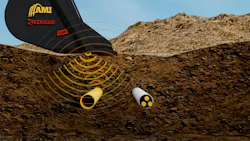
Let’s look at how integrating AI with modern GPR (ground-penetrating radar) linked to cloud-enabled subsurface mapping is making a difference. RodRadar developed the live dig radar (LDR) technology that’s being called a significant game-changer for excavation applications. So, what’s LDR and how is it related to GPR?
RodRadar’s LDR technology integrates GPR sensors directly into the excavator’s digging buckets producing real-time detection of underground facilities during trenching. It automatically identifies and warns operators of subsurface infrastructure during active excavation. Each pass of the bucket creates a new high-resolution GPR image of subsurface conditions below the bucket that’s displayed on a monitor unit located in the excavator’s cabin. It also provides visual and audio alerts, so there is no excuse for a dig-in when this technology is used. It’s a major improvement over the traditional cart-mounted GPR system.
The Changing Workplace
That’s not all either; cutting-edge technologies are being found throughout today’s construction sites. There are a new varieties of smart loaders, excavators, bulldozers, and graders improving productivity up to 30% according to specialists. They’re equipped with AI algorithms, GPS (global positioning system), LiDAR (light detection and ranging), and high-resolution cameras making them autonomous and semi-autonomous machines. They can share data, coordinate operations and respond to changing site conditions in near real-time. In addition, they perform repetitive activities like grading, digging and moving material with minimal human interaction.
These enhanced systems are also saving fuel and reducing the jobsite’s carbon footprint. Yes, zero-emission jobsites are becoming prerequisites for building permits. Remember “Charging Ahead” looked at eco-friendly concrete in August and environmental regulations pushing stricter emissions, and noise regulations. That brings up the transformation on the worksite. Heavy construction equipment is moving away from fossil-fuels toward electric construction equipment. Adoption is increasing, especially in congested urban areas where construction equipment idling all day is not welcomed.
It’s estimated that the global electric construction equipment market reached about US$13.6 billion in 2025 and is expected to hit US$16.5 billion in 2026. Decreasing battery prices and volatile diesel prices plus lower total cost of ownership for electric fleets are playing a significant role in this transformation. Yesterday’s jobsite relied on manual labor, today’s is data-drive and interconnected making them safer and efficient!
About the Author
Gene Wolf
Technical Editor
Gene Wolf has been designing and building substations and other high technology facilities for over 32 years. He received his BSEE from Wichita State University. He received his MSEE from New Mexico State University. He is a registered professional engineer in the states of California and New Mexico. He started his career as a substation engineer for Kansas Gas and Electric, retired as the Principal Engineer of Stations for Public Service Company of New Mexico recently, and founded Lone Wolf Engineering, LLC an engineering consulting company.
Gene is widely recognized as a technical leader in the electric power industry. Gene is a fellow of the IEEE. He is the former Chairman of the IEEE PES T&D Committee. He has held the position of the Chairman of the HVDC & FACTS Subcommittee and membership in many T&D working groups. Gene is also active in renewable energy. He sponsored the formation of the “Integration of Renewable Energy into the Transmission & Distribution Grids” subcommittee and the “Intelligent Grid Transmission and Distribution” subcommittee within the Transmission and Distribution committee.