Lineworkers Around the World
Key Highlights
- Lineworkers worldwide share a commitment to safety, teamwork, and community service, despite differences in work environments and standards.
- Technological advancements such as drones, GPS, and digital tools are transforming how line crews inspect, maintain, and respond to outages, enhancing safety and efficiency.
- Storm response and emergency restoration are critical aspects of the job, requiring adaptability, specialized equipment, and coordinated teamwork across regions.
- Training programs vary globally but emphasize hands-on experience, safety procedures, and progression opportunities, with apprentices often starting young and advancing to supervisory roles.
- Personal stories from RaeLynn Hawco, Liam White, Callum White, and Jimmy Marinus demonstrate the industry’s rewarding nature, the importance of resilience, and the shared goal of powering communities safely.
Over the last 14 years, Journeyman Lineworker RaeLynn Hawco has traveled across North America to work in the line trade. Along the way, she has met great people, worked in amazing places and faced new challenges that helped her to grow on and off the job site. “One of the coolest things about working in the line trade is getting to see parts of the country that most people never get to experience,” said Hawco, a power line technician (PLT) for Midlite Construction LP in Woodlands, Manitoba, Canada.
She has also discovered that at the end of the day — no matter where she is working — lineworkers have the same goal: to work safely and keep the lights on for the communities they serve.
“We work hard, look out for each other and take pride in the work we do every day,” she said. “The friendships, teamwork and sense of accomplishment that come with this trade are what make it so rewarding, and that’s something lineworkers everywhere can relate to. Being a lineworker is an incredible career no matter where you live.”
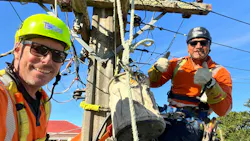
Jimmy Marinus, field team leader and “linesman” for Powerlines Hawke’s Bay Ltd. in Hawke’s Bay, New Zealand, agreed. He has been in the trade for 24 years and enjoys serving his community.
“At the end of the day, we all do the same job in different parts of the world,” he said. “Just because it looks different doesn’t mean it’s wrong or unsafe.”
While lineworkers globally go by different job titles, adhere to varying grid standards and employ diverse work practices, when you get down to it, they are all the same, said Liam White, an OHL (overhead line) engineer for National Grid in Skelton Grange, Leeds, United Kingdom. “We work hard, play hard and are top people,” he said.
White, whose son is also in the line trade, said every day is different due to varying weather conditions and job sites and locations, and he enjoys the team dynamic and bantering with the other crew members. “Working on a tower is the best office in the world, when it is not raining or blowing a gale,” White said.
Around the globe, lineworkers are constructing and maintaining infrastructure to power their communities. In the United States alone, more than 120,000 work as power line installers and repairers, according to the U.S. Bureau of Labor Statistics. In North America, the International Brotherhood of Electrical Workers (IBEW) supports 250,000 utility and natural gas workers through 433 local unions.
Here is a look at lineworkers around the world, from Canada to England to New Zealand, and how they are keeping the lights on and the power flowing for their communities.
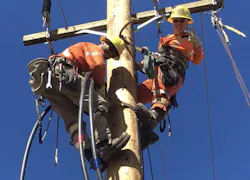
Traveling Through North America: Rae-Lynn Hawco of Midlite Construction LP
Hawco has worked in unique and challenging environments across Canada — from the mountainous winter terrain of the Yukon to the extreme weather conditions of British Columbia to the zig-zagging power line routes spanning Ontario’s countless lakes and waterways to Alberta’s oil sands.
“Each region brings its own challenges, requiring crews to adapt to different weather conditions, terrain and construction methods,” she said. “Whether it’s harsh winter conditions, remote access, difficult terrain or long hours during emergency response, lineworkers need to be prepared to respond safely and efficiently.”
She has had the opportunity to work on transmission and distribution projects and help with heli-stringing projects across Canada, where she said the future of the line trade in her country is bright. As the demand for reliable power continues to grow, she expects it to create lots of opportunities for skilled lineworkers to help build, maintain and improve the country’s electrical system.
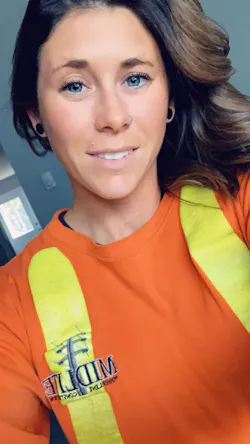
“As Canada continues to grow, so does the need for reliable electricity,” she said. “New transmission and distribution projects are being built to help power communities, industries and future developments. No matter where the project is, the goal is always the same — making sure people have safe, reliable power when they need it. For me, it’s rewarding to be part of building and maintaining the infrastructure that keeps our communities connected and running every day.”
She started out in the trade as an apprentice and then topped out as a “power line technician” or PLT. Over her four-year apprenticeship, she gained hands-on experience in the field and completed the required hours for her apprenticeship “block.” She then passed her “Red Seal” exam, which allowed her to work anywhere in Canada. “One of the best parts of the trade is learning from experienced journeymen, and now I enjoy passing that knowledge on to the next generation of lineworkers,” she said.
Another rewarding part of the trade is storm response and restoration work, she said. “I enjoy knowing that the work we do has a real impact on people’s lives by keeping the power on and communities connected. There is a tremendous sense of pride in working alongside your crew to restore power and get communities back on their feet. Knowing that your work directly impacts people’s homes, businesses and daily lives makes the long hours and difficult conditions worthwhile.”
During her career in the line trade, she has had the opportunity to respond to storms not only in Canada, but also in the United States. For example, she said one of the most memorable experiences of her career was traveling to Louisiana to help with hurricane restoration efforts. While seeing the amount of damage left behind by the storm was eye-opening, she said it was also incredible to see lineworkers from all over come together to restore power and rebuild communities.
“We worked long days in challenging conditions, but everyone was focused on the same goal — restoring power for people who needed it,” she said. “That experience taught me the importance of teamwork, adaptability and staying positive under pressure. More than anything, it reminded me why I’m proud to be a lineworker and how rewarding it is to help people when they need it most.”
From her experience working in the United States during storm restoration, she learned the job is similar, but the biggest difference is the terrain. Each area comes with its own challenges and requires different equipment and construction methods, and she has discovered a mix of wood and steel poles and transmission towers on both sides of the U.S.-Canada border.
Global Lingo for Lineworkers
In the United States, apprentice lineworkers typically complete a four-year apprenticeship program before topping out as a journeyman lineman, but in other countries, they perform the same work, but go by different job titles. Here are a few from around the world.
- United Kingdom: Linesman, Overhead Line (OHL) Craftsperson or Chargehand
- Canada: Powerline Technicians or Powerline Supervisors
- Australia and New Zealand: Powerline or Electrical Mechanic, also known as “Sparkies” or “Volties”
- France: Monteur
- Germany: Linienrichter (translates to linesman or lineswoman in German)
- Latin America: Liniero
- China: Electrical Workers (also nicknamed “Spider-Men” by the local and national media for working on high-voltage lines)
- India: Linemen, Wiremen or Power Line Technicians (they are also called “Electricity Pilots” or “Electricity Protectors”)
- Brazil: Network Electricians or Distribution Electricians
- Philippines: Linemen or Lineworkers (but also affectionately called “Warriors of Light”)
“One of the coolest parts of the trade is all the different equipment we get to work with,” she said. “Whether we’re building new power lines, maintaining existing infrastructure or responding to an outage, having the right equipment on hand is a huge part of the job. That’s one of the things I love about line work — every day is different, and there’s always something new to learn.”
She said the line trade is changing all the time, and new technology is helping her and the other PLTs to work smarter and safer. One of the biggest advancements is the use of drones for inspections, she said.
“Instead of putting workers in hard-to-reach areas, drones can quickly inspect power lines and equipment while keeping people out of harm’s way,” she said. “We’re also using better communication tools, GPS technology, digital paperwork and upgraded equipment that help crews stay connected and work more efficiently. These tools allow us to spot problems faster, plan jobs better and respond more quickly during outages and storm restoration.”
Even with all the new technology, however, she said nothing replaces good training, experience and teamwork.
“The best tool on any job site is still a crew that communicates well and looks out for each other,” she said. “Technology helps make our jobs safer and more efficient, but at the end of the day, it’s the people behind the tools who get the work done and keep the lights on.”
For example, in addition to her powerline qualifications, she also holds a crane operator apprenticeship and a Class 1 license, which has allowed her to broaden her skill set and contribute in a variety of roles across projects. At Midlite, she’s had the opportunity to work in materials, QA/QC and now Health and Safety.
Today, her key responsibilities focus on supporting crews, improving safety processes and helping to build a stronger and safer workplace.
“Moving into Health & Safety felt like the right next step for me because it gives me the opportunity to support crews and help make the job safer for everyone,” she said. “My goal is to be the safety person I wish I had when I was working on the tools as a linewoman —someone who understands the realities of the job, listens to concerns and helps crews find solutions that work in the field. No matter where my career takes me, I’ll always stay connected to the line trade,” she said. “It’s an industry I’m passionate about and one I will never leave behind.”
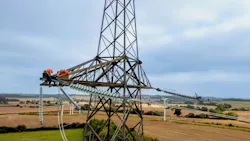
Powering the United Kingdom: Liam and Callum White, a Father-and-Son Duo from National Grid
Thousands of miles away from Canada, White has spent the last 36 years working in the line trade for National Grid in Skelton Grange, Leeds, United Kingdom. During his career, he has served as a “linesman,” SAP development engineer, OHL trainer, OHL engineer and team engineer and responded to his share of storms.
“They seem to get worse every year,” he said. “National Grid’s transmission system is built to last, but when there are emergencies, we all pull together and do what’s required.”
To safeguard the field workforce, National Grid offers annual tower rescue and First Aid training and equips its field workforce with PPE. For example, lineworkers wear helmets, steel-toe boots, orange high-vis overalls, work gloves and safety glasses. While working at height, they also don harnesses and use the Step-Safe double lanyard, work positioning lanyard and tower rescue kits.
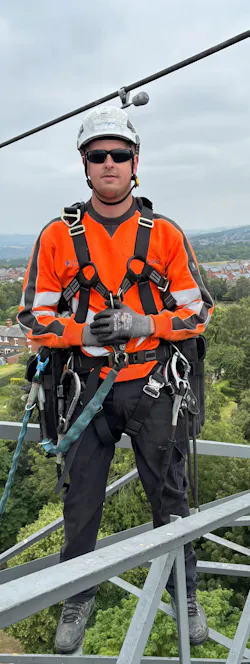
“Safety is key when you’re working next to 400 kV and 200 ft high,” he said. “We focus on team spirit, being your brother’s keeper and looking out for one another.”
Along with traditional work methods, the line crews are also learning live line and rope access techniques, and National Grid is introducing lighter equipment, improving procedures and developing more helicopter access work. “We need to adapt to new technology and then develop new procedures and introduce these into the line work safely and successfully,” he said.
In England, the line crews don’t work on DC towers or transposition towers. Instead, the lineworkers scale steel lattice structures with about 10 different design types depending on voltage and load requirements and location. For example, National Grid has 50 to 100 T-Pylons, single-column, double-circuit structures, which require mobile elevated work platform (MEWP) access.
In his service territory, £31 billion of investment in the network across England and Wales will be completed between now and 2031, and in the Yorkshire and Humber region, the lineworkers are connecting the renewable energy projects to the grid through the Eastern Green Link connections.
White, who has spent nearly four decades in the line trade, is looking forward to retiring in the near future and watching his son, Callum, progress in the trade. With nearly four decades in the trade, he plans to retire in the near future.
"I am looking forward to watching him have a long and fulfilled career, just like I’ve had, and be part of a team transforming the United Kingdom’s electricity transmission infrastructure,” he said.
Four years ago, he encouraged his son to go down the same career path and become a lineworker through the apprenticeship scheme. National Grid offers a three-year-long OHL apprenticeship program with the first year at National Grid’s training facility learning basics and fundamentals. During the second and third year, apprentices spend more time gaining on-the-job experience with their “base team.”
During his three-year OHL advanced apprenticeship, Callum learned the basics of overhead lines and spent time at the National Grid Training Centre at Eakring in Nottinghamshire, where he studied and completed a level 3 subsidiary diploma in power network while learning maintenance techniques from skilled OHL trainers.
Since he started at the utility, National Grid has shortened the apprenticeship from three years to two-and-a-half years. After completing their apprenticeship and working full-time with their base team, they can become a full-fledged journeyman lineworker, also known as a “linesman,” and earn the title of “OHL craftsperson.” Eventually, they can work up to a “chargehand,” a senior craftsperson with supervisory responsibilities, similar to a foreman in the United States.
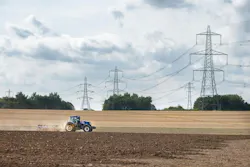
“When you become fully fledged is dependent on how much work you see and are involved in, which can vary in different regions,” Callum said. “So far, I have really enjoyed my career, especially now I am out of my apprenticeship and can continue to progress.”
He said every lineworker — whether they are up on the tower or part of a ground crew — plays a major role in making sure jobs and tasks are completed safely and to a good standard. That way, if an emergency occurs, they can act accordingly and fix damages as quickly as possible.
During storm response, as well as every day, safety in the line trade is vital, Callum said. For example, the safety rules and national safety instructions keep National Grid lineworkers safe from the system when working on or near high-voltage overhead lines. They also rely on tower and trolley rescue procedures in the event of an emergency when they need to rescue someone safely during a worst-case scenario. The lineworkers adhere to working procedures outlined in the “M1 manual,” which consists of proven and tested working procedures for daily maintenance.
To perform their work in the field, they rely on a variety of different equipment and vehicles, including trucks with a capstan winch for lifting and lowering gear. They also stock their trucks with a tower rescue kit, ropes and rope blocks, lifting equipment and site demarcation to establish a work area and danger zone. In addition, they rely on temporary, portable earthing leads called “drain earths,” available from companies such as P&B Weir Electrical and CATU Electrical, to safely discharge electrical energy to earth and protect workers from induced high voltages.
While the work can be challenging, Liam said he enjoys working outside and traveling to different places as an OHL craftsperson. He also said line work is a mentally rewarding job when he and his crew members complete work and tasks to good standards.
Over the next 15 years, he is looking forward to being a part of the major projects underway in his service territory and the construction of the “T3,” which will go on for the next five years. He also plans to progress to higher levels within OHL when the time is right.
“There are lots of opportunities for progression, and my plans for the future are to learn as much as I can and be the best lineworker I can be,” he said. “I love what I do, and I hope to have a long and successful career.”
Working in New Zealand to Competing at the Rodeo: Jimmy Marinus of Powerline Hawke’s Bay
While Liam White and his son, Callum, haven’t been to Kansas City for the International Lineman’s Week, he urged the committee to bring the event to England.
“Bring it to the UK, and we’ll show you RODEO!,” Liam said.
One lineworker from overseas who will not only attend the 2026 International Lineman’s Rodeo, but also compete, is Jimmy Marinus, field team leader and lineman for Powerlines Hawke’s Bay Ltd. in Hawke’s Bay, New Zealand.
His company, along with sponsors Wagners and Mita Consulting, is supporting their trip to Kansas City, making it the first time a team from their part of the world is competing at the International Lineman’s Rodeo.
“We had some amazing help from our sponsors, and without that help, this wouldn’t be possible,” he said. “I think it’s safe to say we will be the team who will be traveling the furthest from New Zealand to Kansas. We are looking forward to representing New Zealand on the international stage and doing ourselves proud.”
Marinus will be competing with Pomare Samupo, a lineman, and Zane Berge, who will act as a groundman. Their manager, Haden Anderson, will also be supporting the crew from the sidelines. “We’ve been quietly training for the events now for a month or so,” he said. “There’s a lot to learn and get used to as some of the work practices are completely different from how we do them at home.”
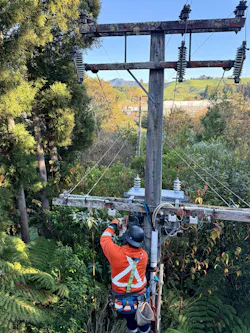
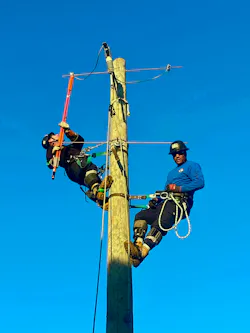
For example, in New Zealand, lineworkers scale a variety of poles, so they use a blend of bucket trucks, light 4x4 utility vehicles and ladders to get to the top.
“We drive multiple different types of vehicles to the job site,” he said. “The most common is a line truck that has a hydraulic crane on the back. It could be a 4x2 or a 4x4, and the truck gets used to drill our holes as well as stand poles and remove the old ones.”
In New Zealand, lineworkers install hardwood poles as well as those that are made from “softwood,” primarily made from sustainably grown Radiata Pine and then pressure-treated to withstand harsh in-ground and marine environments. In addition, they install new poles made from steel, concrete, fiber-reinforced polymer (FRP) and fiberglass. Marinus said lineworkers in his country are starting to see a big shift toward FRP products with companies like Wagners manufacturing poles and crossarms. “FRP products tend to be lighter, so the installs tend to be easier compared to heavier materials,” he said.
In his service territory, the lineworkers are focusing on strengthening the grid by building out infrastructure to support a huge push for renewables, especially solar. Like in other parts of the world, the crews are also focusing on storm response. As weather patterns change, so do the storms, which are becoming more frequent and sometimes more severe.
“We prepare the best we can, and once the storm hits and the dust settles, it’s all hands on deck to get the network back up and running and the customers reconnected,” he said. “No matter where you go, there is a huge emphasis on safety, and that is at the forefront of what we do.”
While Marinus has worked on many different storms, one stands out in his memory — a huge snowstorm in the central North Island in 2016. This storm took down several poles, crossarms and conductor, and one area had nearly 300 poles down.
“These jobs are always interesting as there are crews from different companies and areas working together,” he said. “It really brings out the best in the industry.”
Safety is often a top priority when it comes to storm response and the day-to-day work in the field. As health and safety evolve, so do the responsibilities on the people out in the field. “We place a big emphasis on making sure we leave the job site safe,” he said. “We make sure what work we have done is in a safe state, that the public doesn’t get hurt and what we’ve done is checked and inspected.”
International Lineman’s Rodeo: Bringing Lineworkers Together
A dozen lineworkers competed in the very first Lineman’s Rodeo in 1984 in Manhattan, Kansas. Over the last four decades, however, it has grown into a global event with more than 5,000 attendees.
While New Zealand will be participating for the first time in 2026 with a journeyman team, the Rodeo has also had long-time competitors from Canada and also participation from lineworkers from England, Jamaica, the Philippines and Ireland.
To check it out, attendees have also traveled to Kansas City from Germany, France, Russia and South Africa to investigate possible future participation in the “Super Bowl” of Lineman’s Rodeos. On the road to the Rodeo, these international competitors often participate in local and regional competitions in their home service territories.
After they top out, they often go by the job title of “line mechanic” in New Zealand, but the terms “lineman” or “linesman” get used as well, Marinus said. He said he has been in the trade for 24 years and landed in the career by luck.
“When I was in high school, a careers teacher told me about a job vacancy she’d seen in the local newspaper for an apprentice lineman at a local contracting company,” he said. “I had no idea what the job was, let alone heard about a lineman before. She helped me to create a CV and prepped me for the interview. The rest is history.”
Marinus said he’s been fortunate enough to come through the trade at a time when there was a lot of opportunity to travel. “The trade has taken me from New Zealand to the UK and Ireland to Australia as well as Fiji,” he said. “My journey has seen me go from an apprentice to a lineman, from a lineman to a foreman, then to a trainer and now a contracting company owner.”
A few of the biggest rewards of working in the line trade in New Zealand are the people in the industry, the trucks and equipment he gets to operate and drive and seeing places some people don’t even know exist.
At the same time, he said one of the major challenges facing New Zealand is staff retention. Due to the cost of living, a lot of people in the trade are looking at alternatives overseas, he said. Like in other parts of the world, the country is also experiencing advancements with AI and robotics.
While it’s challenging to predict the future for the line trade, he said he plans to enjoy it while he can. He said while line work may look different around the globe, lineworkers all have a similar mission.
“I love the trade and the people in it,” he said. “That’s why I think it’s important that what we do while we are at work is to the best of our ability in order to get everyone back home safely to their families.”
Experience the World: Overseas Opportunities to Work on the Line
American lineworkers can volunteer to work overseas through organizations such as the National Rural Electric Cooperative Association. If they are looking to work overseas, they must obtain their journeyman certification, a valid U.S. passport and a Commercial Driver’s License. They can then explore these avenues.
- Pursue contract work. Large contractors, such as KBR hire IBEW lineworkers to work in locations like the Caribbean, Middle East or U.S. military installations overseas.
- Check with your local IBEW signatory. Some signatory contractors specialize in overseas work, which can allow a member to retain their U.S. pay and benefits while traveling.
- Check job boards online. Positions are posted on sites such as ZipRecruiter, which list international power lineman jobs.
- Apply for a working holiday visa. Lineworkers under the age of 30 can apply to work directly for utilities overseas for six to 24 months, depending on the country.
- Enroll in the U.S. Army’s Prime Power 249th Engineer Battalion. Lineworkers can sign up either as active duty or reserve for Prime Power, which deploys worldwide to provide electrical power, infrastructure assessments and technical engineering for military operations or disaster relief. Consider swinging by their booth at the International Lineman’s Expo or talking to the competitors in the military division for more information.
About the Author
Amy Fischbach
Electric Utilities Operations
Amy Fischbach is the Head of Content for T&D World magazine and manages the Electric Utility Operations section. She is the host of the Line Life Podcast, which celebrates the grit, courage and inspirational teamwork of the line trade. She also works on the annual Lineworker Supplement and the Vegetation Management Supplement as well as the Lineman Life and Lineman's Rodeo News enewsletters. Amy also covers events such as the Trees & Utilities conference and the International Lineman's Rodeo. She is the past president of the ASBPE Educational Foundation and ASBPE and earned her bachelor's and master's degrees in journalism from Kansas State University. She can be reached at [email protected].