Training in the Line Trade
Key Highlights
- Approximately 45% of lineworkers are eligible for retirement within the next decade, creating a significant skills shortage.
- Utilities are investing heavily in training and education to ensure a steady pipeline of skilled lineworkers for the future.
- Pre-apprentice and apprenticeship programs are crucial in providing hands-on experience and foundational skills to new entrants.
- Technological innovations like VR, simulators, and energized training are enhancing learning and safety in lineworker education.
- Mentorship and passing on industry knowledge from seasoned workers are vital for maintaining safety standards and operational excellence.
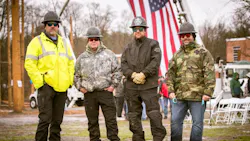
About 45% of lineworkers will be eligible to retire within the next decade, according to the 2025 State of Power Line Jobs by Lineman Central. This retirement wave, compounded by the demand for power and grid modernization, is fueling a skilled labor shortage. Case in point: this year alone, 21,800 jobs are open for lineworkers, and the demand is expected to climb by 8,5 percent in the next two years, according to labor statistics.
A “Silver Tsunami” is hitting the line trade with Baby Boomer journeymen lineworkers walking out the door with three or four decades of experience said Max Fuentes, a retired field supervisor, former training instructor for Northwest Lineman College, founder of Trade Tech and owner of Fuentes Consulting.
Training to work on the line, however, often takes thousands of hours of on-the-job training and classroom instruction. As a result, electric utilities are investing more in training and education, and pre-apprentice schools are helping aspiring lineworkers to hit the ground running in their apprenticeship programs.
“The opportunities in our industry are wide open for anyone willing to chase their dreams,” said James Alexander, senior technical trainer for Orlando Utilities Commission (OUC) in Orlando. “The power industry is in extreme need of willing and competent individuals to lead us into the next generation for our industry.”
Alexander started in his apprenticeship program 30 years ago and now he’s preparing others for a career in the line trade. He said he loves working as an instructor and inspiring and training future lineworkers. “I have a huge pride in being part of the next generation of line techs coming up by assisting them in their growth and being a part of their journey,” he said. “I feel our industry’s future depends on what we, the older guys, pass on and put into the apprentice programs across the country.”
With more lineworkers nearing retirement, line instructors are shaping America’s future field workforce. Here are the stories of four line instructors who started out their careers in the field and are now helping to train aspiring lineworkers to power their communities.
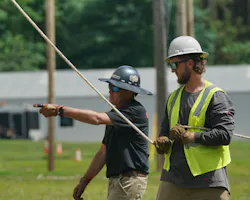
Zach Taylor: From the Field to the Training Yard
Zach Taylor, whose father worked in the line trade for 35 years, spent his career on the line before transitioning to work as a trainer for Utilitrain in Elkton, Maryland. The opportunities for today's students are growing faster than ever with aging infrastructure and advances in technology that require updates to the systems, he said.
“I try to inspire students by explaining to them that this trade is not easy, but it can be extremely rewarding — from the lifelong friends you make on the road to restoring power after a big storm.”
In 2004, Taylor wrapped up his four-year apprenticeship, and he said he wouldn’t change a thing. For him, it was the right blend of classroom training along with field work to prepare him for the long days and nights that followed. “For me, the first few weeks were a bit intimidating, but then I realized that all the time spent in the field prepared me for training the next generation of linemen,” he said. “I try to keep it pretty much the same as when I was learning because all the old guys who trained me were great trainers, and I use the same process that they taught me. “
One of the most challenging parts of training today’s students is explaining to students with no background knowledge of the trade all the career paths available to them — transmission, distribution, overhead and underground. He said without a doubt, all the advances in equipment and technology make some tasks that used to be extremely difficult much easier today. “Technology is such a big part of everyone's lives that if the classroom and training yard don't have the latest advances in technology, you risk falling behind the times,” he said.
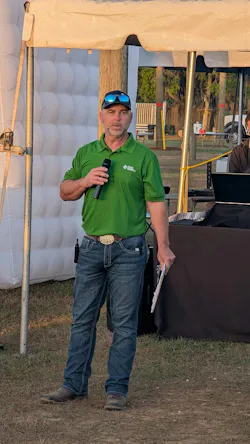
Transitioning from the Tools to the Training Center: Jason Mastin of Duke Energy
Jason Mastin launched his career in the trades as a journeyman electrician when a close friend inspired him to apply to Duke Energy Florida. While he was skeptical about starting over, it was the best decision he has made for his career, said Mastin, manager, PGO technical training.
He started out as a groundman in the line distribution department, where he worked his way to journeyman lineman after completing the apprenticeship, which typically takes about four-and-a-half to five years. He said it was a definite transition from going to the field to the training department.
“You have to adjust from outside on the go, working long hours, to a slower, more scheduled pace,” he said. “I still miss being in my tools and working with the crew from time to time.”
Since he first started in the trade, he said technology has transformed line work with more computer-based training and programs. Tools have also been improved, which has made the work a little easier for the lineworkers, he said. The biggest difference, however, is generational in that not as many young people grew up the way he and others did.
“Some of the life skills and experience working outside prior to coming into the program have changed considerably,” he said. “It just takes a little more time getting them adjusted with one-on-one time.”
He said each learner can be different when it comes to teaching them basic line skills, including how to climb a pole for the first time. “Some take to it like a squirrel, while others need that one-on-one time to help understand the fundamentals."
The introduction of the Buck Squeeze from Buckingham Manufacturing has changed the way he and the other instructors teach, he said. For example, when he started in the trade, he and the other lineworkers free-climbed without a device holding them to the pole while ascending and descending. “We only held on with our hands,” he said. “Most of the students today say they wouldn’t make it if they had to climb that way.”
While scaling the poles or learning other skills of the trade, they learn that safety is the priority, and they must work safely not only for themselves, but also for their families and coworkers, he said. “I try to help them understand that the craftsmanship of their work is a direct reflection of them. I also show them how what they do impacts their community — good or bad.”
To provide real-life training to the students, Duke Energy also conducts energized training. Recently, the utility launched a new system that puts primary voltage on the line without the risk of electrocution. The technology is also making its way into the classroom as the students no longer use books. Instead, everything is on a tablet, and they can look up their training on the company’s SharePoint.
This technology is helping lineworkers to expedite outage restoration and improve power reliability for the customer. He said the sky is the limit for the future of today’s students. “We will always have the need for power,” he said. “However it is produced, we must have the ability to get it to the customer. With the push for AI and other technology, today’s linemen have better ways to troubleshoot outages, quicken restorations and keep the grid operational.”
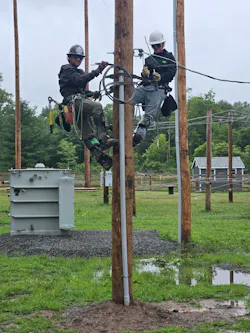
Bill White: Moving from the Electrical Trade to Line Work
Another electrician who moved into line work and the world of training is Bill White, an instructor for Lineman Institute of the North East (L.I.N.E.) in Kingston, New York. He was the first one in his family or friend group to be a lineworker. He started out his career as an electrician, so most of his interactions with lineworkers involved house services.
“To be honest, I don’t think I had a complete picture of what a lineman did,” he said. “I came off the street into the local utility in my area, and the training had a real ‘Boot Camp’ feel to it. It was — you can do it, or there’s the door. This was also still in the days when linemen free-climbed, and that sent a lot of guys walking. I quickly started to question what I had gotten into. I could tell right away that this was unlike anything I had done before.”
When he topped out as a journeyman, however, he became an instructor for his company’s apprenticeship program, so he was accustomed to training lineworkers. Once he started full-time at the pre-apprenticeship school, however, it became his sole function. Today, he spends most of his time with his students reviewing fundamental skills used in the line trade.
For example, for the first few weeks, he and the other instructors focus on proper climbing form, so the students learn how to climb the poles with locked legs, trust their equipment and adjust fall restraint belts. In many cases, students can get over-reliant on fall protection and get away from proper technique, he said.
“We know if properly adjusted, students won't fall to the ground, and a lot of them will develop bad climbing habits that they can get away with for a time,” he said. “I've often heard students say, ‘I only cut out once today.’ The point is not to cut out at all, so we need to constantly reinforce proper form.”
To drive this point home, L.I.N.E. has a free climb pole with a harness and tether in the training yard. That way, the pre-apprentices can get a feel for relying only on their technique to keep them on the pole. By learning how to climb a pole before they start an apprenticeship program, it puts his students ahead of the game, White said.
“They come in with a basic foundation in line work,” he said. “They have a long way to go for sure, but they can essentially be put to work on day one. When I started, line schools were unheard of if they existed at all.”
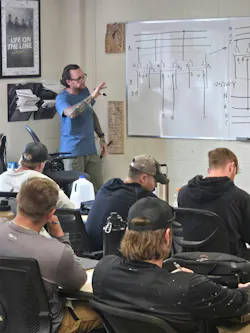
At L.I.N.E., the instructors take a real-world approach by limiting the classroom time to explanations of the electrical system, theory and transformers. They then introduce bigger concepts in the field they may not be able to do on the property, like helicopter transmission work. The bulk of their time is spent in the training yard.
“Most students are hands-on learners, and so is this trade,” he said. “At L.I.N.E. we want them setting poles, running wire, hanging transformers and secondaries — because that's the job. Taking the time to introduce and understand concepts is necessary, but eight hours in a classroom to us, is not realistic.”
He said there are tremendous opportunities in the power industry. As such, the instructors push students to take every part of the course seriously and realize that resumes, interviews, applications and follow-up are all instrumental parts of securing a career.
“To be able to secure a career that has steady work and pays well is huge in today’s world,” he said. “We always explain that there are many rewarding careers at any utility, not just overhead line. It is also a competitive market.”
He said the line trade is unlike any other, and a lineworker’s personal safety and the safety of brothers and sisters in the trade is paramount.
“The skills you learn and eventually master are a huge part of this,” he said. “We have to be on top of our students to understand this. Something as simple as tying a knot can make the difference between going home at the end of a shift or getting yourself or someone else injured. We want them not just to learn these skills because it’s part of the program, but to understand the importance of them in everyday work on the line.”
These skills could also be the deciding factor in landing a job, he said.
“If you come out of a school like ours, go to an orientation and climb with say, bent knees or can't tie a knot, it's not going to look good to say the least,” he said.
Pre-apprenticeship schools provide a great opportunity for lineworkers to pass on their knowledge and experience to the next generation, he said. He said they have definitely changed the industry and provide benefits to both unions and utilities.
“The more of our graduates who enter the field, the more companies come to us with positive feedback,” he said. “For linemen who may be interested in becoming an instructor, I can tell you that it is extremely rewarding. There are very few things like watching a student with fear in their eyes on day one, helping them through the program, graduating with confidence and then getting a call that they landed a job.”
White said one of the biggest challenges for line instructors is to get students to understand that the line trade is unlike any other on the planet.
“It is not just a job, but a lifestyle,” he said. “Nobody has to deal with the danger, the hours, and the weather like linemen. Many students don't realize how challenging this trade can be, especially when they are first starting out.”
One of the best ways he and the other instructors have discovered how to deal with this issue is to push the students through one day at a time.
“You also need to remind them of their progress — from day one, when they can barely take a step up the pole, to day two or three when they’re at the top,” he said. “As the days go on, if you can remind them of their progress, it helps to build confidence.”
James Alexander: Instructing Apprentices in Florida
Alexander’s cousins and family friends worked in the line trade, and they introduced him to the industry. In 1996, he started in the apprenticeship program, which at the time lasted for eight to 10 years and focused on overhead, underground, transmission, and trouble work. Because OUC needed journeymen, he was fortunate to test early and topped out in seven-and-a-half years.
Now with OUC in Florida, he can train other lineworkers and gain computer skills. When he first started in the training department, he said the computer work was extremely intimidating, but because OUC has a good ratio of classroom and field work, he was able to quickly adjust.
For example, Altec teamed up with a tech company and is building the software around their products and controls, and OUC is getting realistic simulators that align with the needs of line work.
“There have been huge advancements in the world of training, such as AI and VR,” he said. “I don’t think anything beats real-world experience; however, new technology is just about as good in some cases. We are hopeful this technology will allow us to create and monitor many real-life situations that we can provide to the students where otherwise they may not get in training.”
Along with teaching the apprentices about new technologies, however, they also learn the hands-on skills of line work. While he said today’s world is at your fingertips, learning the skills of line work is not an instantaneous process.
“We guide our students by working beside them and doing the tasks over and over again until they are comfortable and display proficiency in their work,” he said.
Case in point: he and the other instructors teach the basics at ground level by allowing the students to develop trust in their equipment.
“Once the student trusts their tools, they are far more comfortable performing at heights,” he said.
Josh Hanawalt: Training in Texas
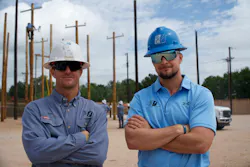
For our final line instructor, we are moving from Orlando to the Hill Country of Texas, where Josh Hanawalt works as the technical training manager for Pedernales Electric Cooperative. Hanawalt, who was recently a guest on the T&D World Line Life Podcast, has been in the trade for 21 years and supports his cooperative’s apprenticeship program, which is an 8,000-hour, four-year endeavor.
For the last three years, his cooperative has honored the top apprentices through an “Apprentice of the Year” program based on acts of service, scores on assessments, character and performance in the field.
“We have more than 150 apprentices enrolled at our cooperative, and the training is demanding, and there are a lot of character-building moments over the four years,” he said. “We developed this award as a way to celebrate and recognize them.”
For 2026, the cooperative selected Benjamin Kent as its top apprentice out of nine finalist apprentices, chosen from PEC’s vast 8,100-sq-ft service territory.
“Typically, our apprentices come in ranging from 18 years old to 22 or 23, and Ben had a little more life experience,” he said. “During the climbing school, he walked up to me and said, ‘Man, this is going to be pretty tough.’ I was like, ‘You got this.’ Here we are four years later, and during that time, he exuded a lot of integrity and passion about strengthening others he worked with. He had a real sense of purpose about him.”
PEC established its apprenticeship program in 2012 and began partnering with Northwest Lineman College two years later to take a hands-on approach to training.
“Our instructors have a mantra of teaching others and not just telling them by demonstrating first and then evaluating them and following up,” he said. “Everything is hands-on at eye level here. We have a really great facility that our board of directors and leadership have invested in heavily, and it’s paying off dividends to where when people show up, they say, ‘Wait. Is this just for practice?”
PEC delivers non-energized training most of the time but can energize the yard for certain parts of line work training, which is crucial given the increased growth of Austin and heightened demand for power, he said. For example, PEC is looking at installing double the number of meters in the next five to 10 years that it installed during its entire more than 85 years in existence. When he first started at the cooperative two decades ago, PEC had about 150,000 to 200,000 meters and is now coming up on the 500,000-meter-mark, he said.
“Living here in Austin in this Hill Country area — everyone’s moving here,” he said. “I feel like there’s a ton of growth of businesses that are moving this area, and they’re demanding reliable, safe power from our linemen.”
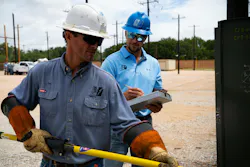
Oftentimes, customers don’t realize how much they value having the power on until it’s gone, he said. As a result, it’s a necessary requirement for the instructors at PEC to be able to demonstrate their live-line skills in a controlled environment. When he was training as an apprentice at the cooperative, he didn’t have the opportunity to experience the hands-on training, he said.
“It was kind of ‘see it once and then try to replicate it,’” he said. “Here you show up for two weeks at a time within a year, if not more, to evaluate and assess where you’re at within the program.”
During the climbing portion of the program, apprentices learn how to get their feet underneath them, go up the pole and find their rhythm.
“There’s a process in which you start trusting your gear, and then the next thing you know, you’re on the top of a 40-ft structure all the way up to 8,500 ft and beyond,” he said.
During the first year, apprentices learn how to climb, and the second year, they focus on learning about the transformers and grounding and the foundational tools of the trade. During the third year, they gain a hot-line glove certification, and by the fourth year, they are trained on how to operate the system, handle system protection and then lead crews.
“We don’t expect our apprentices to know everything, but it’s important for them to have some humility, determination and be able to work well with others, especially in the worst of conditions when you’re probably lacking sleep and not having the mental bandwidth and then having to go home and rinse and repeat.”
He said he has enjoyed helping with PEC’s in-house apprenticeship program for the last six years and working with the supporting staff at PEC.
“This is a brotherhood, and it gives you a sense of purpose at the end of the day to know you’re part of something bigger,” he said. “I’m blessed for the opportunity to be here and work with people like Ben every day.”
Ten Tips for Lineworkers Looking to Transition to the Training Yard
After working in their tools on the line, lineworkers sometimes move into the training department at their own company or work for a training program or line school. Here are some best practices from those who have made that transition.
- Be patient. Sometimes today’s successful instructors need to step back and realize they were once young students themselves, said Zach Taylor of Utilitrain.
- Focus on climbing fundamentals. When they students first learn how to climb a pole, Taylor trains them to instill a sense of trust in their gear and their fundamentals. Also, he said instructors should consider scaling the poles along with their students. “It helps to show them you are not asking them to do anything you wouldn’t do,” he said.
- Understand that students have varying levels of experience and diverse backgrounds. For example, Bill White of the Linemen Institute of the North East has students who have a mechanical background and are looking for a career change, and others who may be straight out of high school and have never used a screwdriver. He said he doesn’t care either way. “I will spend the time to teach anyone as long as they are engaged and willing to learn,” he said. “I think if you’re looking to make the transition to a school like ours, linemen need to understand that the students are not apprentices yet. We help them to build skills they will use to obtain jobs in the fields.”
- Explain the real-world applications of the skills in the program. “We want them not just to learn these skills because they are part of the program but understand the importance of them in everyday work on the line,” White added. “They need to always be reminded that everything instructors tell them or show them—whether it is here or in the field—has a reason behind it.”
- Highlight safe work practices. “This is a trade like no other, and safety of yourself and your brothers and sisters on the line is paramount,” White said.
- Be open-minded, creative and hard working. Also, Alexander said line instructors should be present and available to their students throughout their training program.
- Work closely with the students to ensure they understand each task. “Everyone learns in different ways, and line work takes the right person who is willing to take the time to learn and master the craft,” Alexander added. “We guide our students by working besides them and doing the tasks over and over until they are comfortable and display proficiency in their work.”
- Be confident in your abilities first. Jason Mastin of Duke Energy said it works best if you train in the field you have worked in.
- Get proficient in public speaking. You will need to be in front of students in a classroom and training center environment, and you need to feel comfortable speaking in front of a group.
- Continue to learn as you teach. It is important to be ahead of the changes as an instructor in the line trade, Mastin said.
Safety in the Line Trade: Advice for Aspiring Lineworkers to Stay Alive on the Line
After working in the field for decades, Maximo Fuentes retired from the line trade and now serves as an expert witness in trials involving lineworkers. He said he is seeing more catastrophic events, especially those involving lineworkers aged 25 to 37.
“I’m seeing some very disturbing trends going on in our trade with a lot of injuries and fatalities,” he said.
From his years of experience as both a journeyman lineworker, instructor, supervisor and expert witness, he offered these best practices for aspiring lineworkers just stepping into the trade. For more information, listen to his interview for the Line Life Podcast at linelife.podbean.com.
1.Focus on climbing mechanics. In the old days, when he and other lineworkers used to free climb, they had a way of recovering if they gaffed out while climbing a pole. Today as an expert witness, he is hearing about lineworkers, even with the pole restriction devices, falling 20 or 30 ft or completely off the pole.
“I never experienced that in my 20-plus years in the field and teaching pole climbing, so there’s a problem out there,” he said.
Also, he said apprentices are often taught to look at their feet when they climb, but oftentimes, the choking device is choked so hard they can’t get their bodies into proper position on the pole.
2. Learn how to stop a fall. Back in 2015, the Occupational Safety and Health Administration (OSHA) began requiring lineworkers to stay continuously attached to wood poles while climbing or changing positions. He said you can engineer safety into certain manufacturing processes, but on human skills, behaviors and actions, it’s hard to make a mechanism that is foolproof.
For that reason, he advised line schools to encourage their students to avoid cutting out 6 or 8 ft down the pole if possible.
“They’re trusting their equipment so much, they’re not taking the step to stop the fall,” he said. “We used to make sure our gaffs were close to the pole and would push against the pole if both feet cut out or we would grab our belt and choke it ourselves,” he said. “This initiated the correct reaction to that event. Now they’re being taught, ‘Hey guys, don’t worry about it. The equipment will save you.’”
While students won’t completely fall off the pole if they drop 8 ft wearing fall protection, they can compress their spine or hips, and if they fall back into their gaffs, they can impact their knees. “In the old days, if you cut out, your reaction was so fast that I don’t recall anyone actually falling more than 2 or 3 ft,” he said.
3. Wear the proper personal protective equipment (PPE). “It’s so frustrating to watch these line hands go out and they don’t use the proper PPE or cover up enough,” he said. “The issue is they are wearing rubber gloves and have sleeves on and the bucket truck is insulated and isolated, but they won’t throw enough cover up on.” Even if they are working in an insulated bucket truck, they should also focus on proper rigging and applying jumpers correctly, he said.
4. Be careful when traveling for line work. Fuentes has noticed a lot of lineworkers traveling to California because there’s a lot of overtime due to wildfire mitigation and system upgrades, but oftentimes, they will have to work in congested urban areas with narrow alleys that can fit an 80-ft bucke truck or a huge line truck, he said.
“If you take a guy from a very rural area in the middle of the country and you stick them in downtown Los Angeles, where the infrastructure is 70, 80 or 100 years old, and you can only use one bucket truck and you’re in an alley, there’s a lot of challenges to overcome,” he said. “It doesn’t mean you are bad at what you do. It means this is a whole new paradigm. Line work is a diverse and complex job.”
5. Speak up if you see an unsafe work practice and stand up for safety. Years ago, when working for a contractor, Fuentes remembers coming home to his wife and telling her, “I’m not going to let them kill me.” He stressed to his supervisor that he was one of the most productive members of the crew even if he took the time to inspect rigging and the equipment and use more cover. Eventually, he gained his trust and respect, and in the meantime, he was able to work safely in the field.
6. Take advice from the experienced or retired lineworkers. Try to preserve their institutional memory from decades of experience in the field and consider inviting them to safety meetings to share their lessons learned.
About the Author
Amy Fischbach
Electric Utilities Operations
Amy Fischbach is the Head of Content for T&D World magazine and manages the Electric Utility Operations section. She is the host of the Line Life Podcast, which celebrates the grit, courage and inspirational teamwork of the line trade. She also works on the annual Lineworker Supplement and the Vegetation Management Supplement as well as the Lineman Life and Lineman's Rodeo News enewsletters. Amy also covers events such as the Trees & Utilities conference and the International Lineman's Rodeo. She is the past president of the ASBPE Educational Foundation and ASBPE and earned her bachelor's and master's degrees in journalism from Kansas State University. She can be reached at [email protected].