NYPA's Decade-Long Journey in Advancing Energy Storage Technologies
Key Highlights
- NYPA has tested a variety of energy storage technologies, including thermal, lithium-ion, zinc-alkaline, and mobile battery systems, to improve demand management and grid resilience.
- The utility collaborates with universities, private companies, and government agencies to demonstrate innovative storage solutions, such as crushed-rock thermal storage and fire-safe batteries.
- Safety best practices, including expert involvement, fire protection, and emergency response planning, are integral to NYPA’s demonstration projects to protect communities and ensure system reliability.
- NYPA’s projects support New York’s ambitious goal of deploying 6 GW of energy storage by 2030, facilitating renewable energy integration and decarbonization efforts.
- Statutory authority granted in 2023 enables NYPA to develop, own, and operate large-scale renewable and storage projects, positioning it as a key player in New York’s clean energy transition.
The New York Power Authority (NYPA)’s path to energy storage kick-started more than a decade ago, fueled by New York State’s renewable energy goals and its vision of a thriving, resilient New York powered by clean energy. Since then, NYPA has tested new and emerging technologies and advanced several energy storage demonstration projects. Today, the utility is not only leading its own energy transition in New York but also inspiring others to explore energy storage opportunities nationwide.
“As one of the nation’s largest public utilities, NYPA is perfectly positioned to take a leading role in energy storage,” said Steve Wilkie, director, research and development for NYPA.
For example, back in 2017, NYPA was already investigating energy storage through a demonstration project pairing a crushed-rock thermal energy storage unit with a combined heat and power unit. This research focused on allowing excess thermal energy to be stored and used later to boost the system’s overall efficiency and performance. NYPA then helped launch a project demonstrating advanced lithium-ion battery technology to show how energy storage influences demand management and peak shaving in commercial buildings.
NYPA now has many New York State energy storage projects underway, ranging from a mobile battery energy storage unit that could replace portable diesel generators to a long-duration battery using an alternative to lithium-ion technology. These clean energy storage demonstration projects validate the various technologies and illustrate how they can be safely and effectively integrated into communities throughout the state.
“Through collaborations with universities and private energy storage tech companies, we’re working to show the key role energy storage can play in helping New York integrate renewables into the grid more efficiently,” Wilkie said. “We’re also ensuring our grid is reliable, resilient and prepared for increasing energy demands.”
Leveraging Rocks for Thermal Energy
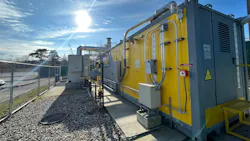
NYPA and Brenmiller Energy collaborated on a project, partially financed by a grant from the Israel-U.S. Binational Industrial Research and Development (BIRD) Foundation, that became operational in 2024. The system, which is still in the demonstration phase, features a Brenmiller bGen Thermal Energy Storage (TES) unit paired with a combined heat and power microturbine and equipped with electric heaters to produce supplemental heat during peak demand periods. NYPA is testing the system at Purchase College in Purchase, New York, to supply heating and cooling for specific buildings.
“The thermal energy storage system essentially uses crushed rocks to store heat from the combined heat and power unit exhaust,” Wilkie said.
The system can also heat the storage media to 1,000° F via internal heaters and store it until it is ready to be discharged on demand as hot water. It aims to effectively manage varied thermal demands throughout the day and across seasons. The system may be a viable option for other institutions seeking to reduce carbon emissions with an innovative storage technology.
It recovers the wasted energy normally released into the environment, creating an efficient system that meets nearly 100 percent of the heating needs of the college’s physical education building. It also enhances energy efficiency and helps to reduce operational costs.
Investigating Fire-Safe Technology
Another project underway is exploring how to ensure a stable energy supply during periods of high demand and in extreme weather conditions. As part of its research, NYPA is investigating an alternative to lithium-ion battery technology to assess load management and on-site resiliency. For this pilot, NYPA will test rechargeable zinc-alkaline battery technology that is not prone to thermal runaway.
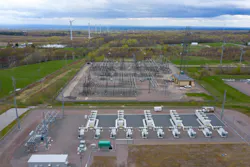
This technology was originally developed through an ARPA-E GRIDS grant at the City College of New York, leading to the formation of the Urban Electric Power (UEP) company in 2012. NYPA is collaborating with UEP on a 600-kW battery with 3.6 MW hours of energy storage to be deployed in upstate New York.
Third-party testing has been performed on UEP’s battery technology in accordance with UL 9540A, the Standard for Test Method for Evaluating Thermal Runaway Fire Propagation in Battery Energy Storage Systems. Initial testing has shown that the batteries did not reach thermal runaway when subjected to external heating and other specified initiating methods. Further, the deployment will be certified in accordance with UL 9540, a comprehensive standard for Energy Storage Systems (ESS) that covers the entire system, including its design and fabrication.
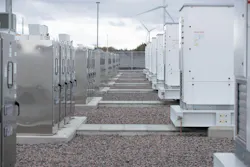
“This rigorous testing ensures the overall safety of the system by addressing electrical, mechanical, thermal and fire hazards, and will enable us to present this technology as a potential benchmark for safety and performance in the industry,” Wilkie said.
Testing Mobile Battery Storage Systems
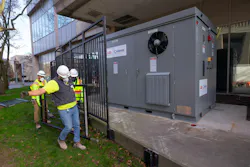
In addition to its stationary energy storage investigative efforts, NYPA is also collaborating with Cornell University and the Electric Power Research Institute (EPRI) to explore mobile battery energy storage systems (MBESS) as a possible alternative to portable diesel generators, which are often noisier and a source of pollutant emissions.
Unlike stationary storage systems, MBESS can be temporarily deployed to off-grid sites to provide temporary power for remote sites, public gatherings and off-grid operations. In emergencies, the mobile units can supply critical backup power for shelters, medical facilities and communications.
The unit being demonstrated at Cornell is being kept at the Ithaca, New York, campus, where it can be charged and available for field deployment. As part of the study, the unit will be primarily used for large-scale campus events where electrical infrastructure is not readily available, and noise from a portable diesel generator and exhaust fumes are major considerations. NYPA funded the research project and engaged Cornell’s Atkinson Center for Sustainability and the Facilities and Campus Services Office to host the demonstration.
Spotlight on Five More NYPA Energy Storage Projects
In 2018, NYPA developed its first battery energy storage project in the Northeast — a solar-plus-storage demonstration project in New Paltz, New York. NYPA managed the project, which was supported by the Electric Power Research Institute (EPRI), NYSERDA and Central Hudson Gas and Electric and hosted by the State University of New York at New Paltz.
A team installed 217 KW of rooftop solar photovoltaic arrays on the gymnasium and library, integrated with a 100 kW/200 kWh battery energy storage system and smart inverters to create a microgrid. While the PV arrays generate electricity during the day, the battery system stores solar energy to reduce reliance on the grid during peak demand times. In addition, it provides backup power for the gymnasium, serving as a community emergency response shelter during power outages.
Here are some other projects where NYPA has supported investigations and demonstrations related to energy storage technology.
- The 20 MW/20 MWh Northern New York Energy Storage project is used as a testbed to assess other investigative tools, such as monitoring equipment.
- A Cadenza Innovation lithium-ion pilot project spotlighted first-of-its-kind technology to showcase the role that energy storage can play in enhancing demand management and peak-shaving in commercial buildings.
- NYPA plans to develop and demonstrate a 100 kW/1 MWh zinc-air energy storage system at the University at Buffalo.
- The utility is looking for a site to demonstrate an aluminum-air technology enabling the generation of clean energy from aluminum, a solid, inert and fully recyclable alternative fuel with zero emissions.
- NYPA is demonstrating a flywheel-based energy storage system paired with a DC fast charger at Clark Energy Center in Marcy, New York, to investigate areas where electric vehicle fast charging is desirable but are otherwise load-constrained.
Focusing on Future Plans
Because storage is essential to a decarbonized grid, NYPA will continue to pursue pilot projects that advance grid transformation and support customer needs, with support from federal and state partners such as the New York State Energy and Research Development Authority (NYSERDA). By 2030, New York aims to deploy 6 GW of energy storage to decarbonize its power sector and improve energy resilience.
“Energy storage is a vital component of New York State’s clean energy transition,” said Chris Hutson, SVP, NYPA Development. “It enables the integration of renewable energy sources, enhances grid stability and supports the state’s clean energy goals. The state’s Energy Storage Roadmap provides a clear strategy to achieve New York State’s ambitious energy storage targets. “
Four Best Practices for Enhancing Safety During Demonstrations
To integrate energy storage while safeguarding communities, NYPA is following these best practices during its demonstration projects.
- Involve subject matter experts (SMEs) during the design and engineering phase.
- Focus on the inclusion of appropriate fire protection systems and features.
- Develop an emergency response plan for energy storage facilities that ensures the availability of an SME in the event of an emergency.
- Conduct site-specific training for local first responders and fire department personnel, as well as periodic refresher training.
To this end, NYPA has been involved in investigating multiple energy storage technologies and demonstrations to support the state’s clean energy transition. These efforts aim to evaluate emerging storage technologies, enhance grid reliability and integrate renewable energy sources.
For example, in 2023, NYPA was granted statutory authority to develop, own and operate renewable energy and energy storage projects. NYPA can now directly develop large-scale renewable energy projects to fill gaps in private sector participation, own and manage energy storage projects to enhance grid stability and integrate renewables and prioritize equity-focused projects benefiting disadvantaged communities.
“This authority positions NYPA as a key driver in achieving New York’s zero-emission electricity goal by 2040,” Hutson said.
About the Author
Amy Fischbach
Electric Utilities Operations
Amy Fischbach is the Head of Content for T&D World magazine and manages the Electric Utility Operations section. She is the host of the Line Life Podcast, which celebrates the grit, courage and inspirational teamwork of the line trade. She also works on the annual Lineworker Supplement and the Vegetation Management Supplement as well as the Lineman Life and Lineman's Rodeo News enewsletters. Amy also covers events such as the Trees & Utilities conference and the International Lineman's Rodeo. She is the past president of the ASBPE Educational Foundation and ASBPE and earned her bachelor's and master's degrees in journalism from Kansas State University. She can be reached at [email protected].