The Data Center Surge Is Here; So Is Wildfire Season
Key Highlights
- Data center energy consumption in the U.S. is projected to reach up to 580 TWh by 2028, significantly increasing load on aging utility infrastructure.
- Over 180 million wood utility poles in the U.S. are vulnerable to failure and wildfire ignition, especially under climate stressors like wind and drought.
- Innovative composite wrapping systems enable rapid, large-scale pole hardening without service interruptions, offering a cost-effective wildfire mitigation strategy.
- AI tools such as machine learning and satellite imagery are used to monitor fire risks, but they depend on hardened infrastructure to be fully effective.
- Utilities must integrate AI risk prioritization, physical hardening, and validated performance data to meet regulatory deadlines and protect communities before the 2026 fire season.
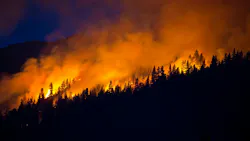
As data centers continue to drive unprecedented energy demand fueled by the rapid expansion of artificial intelligence (AI), pressure on aging utility infrastructure is intensifying. This surge in load comes at a time when climate risks are escalating, making grid resilience more critical than ever. With wildfire seasons growing longer and more severe, utilities face a dual challenge: meeting rising power needs while safeguarding systems against heightened environmental threats. Heading into 2026, the urgency to modernize infrastructure, enhance grid reliability, and strengthen wildfire preparedness has never been greater.
The 2025 wildfire season opened with a brutal reminder of what is at stake. The January Los Angeles fires caused billions in damage and took lives, with utility infrastructure once again under scrutiny as a potential ignition source. As the 2026 fire season approaches, utilities across the western United States face a compounding challenge: the grid is being asked to do more than it was ever designed to do, at precisely the moment when the consequences of failure are most severe.
The driver behind much of that new pressure has a name: artificial intelligence.
A Demand Curve That Changes Everything
Data center energy consumption in the United States nearly doubled between 2018 and 2023, climbing from roughly 76 TWh to 176 TWh annually. Projections suggest that figure could reach 325 to 580 TWh by 2028 (potentially 6 to 12 percent of total national electricity consumption) as hyperscalers race to build out AI infrastructure. The U.S. is planning to add 86 gigawatts of utility-scale generation capacity in 2026 alone, the largest annual expansion in decades.
That buildout is reshaping load patterns in ways transmission and distribution infrastructure was not designed to handle. A Stanford Woods Institute analysis put it plainly: America's energy infrastructure is not ready for what's coming. PJM Interconnection, the largest grid operator in the country, projects it will be six gigawatts short of its reliability requirements by 2027. Sensor data from more than 700,000 homes suggests that power quality is already degrading in areas near major data center clusters, a pattern that stresses downstream equipment and raises the risk of fault-related ignition events.
For utilities managing aging distribution infrastructure in high fire-risk areas, this is not an abstract concern. Overloaded lines, aging transformers, and poles carrying loads they were not rated for generate more heat, more arcing faults, and more potential ignition points. The same climate conditions that have made wildfire seasons longer and more destructive also increase the mechanical stress on poles and conductors through wind, drought-driven ground movement, and pest pressure on wood structures.
The Infrastructure Gap in the Field
Utility poles are the often-overlooked linchpin in wildfire risk. There are approximately 180 million wood utility poles in service across the United States, and many are decades old. Poles weakened by woodpecker damage, moisture intrusion, fungal decay, or years of loading at the base don't just fail structurally; they represent a compounding wildfire vulnerability. A wind event that downs an energized conductor onto dry vegetation can trigger a catastrophic fire. Both the 2018 Camp Fire and the 2025 Los Angeles fires have kept that risk front of mind for regulators and utility executives alike.
The challenge is scale. Utilities serving high fire-risk circuits may have tens of thousands of poles that need hardening before fire season. Full pole replacement (the traditional answer) is costly, slow, and requires permitting and service interruption. With regulatory deadlines tightening and fire seasons arriving earlier, that approach simply cannot keep pace.
Field-Ready Hardening Solutions
A new class of composite wrapping systems is emerging to address this gap. Rather than replacing poles outright, these solutions install directly around existing poles in the field, forming a durable barrier against flame, moisture intrusion, and structural degradation with no service interruption or specialized site preparation required. Designed for large-scale deployment, they allow utilities to harden high fire-risk circuits on a timeline that aligns with regulatory mitigation deadlines.
Third-party performance validation is increasingly important for compliance purposes, and several products in this category have pursued independent testing. Evaluations conducted under standards designed specifically for utility poles exposed to wildfire conditions subject poles to temperatures up to 1,840 degrees Fahrenheit with fan-applied airflow to simulate actual wildfire heat and wind dynamics. Structural testing conducted per ASTM and ANSI standards has demonstrated reinforced poles withstanding up to three times more load than unreinforced poles, which is significant given that wind-driven failures (not flame contact alone) are a primary mechanism through which distribution infrastructure ignites fires.
Critically, the most effective systems preserve pole climbability, a practical requirement for ongoing maintenance access that rules out some alternative approaches. At a fraction of the cost of full pole replacement, composite wrapping represents a scalable option for utilities trying to harden large numbers of poles without exhausting capital budgets already stretched by grid modernization demands.
AI as Both Problem and Tool
There is a certain irony in the current moment: the same technology accelerating energy demand is also being deployed to manage the wildfire risks that demand helps create. Major utility companies are using machine learning and computer vision to monitor fire conditions, prioritize vegetation management, and trigger automated line de-energization. The U.S. Department of Energy FireMap tool combines satellite imagery, weather data, and machine learning to characterize wildfire fuel conditions and model risk to grid components at a circuit level.
These tools are valuable, but they are most effective when the underlying infrastructure has been hardened. AI-driven monitoring can identify when a pole is at risk; it cannot compensate for a pole that fails before an alert is acted upon.
... the same technology accelerating energy demand is also being deployed to manage the wildfire risks that demand helps create.
What the 2026 Season Demands
The convergence of accelerating energy demand, aging infrastructure, and earlier, more intense fire seasons means utilities cannot afford to treat wildfire preparation as a seasonal project. Regulatory scrutiny is intensifying, with California's Office of Energy Infrastructure Safety and counterparts in other western states pushing for documented, measurable mitigation outcomes. Utilities face real financial exposure when infrastructure is implicated in fire causation.
The most defensible posture heading into 2026 combines three elements: AI-assisted risk prioritization to identify the highest-exposure circuits and assets; structural and fire hardening of the poles and lines most likely to fail or ignite; and documented, third-party-validated performance data to support regulatory compliance.
The window before peak fire season is narrow. The utilities best positioned for what is coming are the ones acting on that reality now.