10 Ways to Protect the Grid Against Wildfires and Storms
As climate change-driven natural disasters become more prevalent and intense, it is now more than ever crucial for utility companies to be prepared for severe storms and wildfires. According to the National Centers for Environmental Information, 61,685 wildfires burned more than 8 million acres of land in the United States alone.
Dr. Yuhsin Hawig, vice president of applications engineering at Southwire, gives insight into the products and solutions utility companies can use to protect themselves against wildfires.
1. Perform strategic undergrounding.
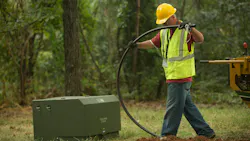
Utility owners have confirmed that burying or undergrounding power lines is the most effective way to prevent them from becoming fire hazards in high-risk wildfire areas. This can help decrease power outages during storms and disasters, prevent wildfires from occurring and make it easier to upgrade your grid.
2. Review the top attributes to design the most resilient underground primary distribution system.
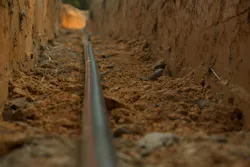
The medium-voltage primary distribution system ranges from 5 kV to 46 kV. Twelve attributes, including conductor sizing, metal stranding, water-blocking, insulation, shielding and jacketing materials, can be used to design the most robust underground system.
3. Consider cable-in-conduit (CIC) solutions.
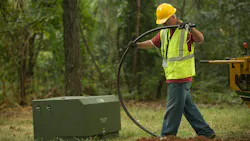
Recent widespread power outages caused by natural disasters have expedited the hardening of our electrical grid. This can be accomplished in several ways, including converting critical overhead lines to a below-grade network via cable-in-conduit (CIC) solutions. Additionally, above-ground circuits like airport lighting, residential secondary circuits, PV wires for power solar farms and primary cables feeding mega data centers, can be converted into CIC assemblies directly buried in the ground or encased in concrete.
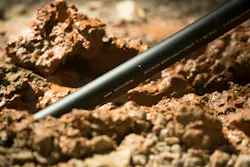
Pulling a single reel containing cables protected by an impact-resistant high-density polyethylene (HDPE) duct saves labor, shortens installation time and prevents field injuries due to an all-in-one material handling system. CIC is more robust than direct-buried cables, extending service life, lowering cable replacement frequencies and lessening outage interruptions. It is also a proven solution for minimizing or delaying the damage caused by brushfires.
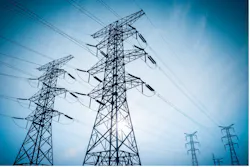
4. Replace bare overhead conductors.
If undergrounding is not feasible due to time permitting for right-of-way (ROW) and budget constraints, then bare overhead conductors can be upgraded to covered conductors (also known as tree wire) to minimize arcing in drought regions. The three-phase bare conductors can collide with one another in windy conditions, potentially triggering sparks. Replacing bare wires lessens the burden of vegetation management and reduces the fire risk.
5. Implement an arc mitigation solution using covered conductor or tree wires.
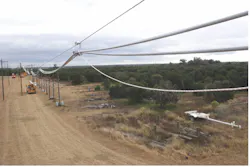
Southwire offers Covered Aerial Medium Voltage (CAMV) solutions to upgrade bare overhead conductors to mitigate wildfire ignition in areas where trees crowd the ROW. The ruggedized crosslinked polyethylene covering (XLPE) over the bare conductor has been proven to prevent arcing and flashovers.
Wildfires with high-temperature flames char the outer covering and thermally deform the inner conductor, which is strung under tension and is the weight-bearing component. Southwire also offers comprehensive forensic testing at its ISO-accredited R&D technology center to evaluate the physical and chemical characteristics of the extruded polymer layers and the mechanical performance of the conductor, helping utility customers decide whether to repair or replace after a storm or fire.
6. Install protected ground wires (PGW).
PGWs are frequently specified for above-ground applications with long-term exposure to harsh weather conditions such as saltwater, poor air quality or a high risk of wildfires.
Bare copper grounding conductors in various sizes are extruded with a polyethylene (PE) or an XLPE layer to shield the bare metal wiring. Since a black covering conceals the metallic appearance of the bare copper, it ultimately prevents copper theft or other vandalism, which often occurs in above-grade applications.
7. Perform digital grid assessments.
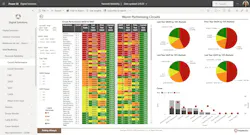
Digital Grid Resiliency Assessments are another great way to identify areas for improvement. By leveraging outage and GIS data, users can locate problematic circuits at the device level, prioritize maintenance actions and get recommendations with expected benefits and cost justifications.
8. Explore cable rejuvenation and life extension.
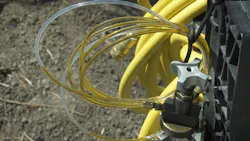
Aging dielectric cables are at considerable risk of causing wildfires. With cable rejuvenation technology, dielectric cables can be restored close to their original state.
For instance, Southwire’s patented rejuvenation technology injects silicone fluid into cables via the stranded conductors. Then, the liquid migrates out to the conductor shield and insulation. This process raises the breakdown strength of the insulation, extends service life and boosts the reliability of old circuits without costly replacement.
9. Use ampacity data.
Recently, more copper conductors than aluminum have been specified due to the high ampacity required for infrastructure expansions, such as electric vehicles and data centers, to meet the growing power demand. Using general ampacity data from a code book might not be sufficient. With comprehensive ampacity studies, utilities can verify the maximum current-carrying capacity for cables under complex installations and unique environmental conditions.
10. Review post-fire recovery methods.
Suppose the conductor, critical shielding or the dielectric component of cables is too compromised to be repaired. In that case, a replacement order must be initiated quickly to shorten the outage duration and restore the power safely. Engineering spec sheets detailing physical properties and electrical parameters must ensure the drop-in replacement cables match the system design and operating conditions.
If an identical cable design is insufficient to deliver future loads, Southwire’s applications engineering team will assess project specifications and upgrade cables accordingly. Utilities can upsize conductors to carry a higher ampacity at the maximum operating temperature or can consider an aluminum-to-copper conversion. All alternative cable configurations will be verified to ensure that a weather-proof and robust cable is chosen for any unique utility, commercial or industrial application.
Additionally, Southwire’s CableTechSupport Services team can assist with cable specifications and system design. They can select more ruggedized conductors, insulation or jacketing materials to withstand harsh weather conditions and heavy operational loading for future projects.
With the increasing frequency of natural disasters, including hurricanes, tornadoes, wildfires and winter storms, it is imperative that electric utilities use innovative solutions to mitigate risks and enhance grid reliability. By adopting these strategies, utility companies can better safeguard their infrastructure, minimize power outages and protect communities from the devastating impact of wildfires. The road ahead may be challenging, but we can build a more resilient and fire-safe future with the right tools and proactive measures.
About the Author
Dr. Yuhsin Hawig
Dr. Yuhsin Hawig, Vice President of Applications Engineering, Southwire.