DOE Announces 13 Phase 1 Winners of Digitizing Utilities Prize
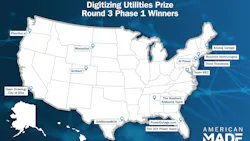
The U.S. Department of Energy’s (DOE) Office of Electricity (OE) has announced 13 teams selected as Phase 1 winners of the Digitizing Utilities Prize Round 3: Resilient Grid Innovation.
Each winning team will receive $75,000 to develop data-driven tools focused on grid reliability and security, including technologies intended to help utilities detect threats, prevent outages, improve grid operations and lower costs. The competition is part of DOE efforts to address the reliability, security and affordability of the U.S. electric grid as electricity demand grows.
“As electricity demand grows, utilities need better tools to identify and respond to grid challenges quickly and cost-effectively,” according to DOE. The Digitizing Utilities Prize brings together utilities, data experts and technology developers to use existing grid data to develop solutions for reliability and security challenges.
"Teaming up to tackle complex grid challenges requires bridging the gap between raw data and practical decision-making,” said Assistant Secretary of the Office of Electricity Catherine Jereza. "As these teams advance to Phase 2, their work with utility partners and our National Laboratories will facilitate the transformation of grid operations and planning to speed-up the deployment of scalable solutions to strengthen grid reliability and security.”
In Phase 2, the competitors will work with their energy sector partners on technology demonstrations. The goal is to develop and refine solutions addressing reliability and resilience challenges and create approaches that can be shared across the U.S. energy sector.
The following teams will advance to Phase 2:
- AI Power (Princeton, NJ)
The team’s “forAIcasting” solution uses AI to enhance load forecasting, allowing utilities to identify where and when flexible resources are needed. - Reactive Technologies (New York, NY)
The team is using high-resolution grid-edge sensing to identify hidden oscillations, with applications for large loads and inverter-based resources, as well as grid planning and operations. - Analog Garage (Boston, MA)
The team’s system is designed to provide electrical models to grid operators and planners. - OpenDrawing/City of Elba (Costa Mesa, CA)
The team has identified hundreds of U.S. utilities that continue to manage their grids using paper and PDF maps and plans to help convert these materials to digital systems. - PowerOutage.com (Orlando, FL)
The team’s OutageIQ solution provides a framework for integrating outage, infrastructure and hazard data for operational intelligence. - Gridient (Denver, CO)
Through the CVR Intelligence Hub, the team plans to unify utility data to enable physics-informed conservation voltage reduction (CVR). - Theta Runaways (New York, NY)
The team has developed an AI-based expert system trained on Electromagnetic Transient (EMT) simulation data to identify grid faults using synchronized voltage and current phasors. - Moonshot (Spearfish, SD)
The team will use machine learning to identify wildfire ignition precursors in harmonic data collected through Advanced Metering Infrastructure and deployed smart meters. - GridSense@UH (Houston, TX)
The team, in partnership with UH and Entergy, proposes using two AI/ML tools for distribution grids: automated Geographic Information System (GIS) and Outage Management System (OMS) model correction, and real-time open-conductor detection. - Team REC (Fredericksburg, VA)
The team identified trees outside the right-of-way as a source of reliability issues for its energy sector partner, REC. Its BrilliT solution will use analytics to help prevent related outages. - The Resilient Alabama Team (Birmingham, AL)
The team plans to use LiDAR data for vegetation risk analytics, with applications including virtual audits, inspections and planning. - Plentiful.ai (Portland, OR)
The team’s solution involves a sensor-fusable digital twin layer designed to link buildings within a utility’s grid infrastructure and provide a single operational context. - The UCF Power Team (Orlando, FL)
The team’s solution is a zero-shot, AI-driven decision-support platform that uses multimodal data to support utilities with real-time restoration following natural disasters.