AI-Driven Load Growth Fuels Surge in Power and Utility M&A Activity

Artificial intelligence-related electricity demand, utility consolidation, and growing investment in dispatchable generation are reshaping merger and acquisition activity across the power and utilities sector, according to PwC's U.S. Deals 2026 Midyear Outlook.
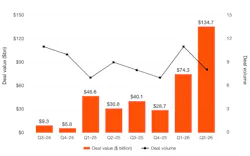
PwC reported that announced power and utility M&A activity totaled $216 billion across 23 transactions during the six months ending in May 2026, a 173% increase from $79 billion across the same number of transactions during the comparable period in 2025.
The report identifies AI-driven load growth as a primary factor behind increasing deal activity, particularly as data center expansion places new demands on generation and grid infrastructure. Constrained grid capacity is also prompting some technology companies to invest directly in power generation assets.
Among the largest transactions announced during the period was NextEra Energy's proposed $67 billion acquisition of Dominion Energy. The all-stock transaction would create a combined enterprise valued at approximately $420 billion. According to PwC, the merger would provide Dominion with access to additional capital to support infrastructure investments tied to growing demand in Northern Virginia's data center market while increasing NextEra's exposure to regulated utility operations.
Other significant transactions included a BlackRock Global Infrastructure Partners and EQT-led consortium's planned $49.6 billion acquisition of AES Corp., a move aimed at supporting AES's future growth plans and contracted clean energy agreements with technology customers.
Private capital also continued to target renewable energy platforms. Brookfield and La Caisse announced a $6.1 billion acquisition of Boralex, while Stonepeak and Bernhard Capital agreed to acquire Cleco for $6 billion from a Macquarie-led consortium.
PwC highlighted a growing convergence between the technology and energy sectors, citing Alphabet's $4.75 billion acquisition of Intersect Power. The transaction signals a shift from traditional power purchase agreements toward direct ownership of generation development assets by technology companies seeking to secure power supply.
Shift Toward Dispatchable Generation
The report suggests that renewable energy is no longer the primary driver of M&A activity in the sector. Instead, investors are increasingly focused on dispatchable generation assets capable of supporting growing electricity demand.
PwC noted that renewable-focused transaction activity declined during the six-month period. Excluding Alphabet's acquisition of Intersect Power, six renewable-focused transactions totaling $10.7 billion were announced, compared with eight transactions valued at $12.4 billion during the prior-year period.
At the same time, operating gas-fired generation assets are attracting increased investor attention. According to the report, rising U.S. liquefied natural gas exports and supply constraints are contributing to stronger capacity payments and energy margins for gas peaking and combined-cycle plants, driving additional capital allocation toward those assets.
Policy and Market Factors
The report also points to policy changes affecting renewable energy development. The One Big Beautiful Bill Act accelerated the phaseout of Production Tax Credits and Investment Tax Credits for wind and solar projects while adding new domestic content and foreign entity of concern requirements.
PwC said the July 5, 2026, deadline to begin construction in order to qualify for certain tax incentives is expected to accelerate deal activity as developers seek to preserve project eligibility.
Outlook
Looking ahead, PwC expects AI-driven load growth to remain a key driver of investment activity across generation, transmission, and distribution infrastructure.
The report suggests hyperscale data center operators will continue expanding their involvement in power development through investments in independent power producer platforms, behind-the-meter generation, and early-stage small modular reactor infrastructure. Utilities and investors are also expected to focus on assets that can provide reliable and dispatchable capacity amid growing demand and ongoing supply constraints.
PwC further noted that the proposed NextEra-Dominion transaction could lead to additional large-scale utility consolidation as companies seek greater scale to fund capital investments and support rising electricity demand.