Beyond Forecasting: How the Grid Can Make Better Decisions Under Uncertainty
Key Highlights
- Uncertainty in the energy sector arises from both external factors and internal system incentives, affecting long-term infrastructure decisions.
- Large-load developments, such as data centers, are outpacing traditional planning timelines, creating new challenges for grid reliability and capacity planning.
- Better forecasting alone is insufficient; understanding customer behavior, incentives, and commitment signals is crucial for effective decision-making.
- Gigawatt-scale customers require a more collaborative relationship with grid operators, transforming them into active system participants rather than mere consumers.
- Operational risks like weather and fire are manageable through reforms, but capital decisions involve higher stakes, making flexible, staged planning essential.
Ask any grid professional or energy planner what is creating uncertainty right now, and the answers come quickly: weather, regulation, supply chains, large loads, budgets, interconnection, winter storms and fire. Those responses are all real.
To explore what uncertainty means in practice, Grid Forward arranged a discussion at its 2026 Annual Meeting with two industry leaders: Julia Frayer, Managing Director at London Economics International, who works at the intersection of electricity markets, infrastructure economics and regulatory policy; and Pablo Vegas, President and CEO of ERCOT, the grid operator responsible for managing reliability across most of Texas.
During the discussion, Frayer and Vegas pushed the conversation beyond a familiar list of risks. The question is not whether uncertainty can be eliminated. The more useful question is how the industry can make better long-term planning and investment decisions when uncertainty is unavoidable.
Together, they framed uncertainty not simply as a forecasting challenge, but as planning, incentives and decision-making challenges for an industry being asked to make enduring infrastructure decisions amid rapidly changing demand, supply and customer behavior.
That distinction matters because many of today’s grid decisions are high-consequence and long-lived. Transmission investments, resource planning decisions and large-load interconnections can shape system costs and reliability for decades to come – and can affect multiple ratepayers. At the same time, demand, supply, technology, customer behavior and policy are all changing at different speeds and, at times, in different directions.
The conversation pointed toward a common conclusion: better forecasting will matter, but the industry may not be able to forecast its way out of uncertainty. It will also need better information, better-aligned incentives, stronger commitment signals and a more collaborative relationship between the grid and its largest customers.
As Frayer noted, planners and investors do not need complete certainty, but they do need to understand the “rules of the game” and have guardrails around the magnitude of uncertainty they are being asked to manage.
Some Uncertainty is Created by the System Itself
The electricity sector often treats uncertainty as the result of external factors: weather events, policy changes, supply constraints, technology shifts or geopolitical factors. Frayer introduced a different lens. Some uncertainty, she suggested, is created within the system itself. Developers, utilities, Independent System Operators (ISOs), Regional Transmission Organizations (RTOs), regulators, investors and customers all make decisions in response to incentives. Those decisions can create unintended consequences or additional uncertainty for the utility.
That is especially important in the current large-load environment for commercial and industrial (C&I) customers. A large customer may benefit from preserving multiple siting options. A utility may have incentives to invest in infrastructure. Developers want capacity available quickly. Regulators and grid operators are trying to preserve reliability and protect customers from unnecessary cost.
Vegas made the incentive problem even more tangible. In the current environment, he said, many incentives point in the same direction: build more and build faster. But if infrastructure is developed for load that does not ultimately materialize, the costs do not disappear. They have to be allocated somewhere, and absent appropriate cost allocation methods, residential and small commercial customers may ultimately carry some portion of that burden.
Better planning, then, is not simply a matter of understanding the megawatts in a forecast. It also requires understanding the behavior and incentives producing the forecast – and mapping their potential outcomes.
Large Loads are Outpacing the Traditional Planning Clock
For many years, the large-load planning process often followed a manageable pattern. Major industrial projects were significant, but they tended to be episodic, location-specific and more closely aligned with the timelines needed to develop supporting infrastructure. That planning paradigm is changing.
Vegas noted that some data center campuses are being planned at two, three or even four gigawatts of demand at a single site - a scale comparable to multiple large generating units. Even if a full campus is not built immediately, initial energization can begin within 18 to 24 months, with 200 to 400 MW potentially coming online in the first few years. Major transmission infrastructure, by contrast, can still take five to six years to plan, design and build, even in Texas, where transmission development can move faster than in many other parts of the country.
That mismatch creates a new planning problem. The grid is being asked to make long-lived capital decisions on infrastructure timelines that may not match customer development timelines. At the same time, the universe of proposed projects may be much larger than what ultimately gets built. In Texas, Vegas said ERCOT’s large-load interconnection queue includes more than 400 GW of requested interest - far more than what is likely to materialize, but large enough to illustrate why planners need better ways to distinguish credible projects from exploratory ones.
The planning challenge is also compounded by supply-side variability. Vegas noted that ERCOT must now model tens of thousands of megawatts of solar and wind output that can rise, fall or shift with weather conditions over the course of a day.
The result is not simply “load growth.” It’s load growth with unprecedented scale, compressed development schedules, location-specific constraints and uncertain realization rates. That combination makes traditional planning tools harder to apply and raises the stakes for getting the decision process right.
Better Forecasting May Require Commitment, Not Just Prediction
Frayer framed this as an incentives problem. Better planning may require mechanisms that encourage large customers to reveal not only their projected demand, but also their true preferences and level of commitment: whether they really intend to build, where they intend to build, and how committed they are to building on a particular site. That may require moving beyond early expressions of interest and asking large customers to provide stronger evidence of commitment - including financial security, site control, equipment orders or other signals that a project is likely to move forward.
ERCOT is also moving from a one-off large-load connection process toward a more integrated annual batch process. Under that approach, qualified large-load requirements can be studied together to assess what the grid can support, what constraints exist and what transmission upgrades may be needed. A later step would require additional financial security to lock in capacity and support infrastructure development.
The broader principle applies beyond Texas: when the forecast itself is influenced by customer behavior, better forecasting may depend less on prediction alone and more on mechanisms that generate credible information. In other words, planners do not just need more sophisticated models of uncertain inputs. They need stronger ways to separate signal from noise.
Vegas also emphasized that the challenge is not uniform across all 8,760 hours of the year. In many places, energy may be available for most hours, while a handful of extreme peak periods create the constraints that drive reliability and infrastructure decisions.
Gigawatt-scale Customers Require a Different Relationship with the Grid
As loads increase, the traditional relationship between utility and C&I customer may no longer be sufficient. Vegas made the point directly; large customers need to be “more of a partner with us versus just a straight customer that plugs in and uses power.” A very large customer can have a grid impact similar to a major generating resource. Grid operators maintain close visibility into generating facilities because their behavior affects grid stability. Operators need to understand when those resources will be available, when they may be offline, and how they are expected to perform. At gigawatt scale, large loads can become just as important to grid operations. Their usage patterns, ramping behavior, outage plans and growth timelines can materially affect reliability and planning.
That means large customers may need to become more active grid partners. Greater transparency into electricity usage, operating plans and future development could help grid operators and utilities manage reliability while still supporting economic growth.
This does not necessarily point to a single model. Large loads may bring behind-the-meter (BTM) resources, front-of-the-meter (FTM) arrangements, demand flexibility, onsite generation or other structures. But regardless of the configuration, the relationship needs to become more collaborative. At sufficient scale, a large load is not merely an endpoint that consumes electricity. It is a grid participant whose decisions can affect the broader system for years to come.
The Greatest Uncertainty May be the Wrong Capital Decision
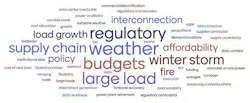
During the Grid Forward meeting, the audience was invited to share concepts that it believed were the primary causes of uncertainty. The resulting word cloud emphasized weather, winter storms and fire. Frayer acknowledged those risks, but she also made an important distinction between operational and capital challenges.
Operational challenges can be severe. The industry has learned painful lessons from extreme events, including winter storms, heat waves and fire risk. But operational problems often have a transitory nature. The industry can identify weaknesses, implement reforms, improve weatherization, adjust operating protocols and prepare differently for the next event.
Capital challenges are different. They tend to involve higher price tags, longer time horizons and fewer easy reversals. That is why the planning question matters so much. If the industry underbuilds, reliability and economic growth can suffer. If it overbuilds around demand that does not materialize, customers may be left paying for infrastructure that was not needed, or not needed in the way it was planned.
As Frayer put it, the challenge is “about the decision-making,” not just the forecasts that inform it. Scenario analysis, better information, staged commitments and flexible planning frameworks all become more valuable in that context. The challenge is not to choose one future correctly. It is to avoid making irreversible decisions that only work under one version of the future.
The Goal is not More Certainty. It is Better Decisions.
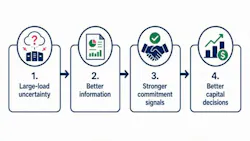
Even with more sophisticated planning tools and models aided by AI, the grid will never have perfect foresight. The weather will remain unpredictable. Policies will change. Technologies will evolve. Some proposed loads will materialize, and others will not. However, the industry can improve how it makes decisions in the face of uncertainty.
That means looking beyond the forecast itself and asking harder questions about the information behind it. What incentives are shaping customer behavior? What commitments distinguish a serious project from an exploratory one? What information is missing? What decisions can be staged as more information becomes available? Which capital investments remain valuable across multiple possible futures?
This conversation between an economist and a grid operator pointed toward a shared answer: uncertainty is not only a forecasting problem. It is a “planning, incentives and decision-making” problem. In the next era of grid growth, better forecasts will still matter. But better decisions may matter even more.
About the Author
Joanna Hamblin
Joanna Hamblin represents Grid Forward as a marketing and communications consultant. She is a climate-tech marketing leader with more than 15 years of experience helping clean-energy and mobility companies bring complex technologies to market. She advises climate-tech startups and growth-stage companies on go-to-market strategy, product positioning, and scalable marketing execution. She also serves on the Advisory Board of Intersolar & Energy Storage North America (IESNA).
Previously, Joanna has led brand, product, and growth marketing initiatives across energy, mobility, and grid infrastructure, including roles at Schneider Electric, Motiv Electric Trucks, and FreeWire Technologies. She has launched new brands and platforms, defined North American eMobility strategies, and built full-funnel marketing programs supporting hardware-plus-software energy solutions. Earlier in her career, she held marketing leadership roles at Power Standards Lab, Gridco Systems, and Ambient Corporation.
Joanna holds graduate and executive training in sustainability leadership from Harvard University and is fluent in English and Polish.