Bringing 3D Awareness to Substation Protection
Key Highlights
- EG.D uses LiDAR and digital twins to continuously scan and visualize substation environments, providing detailed 3D insights for operators.
- The system automatically directs cameras toward detected objects, enabling quicker verification and response to events.
- Safety zones around high-voltage equipment are defined in 3D space, allowing real-time alerts when personnel enter hazardous areas.
- Portable LiDAR units offer flexible deployment for maintenance, construction, or security needs, with quick setup via tablet interface.
- The ongoing pilot phase ensures technology validation, aiming for broader implementation to enhance infrastructure resilience and safety.
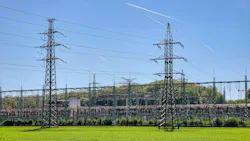
Across the Southern Moravia and Southern Bohemia regions of the Czech Republic, EG.D — a member of the E.ON Group — operates a vast network of unmanned high voltage transformer substations. These facilities sit at the core of regional power distribution, quietly stepping voltage down from the transmission grid to serve homes, hospitals, industries and communities. Their reliability is non-negotiable.
As with many utilities managing increasingly remote and automated infrastructures, EG.D continuously evaluates how to complement established protection systems with new technologies that can provide additional insight and resilience. The combination of open terrain, isolated locations, changing weather and dense metal structures creates an operational environment that can be challenging to interpret in real time. Operators may know that something has occurred, but determining what exactly happened and whether a response is required can take valuable time.
In response, EG.D began exploring technologies capable of delivering greater situational awareness and precision. This led to the deployment of Octave Coda Spatial (formerly HxGN dC3 LidarVision), a LiDAR-based 3D volumetric detection platform designed for complex outdoor environments. What started as a security-focused initiative gradually evolved into a broader exploration of how the same technology could support both infrastructure protection and worker safety.
From Lines to Volumes
Initial deployments of Coda Spatial were carried out at selected substations within EG.D’s network. Rather than focusing on predefined zones or limited viewpoints, the system continuously scans the entire three-dimensional space of each site. Every LiDAR scan produces a precise 3D point cloud, capturing the location, shape, height and movement of objects within range.
This approach gives operators a clearer understanding of on-site activity. When movement is detected, the system identifies its position, size and trajectory within a digital representation of the substation. Integrated PTZ (pan-tilt-zoom) cameras are automatically directed toward the detected object, enabling faster visual verification.
The result is not a replacement of existing systems, but an additional layer of awareness that helps operators interpret events more quickly and with greater confidence. It also improves the ability to distinguish between routine background activity and situations that may require attention.
Digital Twins as an Operational Interface
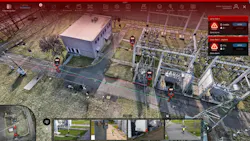
A key element of the solution is the use of photorealistic digital twins. These models were created using drone photogrammetry, resulting in detailed 3D reconstructions of substation environments. Equipment, structures and spatial relationships are represented with high fidelity, allowing operators to navigate the site virtually.
When an event occurs, the detected object is visualized directly within this environment, including its movement trajectory. Operators can adjust viewpoints, zoom in or inspect areas from perspectives that may not be physically accessible or safe. This shared visual context supports faster and more informed decision-making.
The same digital models are also used within Octave Coda Designer, a tool that enables EG.D’s internal teams to design and adjust detection layouts. This in-house capability allows the utility to test different configurations, simulate scenarios and validate coverage without relying on external partners or exposing sensitive infrastructure details.
Exploring the Intersection of Security and Safety
During deployment, EG.D identified an additional potential application in the field of operational safety. Work in proximity to energized high-voltage equipment remains one of the most hazardous activities in the energy sector. Even small, unintentional movements can pose serious risks.
Using the same volumetric detection principle, the system can define three-dimensional safety zones around critical infrastructure such as overhead conductors. These zones exist in space rather than on the ground, allowing personnel to move freely while still maintaining a defined safety boundary.
If an object enters a protected zone, the system can trigger immediate warnings, including automated audio alerts. This provides an additional layer of protection that complements existing safety procedures and helps reduce reliance on purely manual supervision.
At present, this safety-related use case remains in a testing phase within EG.D, with ongoing evaluation planned through approximately Q2 2027. The solution is being assessed to ensure it aligns with operational processes and safety requirements before any broader rollout or handover to operational teams.
Importantly, the system is designed to adapt to maintenance workflows. Specific areas can be temporarily deactivated when equipment is safely de-energized, allowing work to proceed while maintaining monitoring elsewhere.
Mobility for Dynamic Conditions
In addition to fixed installations, EG.D has also explored the use of portable LiDAR-based units for temporary or rapidly changing scenarios. These systems combine LiDAR sensors, cameras, speakers and onboard power into a mobile platform that can be deployed in the field as needed.
Setup is managed through a tablet-based interface, enabling crews to define detection zones within minutes. The system can then communicate with monitoring centers or directly with personnel on site. This flexibility makes it suitable for temporary protection needs, such as maintenance activities, construction work or heightened security situations.
Measured Benefits and Ongoing Evaluation
The introduction of volumetric LiDAR detection has brought several observable benefits. Operators gain faster visual context when events occur, supporting more efficient decision-making. Automated camera guidance helps reduce the time needed to verify situations, while the overall system contributes to a clearer understanding of site activity.
At the same time, EG.D continues to evaluate the technology in real-world conditions. The current deployments serve not only as operational tools, but also as a foundation for further learning and refinement. This measured approach ensures that any future expansion is based on validated performance and alignment with operational needs.
Expanding awareness in Substation Protection
By introducing LiDAR-based volumetric detection and digital twin technology, EG.D is expanding the way it monitors and understands its substation environments. Rather than replacing established protection methods, the solution adds a new dimension of spatial awareness that supports both security and safety objectives.
The ongoing pilot phase reflects a broader industry trend: utilities are increasingly combining traditional, proven approaches with advanced sensing and visualization technologies. In this context, EG.D’s experience illustrates how three-dimensional awareness can enhance decision-making, improve responsiveness and contribute to safer, more resilient infrastructure operations.
About the Author
Martin Hetflajš
Martin Hetflajš is head of business resilience for EG.D.
Martin Vojtek
Martin Vojtek is executive manager, Coda Spatial, for Octave.