Engineering Switchgear for New York City
Key Highlights
- Industry standards from IEEE/ANSI and NEMA set baseline requirements, but utilities often impose additional specifications based on environmental and operational factors.
- New York City’s infrastructure demands switchgear capable of handling fault ratings up to 44 kA, exceeding standard 40 kA ratings for enhanced safety margins.
- The Champlain Hudson Power Express project utilizes HVDC technology to efficiently transmit renewable energy over long distances, integrating into NYC’s grid via specialized converter stations.
- High-power laboratories are essential for testing and certifying equipment to withstand extreme fault conditions, ensuring safety and reliability in critical applications.
- NBS’s Citadel switchgear offers rugged, utility-grade solutions with certifications like KEMA C37.013, supporting dense urban environments with space-efficient, high-capacity designs.
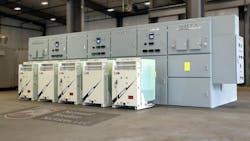
Electrical equipment such as switchgear, transformers, and circuit breakers must meet a range of industry standards established by oversight organizations including IEEE/ANSI and NEMA to ensure safety, reliability, and performance. Beyond these baseline requirements, some leading utilities impose additional specifications tailored to the unique demands of their networks. These enhanced standards often account for geography, environmental conditions, electrical topology, and established safety and operational practices.
Serving one of the most demanding and densely populated electrical networks in the world, New York City requires industry-leading capabilities for fault close-and-latch and interruption ratings.
Meeting these requirements demands substantially higher mechanical strength and carefully engineered designs that allow a single operator to manage equipment safely and efficiently. In these environments, conventional equipment often proves inadequate, making it essential to rely on manufacturers capable of designing, building, and certifying switchgear in high-power laboratories to meet more rigorous and exacting standards.
This reality became evident during a large-scale energy infrastructure initiative currently under development to transmit 1.2 gigawatts of high-voltage direct current (±400 kV HVDC) power generated by renewable sources in Québec, Canada, to Queens, New York.
To make the project practical and cost-effective, this large block of clean electrical power will be converted from alternating current (AC) to ±400 kV DC at its source in Canada, transported to New York City over just two 5,000 MCM copper cables with a total insulation diameter of approximately five inches, and then reconverted from DC to 345 kV AC for integration into New York City’s electrical grid.
Medium-voltage switchgear directly connected to the New York City grid must comply with the local utility’s stringent requirements for ratings, safety, and operability. Accordingly, the switchgear was required to meet the utility’s 38 kV draw-out specifications, including fault ratings, grounding and test device requirements, and revenue-metering cubicle design standards, among others. Close-and-latch and short-circuit ratings were required to be verified through independent high-power laboratory testing.
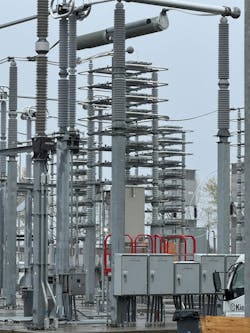
The Project
The Champlain Hudson Power Express is a permitted high-voltage direct-current (DC) transmission project designed to deliver firm, dispatchable hydropower from Québec directly into New York City through an underground and underwater cable system.
Developed by Transmission Developers Inc., an affiliate of Blackstone, the 330-mile line uses Hitachi Energy’s HVDC Light technology and is designed to transmit approximately 1,250 megawatts at ±400 kilovolts—enough clean energy to power roughly one million New York homes.
HVDC technology enables the efficient transmission of large amounts of electricity over long distances and is widely used around the world to move power across borders and under seas. DC transmission minimizes electrical losses, eliminates reactive power issues, and simplifies insulation requirements. By avoiding synchronization challenges, HVDC systems provide the flexibility needed to connect renewable generation sources such as wind and solar to existing grids.
The line originates near Hydro-Québec’s Hertel Substation, runs south beneath Lake Champlain and the Hudson River, and terminates at the converter station in Astoria, Queens. At the Astoria Converter Station, the DC power is converted back to 345 kV high-voltage AC and tied into the New York Power Authority’s (NYPA) Astoria Annex. From there, the renewable, dispatchable power flows through the Astoria–Rainey cable to Con Edison’s 345-kV Rainey Substation in Long Island City for injection into the New York City grid.
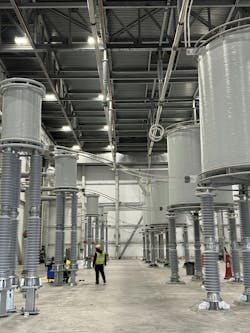
The Astoria Converter Station
Operating the extensive physical plant surrounding Hitachi Energy’s extra-high-voltage conversion equipment requires a significant amount of auxiliary, or “house,” power. This power was sourced from the local utility grid. In the Astoria neighborhood, Con Edison’s distribution system operates at 27 kV but specifies the use of 38 kV-class equipment to maintain robust safety margins. As a result, house power for the converter station had to be supplied through Con Edison-approved 38 kV switchgear.
This switchgear plays a critical role, enabling circuits to be isolated, fault currents to be interrupted, and maintenance activities to be performed safely—particularly under abnormal operating conditions.
As part of the utility’s ongoing system studies and reviews, local 38 kV medium-voltage (MV) switchgear requirements can exceed the ANSI 40 kA short-circuit rating, depending on location. In these cases, equipment must demonstrate, through formal certification, the capability to withstand fault currents of up to 44 kA. Only a small number of high-power test laboratories worldwide can generate the required 38 kV, 44 kA conditions—along with the associated peak currents—to verify survivability under extreme close-and-latch and fault-clearing events.
Switchgear rated for 38 kV and 44 kA exceeds ANSI’s standard 40 kA design criteria and provides an added margin of certified safety. As utilities encounter portions of their systems approaching the limits of conventional 40 kA equipment, this higher rating allows continued system growth without compromising reliability or safety.
National Breaker Services (NBS) was selected by ABB/Hitachi for this project due to its ability to meet Con Edison’s exacting switchgear specifications. Based in Middlebury, Connecticut, NBS specializes in the engineering, design, and manufacture of medium-voltage circuit breakers and switchgear for electric utility substations and generating facilities.
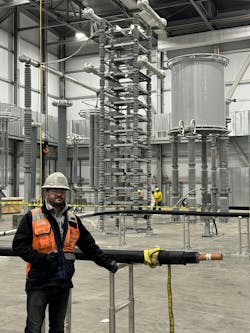
The company’s flagship product line, the Citadel, reflects its focus on rugged, utility-grade construction. Originally developed as fixed-mounted breaker elements to retrofit legacy switchgear systems, the Citadel element was dimensionally designed to fit nearly any medium-voltage breaker chassis up to 38 kV manufactured by major domestic suppliers since the mid-1940s.
NBS offers Citadel breaker elements and switchgear in both fixed and draw-out configurations, spanning ratings from 5 kV to 40.5 kV. The Citadel family includes a comprehensive line of MV roll-in replacement breakers for legacy equipment from manufacturers such as GE, Westinghouse, ITE, Allis-Chalmers, McGraw, and Federal. Free-standing “doghouse” designs can be as high as 40.5 kV, as high as 63 kA, and up to 5,000 amps (no fans), while draw-out switchgear configurations include indoor, outdoor, shelter-clad, and e-house designs. With KEMA C37.013-certified testing, the 5,000-amp, 63 kA elements are well suited for generator circuit breaker duty in applications exceeding 100 MW.
At Hitachi’s request, NBS also engineered and manufactured a reduced-footprint utility revenue-metering cubicle that remains fully compliant with Con Edison’s stringent metering standards. The result is a reliable, space-efficient solution suited to dense urban environments like New York City, where high real estate costs and limited space make compact, standards-approved equipment essential.
By adhering to these elevated benchmarks, utilities can improve system reliability, maintain consistent performance across their medium-voltage networks, and support safer operating conditions. Such standards help protect critical infrastructure as well as the operations and maintenance personnel who work within these systems, offering a framework that may be applied by other utilities facing similar operational and network challenges across North America.
About the Author
Jeff Elliott
Jeff Elliott is a Torrance, Calif.-based technical writer. He has researched and written about industrial technologies and issues for the past 20 years.