HIL Testing for Data Centers: Engineering Confidence Before Energization
Key Highlights
- How real‑time simulation and HIL testing can uncover risks early - before they impact data center construction schedules and commissioning
- The technology that demonstrates predictable data center behavior to utilities, reducing interconnection uncertainty
- Project examples where validation of multi‑vendor power architectures in a lab have helped data center leaders deliver complex facilities with greater confidence
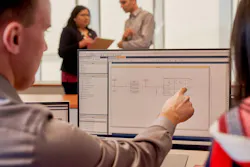
Data centers are among the most power‑intensive and schedule‑critical facilities being built today. Growth in cloud computing, hyperscale platforms, and AI workloads is driving both scale and urgency, often requiring large electrical systems to be designed, integrated, and commissioned on compressed timelines.
For projects of this complexity, traditional design studies and staged testing approaches are increasingly strained. Power‑electronic‑dominated architectures, large UPS and battery systems, and tighter coupling to utility grids introduce risks that are difficult to fully characterize before energization. Real‑time simulation and hardware‑in‑the‑loop (HIL) testing are now being applied to address these risks earlier and more effectively.
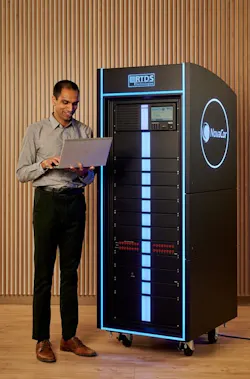
The RTDS Simulator has been adopted by countless leaders in the data center space – hyperscalers, EPCs and consultants, utilities, OEMs, and national research labs. Here’s how and why.
The need for detailed modelling and testing in the data center environment
Today’s data center electrical systems rely on fast‑acting controls and tightly coordinated subsystems. Power and energy management systems, UPS and battery energy storage system controls, and protection must respond correctly to disturbances without interrupting service. Many of these responses occur on sub‑cycle to millisecond timescales.
At the same time, utilities are managing unprecedented load growth, complex interconnection requests, and tighter performance expectations for large customers. Data centers are increasingly required to demonstrate predictable behavior during faults, grid disturbances, load ramps, and, in some cases, islanded operation.
When issues are discovered late—during commissioning or early operation—mitigation often involves schedule impacts, system redesign, or long‑term operational compromises. The cost of uncertainty escalates quickly.
Why choose real-time simulation and HIL testing?
Many of the most consequential behaviors related to data center electrical architecture emerge only when real hardware interacts with fast system dynamics outside the fundamental frequency. Protection mis‑coordination, control instability, and vendor‑to‑vendor interoperability issues can be difficult to identify; that’s where real-time simulators and HIL testing come in.
Real‑time electromagnetic transient (EMT) simulation enables closed‑loop testing of data center electrical architecture components by solving detailed power system models fast enough to interact directly with physical hardware. With HIL testing, actual protection relays, UPS controllers, plant controllers, and power management systems are connected into a simulated power grid and exercised under realistic conditions in the safety of a lab.
In short, the RTDS Simulator allows engineers to observe how complex systems practically behave under a huge range of operating scenarios – not just how they should behave on paper – and demonstrate this to data center project stakeholders.
Applied early, real‑time simulation reduces risk across the project lifecycle. Control strategies and protection philosophies can be validated before designs are finalized. Interactions between equipment from multiple vendors can be tested directly. Thousands of operating scenarios, including abnormal and extreme events, can be evaluated safely and repeatably.
Commissioning becomes more predictable because many integration challenges have already been identified and resolved. Just as importantly, utilities, EPCs, and OEMs gain a shared, high‑fidelity understanding of system behavior based on measured performance rather than assumptions.
The benefits of HIL in action: project examples
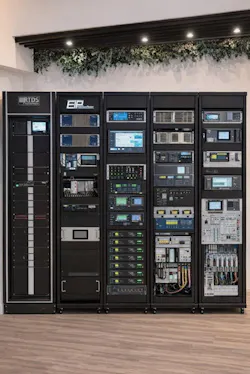
EdgeTunePower is an EMS/PMS vendor and leader in the HIL testing space; they’ve applied real‑time simulation and hardware‑in‑the‑loop testing to evaluate full stack data center power management and protection behavior before deployment. Their lab includes an RTDS Simulator which can be connected to any number of control and protection devices to evaluate their performance in the simulated data center power system. Their closed‑loop testing capabilities have been used to verify coordination between power management systems, protection elements, and fast‑acting controls, allowing potential integration issues to be identified and resolved prior to commissioning. By validating performance under realistic conditions, the approach reduced uncertainty during site energization and improved confidence in long‑term operability.
A similar approach has been taken at the National Laboratory of the Rockies (NLR), where real‑time simulation and HIL testing with the RTDS Simulator have supported the development of a grid‑interactive data center architecture for developer Verrus. Verrus integrates an innovative, grid-aware power management system (PMS) with on-site battery energy storage - a system capable of fast-responding demand flexibility that can support requests from the utility during grid events. At NLR, the control software coordinating this system was put to the test using the RTDS Simulator in their impressive HIL laboratory.
The testing campaign subjected the Verrus control platform to grid disturbances, rapid operating transitions, and edge cases that would be impractical or risky to test on an energized system. Engineers were able to stress‑test system behavior, identify vulnerabilities, and confirm control responses well before field deployment. The results demonstrated that the architecture could perform as intended under real‑world operating conditions – including a reproduction of an actual event that caused a large load loss in Virginia – supporting readiness for utility interconnection and commercial operation.
Confidence before energization
As data center projects grow in scale and sophistication, risk increasingly resides at system interfaces—between vendors, between facility and grid, and between design intent and operational reality. Real‑time simulation provides a neutral, technically rigorous environment where those interfaces can be tested directly.
For EPCs, this translates into fewer commissioning surprises. For utilities, it offers clearer insight into how large, fast‑responding loads will behave under grid events. For OEMs, it enables earlier validation of controls and protection in realistic network conditions.
By validating system behavior before energization with the RTDS Simulator, data center stakeholders can replace assumptions with evidence and uncertainty with insight. In an environment where downtime is unacceptable and schedules are unforgiving, that confidence is becoming a prerequisite for successful data center delivery.
Learn more at https://www.rtds.com/applications/data-centers.
This content is sponsored by: