Grid Reliability and Wildfire Prevention: Aligning Utility Priorities
Key Highlights
- Wildfire risk is rising, forcing utilities to balance reliability with prevention.
- Traditional reliability metrics alone no longer address growing wildfire threats.
- Regulators, insurers, and communities are driving stronger wildfire mitigation efforts.
- Advanced data, forecasting, and AI tools are transforming wildfire decision-making.
- Utilities are using targeted operations to reduce wildfire risk and unnecessary outages.
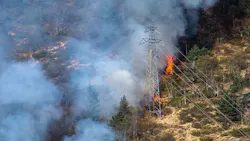

Wildfire risk is increasing due to climate change, evolving fire behavior, and continued development in wildland areas. Fire agencies and utilities are prioritizing prevention and risk mitigation alongside suppression, with data, modeling, and monitoring technologies playing a growing role in decision-making.
From a fire agency perspective, Chris Waters—who spent 25 years with CAL FIRE as an Operational Division Chief—notes the shift in fire dynamics:
“If you look at the last decade of fire seasons in California, you see a significant increase in complexity, intensity, size and progression. The overall fire behavior environment has changed dramatically, and that has pushed fire agencies to deal with a very different operational landscape”.
“There’s also the reality of community expectations. People are moving into wildland areas, so, you have a convergence of problems: climate change, the resulting fire behavior implications and the growing desire to live in the wildlands”.
Driving Forces for Grid Reliability
For over a century, utilities have focused on reliability above all, measured through key metrics:
- SAIDI: average outage duration: Utilities use SAIDI to track system performance, identify circuits needing investment, and set performance targets for operational teams.
- SAIFI: outage frequency: Lower SAIFI numbers represent less interruptions and better electric reliability.
- CAIDI: restoration time: The lower the number of minutes, the faster the utility restored service to customers.
These metrics, enforced by regulators, drive funding and operational priorities. However, they have also shaped industry mindsets and created silos, especially in regions historically unaffected by wildfire risk.
Today, utilities across North America recognize that grid-related ignitions—driven by aging infrastructure, drought, wind, and extreme weather—pose significant wildfire risks.
Driving Forces of Fire Prevention
Pressure from regulators, insurers, the public, and utilities themselves is driving a shift. The human and financial risks—often exceeding $100 million or even $1 billion—have made it clear that reliability alone is no longer sufficient. A balance between reliability and wildfire prevention is now essential, though regulatory frameworks and leadership culture are still evolving.
Utilities are addressing aging infrastructure through vegetation management and grid hardening, including replacing poles with steel or concrete. However, financial constraints—especially for cooperatives and municipalities—limit the pace of these upgrades.
Thaddeus (Thad) Petzold, Associate Director of Wildfire Risk and Vegetation Management, highlights this cultural shift beyond traditionally high-risk regions:
“Upper management does not want to turn the power off. They do not. It's a decision they do not want to make. We know that we're going to be in an operating position to either do some adjusted settings, whether that's EPSS (Enhanced Powerline Safety Settings), or whether that's putting our system on non-recloser”.
He also notes changing fire seasons and operational challenges:
“Our fire season traditionally used to be between basically April 1st - October 1st. That's kind of changed a little bit. It's expanded, I would say probably March 1st, but we don't want to necessarily put our system on enhanced settings that whole period, because right around the end of June we have monsoon season come in, so we get a lot of lightning, and we don't want to do it”.
In the Southwest, dry lightning and high winds before monsoon rains create critical wildfire conditions. As Thad explains: “it doesn't mean that we're not going to have broken cross arms and limbs that break out and cause problems. We're trying to get the message out. If we feel that our thresholds are being hit to turn the power off, yes, we're going to do that. But, even if we don't, we need to make sure our customers are aware that potential power outages can still occur during those kind of storms”.
Technology and Operational Transformation
Investment in wildfire prevention has accelerated technological innovation. Chris Waters emphasizes: “the state has been forced onto the leading edge of technology and access to information to support incident management. “CAL FIRE is the backbone of large wildland fire operations in the state, and the incident management teams are constantly trying to improve efficiency, capability and the flow of information, both for suppression operations and firefighter safety”.
The ALERTCalifornia network and AI-enabled smoke detection, combined with satellite data, fire modeling, and real-time mapping, are improving situational awareness: “When you combine satellite detection with cameras, fire modelling and real-time mapping, you can start delivering much better information directly to firefighters in the field”.
Utilities are making similar investments—leveraging 10-20 years climatology data, vegetation management, and advanced forecasting tools to identify high-risk areas and adjust operations. Thad notes: his utility “uses multiple platforms to make decisions and Indji Watch for its daily SA (Situational Awareness).”
Easily integrating fire operating conditions forecasts and observation data into a single platform for grid operators, wildfire mitigation teams, and electric field operations. Besides smoke detection cameras, utilities across N. America are investing heavily in the grid. Modernization efforts include reclosers, sectionalization, and localized weather stations, which provide ground truth to the forecasts and minimize unnecessary outages.
“For the most part we're able to really drill down into what we call our high fire risk areas and separate from the rest of our system so that we don't unnecessarily have to de-energize circuits.
“During one event last year, localized wind observations were less than the forecasts and allowed them to just go into a non-reclose situation and we're able to spare thousands of customers, probably 5 to 10,000 customers”.
Conclusion
Despite budget constraints, utilities are prioritizing both prevention and risk mitigation with infrastructure upgrades, aggressive vegetation management, and deployment of advanced technologies such as covered conductors, fire-resistant materials, localized sensors, and smoke detection cameras. The integration of data, forecasting, real-time situational awareness and operational tools—combined with improved communication—demonstrates that wildfire prevention and grid reliability do not have to be competing forces but can be aligned through thoughtful strategies and technological advancement.