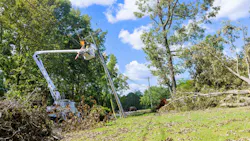
Every utility knows how to tell the story of a good restoration. The storm hits, crews mobilize, the outage management system lights up, and within hours or days the lights come back on. Leadership sends a thank-you note to the workforce, the local news runs a segment on the linemen who worked through the night, and everyone moves on to the next event. It's a story worth telling. Restoration crews are, without exaggeration, some of the best in the business at what they do.
But there's a second story that almost never gets told: what the outage actually revealed about the grid, and whether anyone stuck around long enough to listen. Utilities have become excellent at the mechanics of restoration and, as an industry, mediocre at the discipline of learning from it. The two are not the same skill, and mistaking one for the other is an expensive habit.
The moment a feeder re-energizes is usually the exact moment the institutional appetite for analysis evaporates. The information that would explain why the outage happened, where the system showed weakness, and what nearly went worse doesn't vanish, but it does scatter into a dozen different places: outage management system (OMS) records, SCADA logs, AMI ping data, crew logs written by hand in a truck, and whatever the weather service reported at the time.
None of those systems were built to talk to each other, and in most utilities, nobody owns the job of making them. The result is that a genuinely well-run restoration and a chronically under-analyzed one look identical from the outside. Both end the same way: power restored, ticket closed. The difference only shows up eighteen months later, when the same feeder trips under similar conditions and nobody remembers, because nobody wrote it down anywhere that mattered.
Many utilities do attempt a post-event review, and it usually starts with someone pulling data into a spreadsheet by hand. That process is slower than it looks: by the time the spreadsheet is finished, stitched together from OMS exports, SCADA timestamps, and someone's recollection of what the crew reported, the urgency has moved on to the next event. It's also shaped by the assumptions of whoever built it. Analysts go looking for what they already suspect happened, which means the spreadsheet is good at confirming a hunch and poor at surfacing the failure mode nobody anticipated — exactly the kind of surprise a utility most needs to catch.
The stakes here are not abstract. Every utility builds a capital plan, and that plan is a bet on where money will do the most over the next several years. When outage learning doesn't make it back into that process, the plan is built on averages, vendor benchmarks, and institutional memory rather than on what the utility's own grid has been trying to say.
When the loop does close, the shift is visible: a feeder that keeps failing under a specific load condition, a piece of equipment that underperforms in a particular weather pattern — these are patterns that only emerge when outage data accumulates and gets analyzed consistently, not just recalled anecdotally after the big ones. The capital plan stops being an educated guess and starts being a response to evidence.
The following three practices can help utilities close that loop.
1. Embed Post-Event Analytics into the Planning Process
Post-storm reviews tend to live entirely on the operations side of the house, evaluated against operational questions: Did the crews follow protocol? Did restoration meet target times? Those are fair questions, but they stop short of the more useful one: what does this event tell the planning team about where the grid is fragile? Utilities that get value out of outage data build a formal handoff so that operational findings routinely reach the people building the five-year capital plan, not just the people writing the after-action report.
2. Unify Operational and Planning Data
In most utilities, operations know what's failing today, and planning decides what gets funded next year, but the two groups interact only through the occasional summary report. Bringing OMS, SCADA, AMI, and field data into a shared, structured view, so planning teams can see patterns as they accumulate rather than waiting for a quarterly briefing, turns planning from a periodic guess into an ongoing, evidence-based process.
3. Standardize the Post-Event Review
The most useful post-storm reviews are the ones willing to ask whether the process itself was right, not just whether it was followed. That only happens reliably when the review has a consistent structure, a defined set of data sources, and a scheduled cadence, so it isn't left to whichever engineer has the energy to run it after a thirty-hour shift. If capturing the lesson requires heroics, it won't happen consistently, and consistency is the entire point.
Restoration Is Halftime, Not the Final Score
None of this argues for less focus on restoration speed; getting the lights back on quickly will always matter, and it should. The argument is that restoration is the first half of the job, not the whole of it.
Utilities that build the systems and processes to capture that record consistently, rather than relying on memory and goodwill after an exhausting event, end up with capital plans, maintenance priorities, and operational playbooks that are grounded in their own grid's actual behavior. That's a meaningfully different starting point than a plan built on assumptions, and over time, it's the difference between a grid that keeps repeating the same failures and one that gets measurably more resilient after every storm, outage, and near miss.