T&D World Live Opens With Call for More Targeted, Data-Driven Grid Decisions
As utilities face aging infrastructure, rising reliability expectations and growing demands for capital, they are looking for ways to make better use of the data already being collected across their systems.
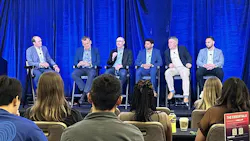
At T&D World Live 2026 last week, representatives from Xcel Energy and CenterPoint Energy joined technology and services providers to discuss how asset intelligence, artificial intelligence (AI) and digital twins can help utilities move beyond traditional, program-based approaches to grid investment.
The goal, they said, is not simply to deploy new technology, but to use better information to make more informed decisions about where to spend money, when to maintain or replace equipment and how to improve reliability and resilience.
Ben Lanz, ESARA, who moderated the session, framed the challenge around the cost of maintaining the existing grid while utilities also invest in new infrastructure.
“How do we address the aging, resilient infrastructure that we need in the face of all the investments that we're making?” Lanz asked, pointing to the need to improve efficiency and affordability as utilities make major investments in the grid.
Extending Asset Life
For Mike Adams, CEO of Osmose Utilities Services, one opportunity is getting more useful life from infrastructure utilities already own.
Adams, who spent 31 years at GE before joining Osmose, said utilities historically have not always used available data to support smarter maintenance decisions.
“The way we did it … didn't seem like we were using data enough to do smart maintenance,” he said.
Osmose works with utilities on structural integrity across a range of assets, including wood poles, steel structures and underground infrastructure. Adams said better data can help utilities determine which assets need action and which can safely remain in service.
He also sees an opportunity to use AI to accelerate decisions based on inspection data. A visual inspection that once required engineers to review information and potentially take weeks to reach a decision could, in some cases, be supported by AI much more quickly.
But Adams said technology does not eliminate the need for field expertise and physical inspections.
Turning Information into Knowledge
Robert Brook, SVP and General Manager - Americas at Neara, emphasized another challenge: Utilities often have plenty of information but struggle to turn it into something people can use to make decisions.
“Communication is important,” Brook said, describing a recurring problem in the industry in which people know about an issue, but the information does not always reach the people who need it.
Digital twins can help by bringing engineering and physical information together in a model that allows users to test potential actions.
Brook described the value as being able to ask what will happen if a utility makes a particular change and receive an answer based on the underlying engineering information.
The technology, however, does not need to be perfect before utilities begin using it.
Brook encouraged utilities to identify a specific problem, determine what information is needed to solve it and start small.
“Sacrificing great for good” can be preferable to delaying a project while trying to assemble perfect data, he said.
Connecting Data to Risk
At CenterPoint Energy, Paul Mathew, director, Strategic Coordination and Analysis, said the emphasis is on bringing engineering, operations and data science together to support risk-informed decisions.
Utilities have large amounts of data, Mathew said, but much of it has historically existed in separate systems. CenterPoint is working to bring together information from remote sensing, sensors, LiDAR, inspections and other sources.
“The first step is understanding the risk that you have [in] the system,” Mathew said.
That risk can then be evaluated alongside its potential consequences, including the number of customers affected and the expected duration of an outage.
Mathew said the approach can help utilities target different types of mitigation. Undergrounding, automation and sensors, for example, can address different elements of risk, allowing utilities to evaluate combinations of investments rather than treating each program separately.
CenterPoint also is using LiDAR data on an annual basis and combining it with other asset information to better understand how conditions change over time, including vegetation growth.
Don't Wait for Perfect Data
Matthew Sattler, CEO of Detect, brought a field perspective to the discussion.
Before building Detect, Sattler owned a power-line construction business and said he saw firsthand how poor or incomplete inspection information could affect crews in the field. He recalled crews arriving at job sites without the right equipment because the information available to them was inadequate.
That experience led to Detect's focus on collecting higher-quality imagery and building AI applications around it.
“Garbage in, garbage out,” Sattler said, describing the fundamental importance of data quality.
He said AI applications in the electric industry have to be designed around specific operational outcomes because missing an important asset condition can have serious consequences.
Todd Conner, senior vice president of Distribution at Xcel Energy, agreed that data quality matters—but cautioned utilities against using the pursuit of perfect data as an excuse for inaction.
“If we wait for perfect data, we will never do it,” Conner said.
Instead, utilities should determine whether data is good enough for the intended decision, validate the results and continue improving the data and models over time.
From Programs to Outcomes
Conner said Xcel is working to combine information from multiple areas of the business so it can evaluate grid performance more holistically.
“AI, digital twins, assets, they're going to do the same thing. They're not going to shrink us,” Conner said. “They're going to change the way you think about our business.”
That change includes moving away from optimizing individual programs in isolation.
“We don't work on programs anymore,” Conner said. “I care about the performance.”
At Xcel, the company is combining reliability, wildfire, storm and operational risks into a broader view of the grid. That allows the utility to look at both near-term operational risk and longer-term capital planning.
Conner described one example in which work that previously might have been performed at the same location over multiple years could instead be coordinated in advance.
The approach has already affected Xcel's capital planning, he said, citing a 20% reduction in its five-year pathway and approximately $5 billion removed from its five-year capital plan through better coordination of work.
Technology Still Depends on People
The panelists ultimately returned to the human side of grid modernization.
Conner said utilities need to bring employees into the technology adoption process early rather than treating AI as something imposed on the workforce.
“My biggest lesson learned, or regret, is that on day one I didn't bring my people in deeply enough and soon enough,” he said.
He said employees need to understand AI's capabilities and limitations and have opportunities to identify how the technology can be incorporated into their own work.
The goal, Conner said, is to remove fear around the technology and encourage employees to approach it with curiosity.
For Sattler, the ultimate objective is similarly practical: give field workers better information so they can spend their time doing the work that requires their expertise.
“We have to make sure that we can allow people in the field to do the job that only they can do,” Sattler said.
The discussion underscored a common theme among the panelists: AI and digital twins are not the outcome themselves. They are tools for helping utilities connect disparate information, understand risk and make better decisions about how to operate and invest in the grid.
About the Author
 Nikki Chandler
Nikki Chandler
Group Editorial Director, Energy
Nikki is Market Content Director for the Endeavor Business Media Energy group, which includes T&D World, EnergyTech and Microgrid Knowledge media brands. She has 30 years of experience as an award-winning business-to-business editor, with 24 years of it covering the electric utility industry. She started out as an editorial intern with T&D World while finishing her degree, then joined Mobile Radio Technology and RF Design magazines. She returned to T&D World as an online editor in 2002, and took over as managing editor in 2017, then market content director in 2023. She has contributed to several publications over the past 30 years, including Waste Age, Wireless Review, Power Electronics Technology, and Arkansas Times. She graduated Phi Beta Kappa with a B.S. in journalism from the University of Kansas.