Cherryland Electric Cooperative's Journey to Smart Meter Deployment and Data-Driven Operations
Key Highlights
- Cherryland deployed over 40,000 smart meters across 3,400 miles of line, significantly improving outage detection and system reliability.
- The cooperative used base stations to mitigate supply chain delays, enabling quick installation and deployment of new meters.
- AI-powered analytics help Cherryland identify voltage issues, faulty equipment, and system anomalies proactively, reducing downtime.
- The upgraded AMI system allows real-time outage notifications, speeding up restoration efforts and minimizing member impact.
- Future plans include leveraging data analysis for real-time decision-making and further enhancing power quality and service reliability.

Twenty years ago, members of Cherryland Electric Cooperative mailed a postcard with their metering data, and a month later, they received a bill in the mail. To streamline the process, the cooperative launched its first advanced metering infrastructure (AMI) project in 2006 and its second-generation AMI system in late 2022.
During the deployment process, Cherryland’s team attended Sensus Partner and Advisor Network (SPAN) user group meetings to share feedback, learn the system and gain support. After four years, the cooperative has now fully deployed its smart meters across its service territory.
The cooperative, located near Lake Michigan’s shoreline in the cherry capital of the world, now manages about 3,400 miles of line, operates 40,000 Sensus meters and serves nearly 40,000 members in six counties.
“It has been a challenge, but we’ve learned a lot,” said Jason Rice, metering supervisor for Cherryland Electric Cooperative. “Our reliability scores are historically very high for a rural co-op, and part of that is the technology we’re able to deploy. We leverage technology because we don’t have a deep bench of staff. We just try to do the best we can for the member.”
Expediting Outage Reporting
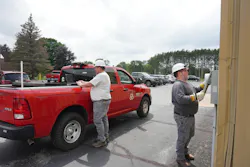
In the post-COVID world, the cooperative faced challenges procuring the meters due to constrained supply chains. To overcome this obstacle, the cooperative deployed 34 base stations across its service territory so the contract technicians could set the meters as soon as they were in stock.
“We knew there would be delays receiving meters because of supply chain issues, so we started with our base stations," he said. “The plan was to install all the base stations first so we could set a new meter anywhere and it would be ready.”
Rice, who supervises field employees including meter technicians and cable locators, said the new technology the meters offered eventually caught the attention of the lineworkers, who started calling in asking about the data.
“They would be going out on a voltage issue, for example, and say, ‘Oh, is this a new meter out here? Can you tell me what it’s seeing?’ he recalled. “They saw the value in what the new meters were recording and measuring.”
Rice also manages the software side of his cooperative’s metering system. He said before Cherryland installed the new meters, the cooperative used a Two-Way Automated Communications System (TWACS) AMI system, which sent meter readings over the power lines on hourly intervals.
While the outage management system (OMS) would ping the first-generation meters to determine the extent of an outage, the second-generation meters don’t require this step due to last-gasp outage reporting. Instead, the meters send a message immediately saying they are out of power, so the OMS quickly learns the scope of the outage and uses the notifications from the meters to activate the restoration process. The updated AMI system effectively eliminates a step, making the restoration process faster and more efficient.
“If there’s an outage in the middle of the night, we know about it right away,” he said. “And then in situations like a cabin, hunting lodge or cottage, where someone only goes up on the weekend, if they happen to lose power, we’re aware of it and restore the outage. The member never knows there was an issue.”
Discovering Anomalies
To take its metering technology to the next level, the cooperative invested in Xylem Data Lake program, which features an AI-driven analytics platform called InsightAI for data reporting. This intelligent assistant allows users to leverage their knowledge of Structured Query Language (SQL) to write intelligent prompts and produce useful reports. It can help users to not only collect data, but also interpret it, even without a coding or data science background.
At Cherryland, it empowered the metering department to refine queries, solve challenges involving many criteria and generate results beyond anything that could be done manually.
Case in point: the software helped the team segment voltage interval data into six different groups, with margins for each range for the three-phase commercial meters. These meters report voltage every 15 minutes, and the data analysis helped to discover where the voltage was outside of allowable limits beyond the ANSI 5% range.
By flagging out-of-range readings for the system, the metering team could find and resolve bad or failing transformers when voltage went higher or lower than expected. They also found issues with secondary services like faulty connections at a lift pole or underground services.
Before Cherryland had access to the software, voltage readings weren’t as frequent, and no database existed on the AMI side where the data was stored and could be reviewed on a large scale.
“Now instead of looking at one meter at a time, we have a view of the entire system at our fingertips,” Rice said.

Taking a Proactive Approach
Cherryland is now building operational intelligence within the system by studying how far the out-of-range meters deviate from the limit. This data will help the team to set the alert program on the meter.
The new Sensus meters can provide the voltage alerts completely separate from Cherryland’s queries. For example, they can send an alert saying “overvoltage” or “undervoltage.” Through the Data Lake program and the data analysis, however, it’s possible to analyze the overall system and use that landscape to decide where to set the thresholds for those alerts.
“While we still write some SQL, this software allows for real-time adaptation,” Rice said.
Through this work, the team learned that it’s helpful to use the InsightAI and Data Lake to identify metadata that doesn’t make sense. That way, they can find anomalies beyond the voltage and interval readings, such as the meter form, the program that’s on the meter, and the groups used to identify meters.
“This often indicates either a mistake in the programming or a meter that doesn’t match the service in the cooperative’s customer management system,” Rice said.
In the future, Cherryland hopes to continue to analyze the data to make real-time decisions, expedite restoration and provide benefits for its members. Through the platform, the smart meters can detect an issue and resolve it before the member even notices it, or it escalates into a power-quality issue or widespread outage.
Amy Fischbach ([email protected]) is the Head of Content for T&D World and the host of the Line Life Podcast. To listen to this story as an audio story, stay tuned to linelife.podbean.com.
About the Author
Amy Fischbach
Electric Utilities Operations
Amy Fischbach is the Head of Content for T&D World magazine and manages the Electric Utility Operations section. She is the host of the Line Life Podcast, which celebrates the grit, courage and inspirational teamwork of the line trade. She also works on the annual Lineworker Supplement and the Vegetation Management Supplement as well as the Lineman Life and Lineman's Rodeo News enewsletters. Amy also covers events such as the Trees & Utilities conference and the International Lineman's Rodeo. She is the past president of the ASBPE Educational Foundation and ASBPE and earned her bachelor's and master's degrees in journalism from Kansas State University. She can be reached at [email protected].