ComEd's Advanced Substation Training and Grid Expansion
Key Highlights
- The TCE Lab provides a realistic, safe environment for engineers to practice and master substation protection, communication, and commissioning tasks, reducing field errors and outages.
- ComEd is investing in 70 substation upgrades and new construction projects to meet increasing power demands from remote work, EV charging, and AI applications.
- The training facility mimics standard substation configurations, including legacy electromechanical relays and the latest microprocessor-based devices, ensuring engineers are prepared for evolving technology.
- Focus on safety and error mitigation principles helps engineers perform tasks efficiently while minimizing risks to customers and personnel.
- The long-range strategy emphasizes community empowerment, grid resilience, and a transition to 100% clean energy, supporting Illinois' economic and environmental goals.
Listen to the Audio Story for the ICYMI Series for the Line Life Podcast
For the past century, the power grid has illuminated and powered America, and line crews have built and rebuilt infrastructure. That same grid, however, must now support growing technology and power needs from remote work and learning to electric vehicle (EV) charging and artificial intelligence (AI) queries.
“These electrification trends, along with data centers and advanced manufacturing, are contributing to unprecedented demand for electric power in northern Illinois and across the nation,” said Angie Schuler, director of testing and commissioning engineering for ComEd.
“Additional substations and expansions are needed to meet this rising demand.”
ComEd has tackled this challenge head-on with a long-range strategy plan, which outlines a path to strengthen and modernize the grid through advanced technologies, predictive maintenance and automation to keep power reliable, resilient and affordable for all customers.
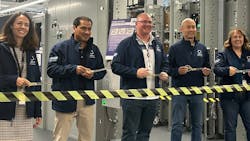
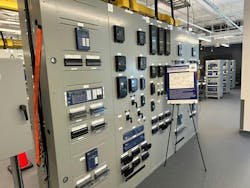
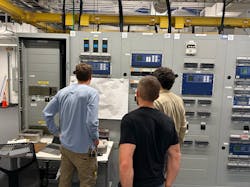
Another pillar in the plan is a focus on training the workforce. To that end, ComEd recently launched the 2,800-sq-ft Testing and Commissioning Engineering (TCE) Lab, complete with fiber ring network and cabling infrastructure, control panels, relay cabinets and SCADA devices. Within the complete, interconnected substation control room, engineers who work on transmission and substation projects can train in a safe, controlled setting without the risk of impacting the live grid.
“The TCE lab compresses the timeline for workforce readiness, as engineers can gain confidence and be prepared for real project work in about one year, depending on project needs, instead of several years,” said Bill Theriault, manager of technical development for ComEd. “The simulated substation control room will prove invaluable to preparing ComEd engineers for supporting the growing transmission and substation projects across northern Illinois to upgrade and protect the electric grid.”
Designing the Lab Environment
Through benchmarking efforts, ComEd knew the best learning environment matches what engineers see in their job every day. “Our TCE team works in substations, and we began to dream of a training environment that mimicked a typical substation control house,” Schuler said.
Carla Frieh, the vice president of transmission and substation engineering at ComEd encouraged the team to “dream big.”
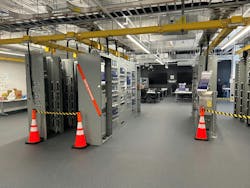
“We now have not only a simulated control house with multiple voltage levels, but also a classroom area that makes for a dynamic learning environment,” Schuler said.
Before the lab opened its doors, most of the training revolved around learning about one device at a time, using different classrooms and requiring instructors to lug around equipment for classes.
“We did have some designated space in Chicago at ComEd’s training center with some substation control house panels to provide a more system view,” Schuler said. “It was equipment patched together and not representative of our standard configurations.”
To attend the sessions, some of the engineers had to make a four-hour drive round trip, which made for long days of training. The new TCE Lab, however, is now centrally located in the ComEd territory and more easily accessible for all the team members. The simulated control room and TCE lab are located in a facility that was under renovation, and the team was able to stake out more than 2,800 sq ft for the space.
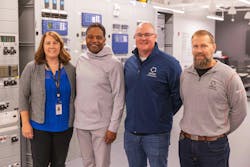
The engineers can now learn about protection and communication devices within a whole system, just as they would see in the field. The simulated control house was based on ComEd’s common protection schemes for 345 kV, 138 kV and 12 kV systems, including transmission line protection and transformer differential schemes.
“The TCE Lab was designed from ComEd’s substation standards, including today’s latest technology and the common protection devices, like electromechanical relays, still in operation today,” Schuler said. “Since it is simulated to be exactly like what they will encounter in the field, there’s voltage, current and contacts driven by a full DC battery system. Our technical development program provides the theory in classroom, then the students can stand-up and practice working with the device(s) they just learned about. We’ve found this to be so successful in engraining knowledge to new engineers on how to do their job – expediting the time it takes to get engineers qualified to perform different tasks.”
Practicing Skills
By training in a simulated environment rather than in the field, the engineers can ensure that customers aren’t impacted if an error is made.
“Because TCE is a field engineering team, a mistake in the field can lead to an outage for lots of customers,” Schuler said. “Error traps can be created in the lab intentionally for learning purposes. This really keeps even the seasoned pros on their toes.”
The engineers can practice routine maintenance tasks like relay testing to ensure proficiency before getting to the field. Additionally, full commissioning testing for protection and control systems is taught.
“We practice commissioning testing best practices,” Theriault said. “This type of testing is much more detailed and ensures every connection, setting and function of the scheme is correct and functional. We also practice troubleshooting and fixing common issues that occur from failure or construction errors or possible design errors.”
Because the space is versatile and inclusive, ComEd can organize scheduled training programs for groups of engineers as well as one-on-one training exercises. The training can also be customized for both newer and established employees depending upon the topic and purpose.
Focusing on Safety and New Technology
Another aspect of the training is focused on event-free performance. By focusing on techniques and processes, engineers can avoid an error that could result in an inadvertent operation or safety event. ComEd offers one-on-one labs to ensure each engineer is using proper techniques to work safely and without impact to customers. These techniques and methods are referred to as the Operating Incident Mitigation (OIM) principles, stressing the importance of a questioning attitude.
“These principles help engineers perform their standard testing and commissioning tasks successfully, as well as navigate complex troubleshooting, in a systematic approach, to avoid mis-operations,” Theriault said. “Our TCE Lab is the most realistic representation of a substation control house compared to any lab we have seen.”
This lab also helps the engineers to keep on top of rapidly changing technology in substations. For example, over time, the technology has moved from electromechanical devices to microprocessor relays, which added communications and SCADA. The TCE Lab has the legacy devices as well as the newest, which is exactly like what the engineers will encounter in the field. For example, ComEd is deploying the latest in IEC 61850 technology for both greenfield and brownfield substations.
As technology continues to advance, the utility company anticipates updating the TCE Lab to ensure the lab continues to provide the best learning environment for engineers.
ComEd’s Long-Range Plan Connects Customers to Tomorrow
ComEd is not only focusing on the needs of its customers today, but also in the future. Its long-range plan highlights the following three key areas to modernize the grid:
- People: The utility is focusing on empowering communities and customers by allowing them to manage costs and benefit from new technologies.
- Power: ComEd is also working on securing an efficient and durable grid that is more safe, intelligent, resilient and reliable.
- Progress: The company is advancing clean energy and economic goals for the state of Illinois. ComEd strives for an equitable energy transition with a grid capable of delivering 100 percent clean energy.
Expanding the Training Options
ComEd is responding to a rapid rise in electric power demand by expanding transmission infrastructure to meet the needs of its customers. Case in point: its recently filed Multi-Year Grid Plan outlines investments for 70 substation upgrades and construction projects.
“The new TCE lab allows for us to get our new engineers up to speed faster to help support this workload increase, as well as teach them about the latest technology,” Schuler said.
ComEd continues to invest in its employees, allowing for career progression and personal growth. For example, the Distribution Automation team is also looking to develop their own simulated environment to take their skill development to the next level.
“The TCE Lab has really set the bar for how to create a space for technical development,” Theriault said. “It has been a game changer for how we think and do technical development for our field engineers that work in substations.”
ComEd’s Long-Range Plan Connects Customers to Tomorrow
ComEd is not only focusing on the needs of its customers today, but also in the future. Its long-range plan highlights the following three key areas to modernize the grid:
- People: The utility is focusing on empowering communities and customers by allowing them to manage costs and benefit from new technologies.
- Power: ComEd is also working on securing an efficient and durable grid that is more safe, intelligent, resilient and reliable.
- Progress: The company is advancing clean energy and economic goals for the state of Illinois. ComEd strives for an equitable energy transition with a grid capable of delivering 100 percent clean energy.
About the Author
Amy Fischbach
Electric Utilities Operations
Amy Fischbach is the Head of Content for T&D World magazine and manages the Electric Utility Operations section. She is the host of the Line Life Podcast, which celebrates the grit, courage and inspirational teamwork of the line trade. She also works on the annual Lineworker Supplement and the Vegetation Management Supplement as well as the Lineman Life and Lineman's Rodeo News enewsletters. Amy also covers events such as the Trees & Utilities conference and the International Lineman's Rodeo. She is the past president of the ASBPE Educational Foundation and ASBPE and earned her bachelor's and master's degrees in journalism from Kansas State University. She can be reached at [email protected].