Transforming Energy Systems: How E-STATCOMs Are Stabilizing Low-Inertia Power Grids
Key Highlights
- The shift to renewable energy is reducing traditional grid inertia, posing stability challenges for power systems worldwide.
- Innovative solutions like virtual inertia through grid-forming inverters and E-STATCOMs are critical for maintaining grid stability in low-inertia environments.
- E-STATCOMs using supercapacitors can deliver rapid support, emulate kinetic energy, and support voltage and frequency regulation without large rotating generators.
- Recent projects in Germany demonstrate the practical application of E-STATCOMs, with plans for widespread deployment across national and international grids.
- The growth of the STATCOM market reflects the increasing need for advanced power quality and stability solutions driven by renewable energy integration.
Whether it’s called a transition or a transformation, the world’s power system is changing as the generation mix changes. Large fossil-fuel power plants are being replaced by inverter-based renewables. The International Energy Agency estimates that 36% of the world’s electricity will be generated by renewable energy sources in 2026 whereas coal is expected to drop to 32%. The U.S. Energy Information Administration reported that overall, renewables made up about 26% of U.S. generation in 2025 and coal only 15% of the generation mix. One more statistic from Wood Mackenzie, a research company, and we’ll move on: It estimates that over the next decade, there will be US$5 trillion of renewable capacity additions made to the global grid.
The bottom line here — that’s a lot of renewables expected, and it will dominate the global power grid. Remember Newton’s third law of motion? It says for every action there’s an equal and opposite reaction. Well, it applies here. With the increase of inverter-based renewables, conventional synchronous generators are being removed. This is where the third law comes in. Those behemoths of synchronous generation create rotational kinetic energy, more commonly known as grid inertia. It wouldn’t be a big deal if renewables weren’t intermittent or could supply physical inertia, but that’s not the case.
As renewables’ penetration increases, inertia decreases, which is challenging when it comes to maintaining power system stability. High inertia acts as a buffer during power disturbances giving control systems time to respond to what’s happening on the grid. With low inertia, however, there’s no buffer. Lower inertia reduces the time control systems have to respond to rapid fluctuations, resulting in stability issues. This transition of the grid’s energy mix makes supplying dependable electricity challenging for utilities and grid operators as they attempt to modernize and compensate for missing inertia.
Virtual Inertia
With traditional large thermal power plants on the endangered species list, suppliers have been developing technologies to replace rotational inertia. Devices like synchronous condensers, synchronous condensers with flywheels, or conversion kits to turn retired thermal generators into synchronous condensers proved viable solutions. There are, however, some caveats to consider with these devices. The devices have maintenance costs, operational losses, and noise to mention a few issues. That’s why digital technologies and their virtual inertia are trending.
The breakthrough came with the development of grid-forming inverters. Unlike the grid-following inverter technology, they provide digital stability by producing synthetic inertia. Additionally, they are capable of riding through grid disturbances without tripping. Moreover, they have that unique black start ability of being able to restart the grid without relying on large conventional power plants, but it didn’t stop there.
Power electronic-based FACTS (flexible alternating current transmission systems) controllers have incorporated grid-forming technology for decades with a particular focus on enhancing FACTS controller performance. FACTS controllers are famous for improving localized power system performance issue like voltage support and power quality, but more was needed. That’s where the latest advancement is of interest: the E-STATCOM (energy STATCOM).
Digital Stability
The E-STATCOM utilizes energy storage systems like supercapacitors or optional batteries with grid-forming controls. Conventional STATCOM technology mainly manages voltage stability through traditional reactive power compensation. E-STATCOM devices are grid-connected FACTS controllers designed to provide voltage and frequency stability in the transient and dynamic time domain. They can control high-frequency fluctuations and mitigate load changes.
In addition to voltage control through reactive power, they can absorb or inject real power through dynamic control of stored energy to smooth frequency excursions caused by energy fluctuations in the transmission grid. E-STATCOMs with grid-forming control offer superior voltage and frequency stability, and deliver active power in milliseconds, which is crucial for low-inertia power grids. The technology has been rapidly evolving by adding additional control modes to provide more services. Most importantly, it enables adaptive inertia regulation.
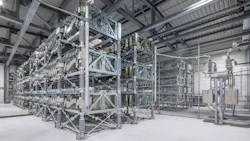
In early December 2025, Siemens Energy in partnership with TenneT, the German TSO (transmission system operator), announced that they had energized and commissioned the world’s first supercapacitor E-STATCOM in Mehrum, Germany. According to reports, the technology has taken more than a decade to develop and about three years to construct. The system operates autonomously and can be monitored and controlled remotely, including its diagnostic and control algorithms. It showcases cutting-edge technical capabilities underscoring its advanced design.
A Closer Look
The Mehrum E-STATCOM is a unique and complex project. At this point, talking with an expert would help in understanding how it works and why that is important. “Charging Ahead” contacted German Kuhn, Siemens Energy’s Principal Engineer FACTS. Kuhn began the discussion, saying, “The power grid is transitioning from large conventional power plants to inverter-based renewable energy sources like wind and solar. Unfortunately, many of these renewables don’t provide inertia. That makes the grid’s voltage and frequency less stable, but E-STATCOMs powered by supercapacitors change all of that. They are capable of delivering support within milliseconds, providing fast inertial response to compensate for frequency excursions.”
Kuhn continued, “Another consideration is the fact that as large rotating generators are being retired, load flow distances are changing. That’s especially important on large national grids like Germany’s. When this happens, critical areas develop that require attention. They do not have sufficient rotating equipment to provide the inertia that would keep that area stable. E-STATCOMs, however, give grid operators a new tool that can provide that inertia exactly where it’s needed. In addition, grid-forming controls support groups of E-STATCOMs working together for a coordinated approach for voltage and frequency support on the national grid. These devices can be deployed individually or in groups to supply the necessary stability support. Economically, it’s logical to have the versatility to deploy the exact E-STATCOM configuration where stability is questionable as the power system transitions.”
Kuhn explained, “Mehrum is the first E-STATCOMs based on supercapacitors. It’s a project that’s leading the way in the energy transition sweeping the world’s power systems. The design can be used on a variety of voltage levels in various grid configurations. Its compact design means that its small footprint is ideal for placement in existing facilities where room may be constrained. Mehrum’s E-STATCOM is rated ±200MW/300MVA with 320MJ of energy storage capacity, providing an inertia-contribution up to 6,000MJ. It proves that supercapacitors can emulate kinetic energy, which can replace those grid-stabilizing functions that were once considered only achieved by large rotating rotors.
The future of E-STATCOMs has great potential. TenneT estimates that approximately 30 similar systems will be needed across the Germany power grid alone, with additional installations already in the planning phase. Siemens Energy has also received inquiries from Australia, Canada, the United States, and several other countries for E-STATCOM systems. It’s exciting to think of E-STATCOMs as FACTS devices that are TSO grid-forming stability assets.”
Transformative
In 2024, Hitachi Energy and the German TSO TransnetBW announced they were collaborating on an E-STATCOM project. They are adding two E-STATCOMs on the German transmission system. The Hitachi Energy Enhanced STATCOM with grid stabilization will improve power quality to TransnetBW’s customers. The project consists of E-STATCOMs using supercapacitor energy storage to absorb and/or inject power into the grid. The E-STATCOMs are expected to be in service sometime in 2026.
In December 2024, the German TSO 50Hertz, announced a contract with GE Vernova and Nidec Conversion to deploy advanced STATCOM technology on their system. GE Vernova will supply three advanced STATCOM FACTSFLEX GFM devices. Nidec Conversion will provide one E-STATCOM with short-term energy storage system utilizing supercapacitors. According to the news release, the installations are needed due to the growing amounts of wind and solar being integrated into the German grid. Operations are expected to begin by 2028.
Grand View Research estimated the global STATCOM market was about US$1.26 billion in 2025 and project its expansion to reach US$2.69 billion by 2033. They attributed the market growth to “the rapid integration of renewable energy sources into global power grids.” They recognize that the market will benefit from technological advancements in STATCOM design including those addressing voltage and frequency instability caused by rising renewable energy penetration.
Gaining Momentum
Those renewable energy sources are expected to continue their explosive growth. By some estimates that expansion is expected to hit 50% of global electricity generation capacity by 2030. Tools like E-STATCOMs and their ability to emulate rotational inertia are essential to utilities and grid operators. They play a critical role for integrating more wind and solar onto the power grid by providing fast and controllable bulk active power keeping the power grid stable.
Enhancements like the E-STATCOMs are providing the tools needed for strengthening the overall performance of power delivery systems worldwide. The fact that manufacturers keep expanding the technologies we rely on is mind boggling, amazing both the techie and newcomers alike. It makes you wonder how they continue to persist in sharpening that cutting-edge of technological advancement, but it’s an undertaking that must happen. A transitioning power grid requires a great deal of innovation!
About the Author
Gene Wolf
Technical Editor
Gene Wolf has been designing and building substations and other high technology facilities for over 32 years. He received his BSEE from Wichita State University. He received his MSEE from New Mexico State University. He is a registered professional engineer in the states of California and New Mexico. He started his career as a substation engineer for Kansas Gas and Electric, retired as the Principal Engineer of Stations for Public Service Company of New Mexico recently, and founded Lone Wolf Engineering, LLC an engineering consulting company.
Gene is widely recognized as a technical leader in the electric power industry. Gene is a fellow of the IEEE. He is the former Chairman of the IEEE PES T&D Committee. He has held the position of the Chairman of the HVDC & FACTS Subcommittee and membership in many T&D working groups. Gene is also active in renewable energy. He sponsored the formation of the “Integration of Renewable Energy into the Transmission & Distribution Grids” subcommittee and the “Intelligent Grid Transmission and Distribution” subcommittee within the Transmission and Distribution committee.