Senate Bill Introduced for New Transmission Line Investment Tax Credits
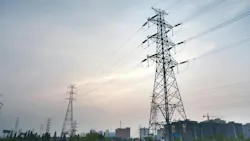
New Mexico Sen. Martin Heinrich introduced September 23 a bill to establish an investment tax credit for installation of regionally significant electric power transmission lines.
The act, called the Grid Resiliency Tax Credit Act, is meant to address the problem of aging infrastructure and help expand the power grid.
According to the wording of the bill, electric power transmission investments will:
- improve resilience and lower costs by enabling access to diverse generation resources across the country;
- increase the electric grid’s ability to weather storms and wildfire by enabling access to financial support for grid resilience measures;
- promote economic benefits and create new jobs in communities across the country; and
- enhance electric grid reliability.
Qualifying transmission lines would receive credits for an amount equal to 30% of the investment for such taxable year with respect to any qualified electric power transmission line of the taxpayer.
Qualifying property shall include: any conductors or cables, towers, insulators, reactors, capacitors, circuit breakers, static VAR compensators, static synchronous compensators, power converters, transformers, synchronous condensers, braking resistors, and any other property which is part of a substation, converter station, or switchyard, and ‘‘any property which increases the capacity, efficiency, reliability, resilience, or safety of a qualified electric power transmission line.”
The act would cover any transmission line with a capacity of not less than 500 MW and transmits power across a state boundary or between transmission planning regions. The act has a voltage requirement of not less than 345 kV in alternating current or direct current voltage of not less than 200 kV.
According to the National Electrical Manufacturers Association (NEMA), electricity demand is expected to increase by as much as 55% by 2050, making this bill well-timed.
“We need to deploy technologies that squeeze as much capacity as possible out of the existing grid while we continue the work of adding new generation, transmission, and distribution resources. The DOE's own Transmission Needs Study has flagged the same urgency,” said NEMA Sr. Director of Government Relations, Peter Ferrell.
"Senator Heinrich's bill gets that. It recognizes that increasing transmission capability doesn't have to mean building new poles and wires from scratch. A lot of it can come from strategic upgrades to what's already in the ground, like swapping in advanced conductors on existing corridors. That's not only faster, it's also reliably cheaper, and it means households and businesses aren't waiting years for entirely new infrastructure,” Ferrell said.
About the Author
Jeff Postelwait
Managing Editor
Jeff Postelwait is a writer and editor with a background in newspapers and online editing who has been writing about the electric utility industry since 2008. Jeff is senior editor for T&D World magazine and sits on the advisory board of the T&D World Conference and Exhibition. Utility Products, Power Engineering, Powergrid International and Electric Light & Power are some of the other publications in which Jeff's work has been featured. Jeff received his degree in journalism news editing from Oklahoma State University and currently operates out of Oregon.