OPINION: Are We Overpaying for Transmission Conductors?

As the nation races to modernize its aging power grid, utilities are spending billions of dollars on massive infrastructure upgrades. Because these investments are folded into consumer electricity rates for the next 50 years or more, spending this money prudently is critical. But a debate is emerging over the very conductors that carry our electricity—and balancing promotional claims against engineering realities across different applications is essential.
On one side, we have traditional steel-core conductors, the long-standing workhorses of the grid. On the other hand, "polymer composite core" conductors are increasingly being adopted as a modern, high-tech solution. While these higher-priced composite conductors offer unique benefits, evaluating their cost-effectiveness across all scenarios requires objective scrutiny. According to a recent engineering assessment by Springer Power Consulting, some of the broader claims surrounding composite cores in certain cases warrant closer examination.
Understanding Capacity Comparisons
One of the most common claims from manufacturers and proponents is that composite-core conductors can carry up to 30% more power than traditional conductors of the same diameter. Industry stakeholders often point to this increased capacity and reduced line loss as key drivers of grid efficiency, justifying the higher initial investment.
While this capacity increase is real and valuable, it is important to distinguish the source of the performance gain. In many cases, the increase is not influenced by the core material but by the design of the aluminum wrapped around it.
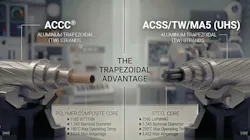
Manufacturers use "trapezoidal" shaped aluminum strands that pack together tightly, squeezing more conductive metal into the same space. The caveat is that you can wrap those exact same compact aluminum strands around a standard, much less expensive steel core and achieve an identical capacity boost in some configurations. Comparing compact trapezoidal designs to original, round-stranded aluminum configurations may not always reflect like-for-like conditions, which can complicate direct comparisons.
Material Performance in Different Conditions
Proponents of composite conductors often point to their lightweight nature and immunity to traditional rust, sometimes framing steel as a legacy material vulnerable to the elements. They argue that composites provide a more durable, modern solution for challenging environments. While this may indicate the presence of genuinely outdated conductors, modern steel-core coatings help address many of these concerns in modern applications.
Material integrity is highly dependent on external variables. However, some scientific studies demonstrate that steel-core designs can provide performance advantages, especially when subjected to heavy ice loading.
Steel is intrinsically 72% stiffer than polymer composite. This higher "elastic modulus" means steel-core conductors more effectively resist stretching under the massive, heavy burden of ice. Comparative analysis indicated that advanced steel-core conductor configurations exhibited a statistically significant reduction in sag—exceeding two feet—when subjected to heavy ice-loading conditions. Furthermore, modern steel conductors are highly engineered with sophisticated corrosion-resistant coatings. Conversely, all polymer materials age and degrade over time when exposed to heat, moisture, and ultraviolet light. Neither technology lasts forever; however, writing off steel as “obsolete” ignores over 120 years of continuous innovation.
The Universal Weak Link: Hoop Stress and Connector Failure
When you push massive amounts of electricity through a conductor, it gets hot. A conductor's maximum power capacity is strictly limited by how much heat it can safely withstand. However, there is a constraint on the grid that affects all High Temperature Low Sag (HTLS) conductors. The true bottleneck is not just the conductor itself; it is the electrical connectors—the long hollow tubes crimped over the conductor to join two sections.
When electricity heats a splice, the aluminum barrel expands radially outward. To maintain a safe, secure grip, the conductor inside must also expand at a similar rate. A traditional steel core has about 50% of the radial thermal expansion of aluminum. This mismatch causes a gradual loss of grip (hoop stress) as temperatures rise. But for polymer composite cores, this lack of expansion is more pronounced. A composite core possesses approximately only 7% of the thermal expansion of aluminum. As the aluminum connector barrel heats up, the polymer core inside expands at a much lower rate, which will increase the radial expansion mismatch. This results in a more significant reduction of the residual stress field, which in turn diminishes contact at the electrical interface between the conductor and the connector.
Unlocking the Real Power
Composite conductors are typically designed to operate up to specific temperature limits (often cited around 180°C), depending on materials and system design. Higher temperatures degrade polymer materials.
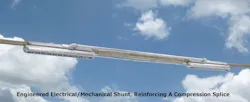
In contrast, advanced steel-core conductors (ACSS) are built to safely run at a continuous 250°C (482°F). Because a grid is only as strong as its weakest link, the way to safely operate an ACSS conductor at its maximum rating is to install engineered electrical/mechanical shunts over all the splices, dead ends, and suspension clamps. By creating a low-resistance thermal bypass over the vulnerable connectors, these shunts prevent the loss of hoop stress and unlock the full thermal capacity of the ACSS conductor.
Where Composite is Seeing Traction and Delivering Value
This analysis is not to say composite cores lack substantial merit. In fact, they are seeing significant traction and delivering value in specific deployment scenarios. Because they are "ultra-low-sag," they are highly effective for overcoming extreme geographic and regulatory hurdles. If a utility needs to string a conductor across a massive river crossing, or if environmental and permitting constraints make it difficult to reinforce or replace existing transmission towers, the lightweight and low-sag profile of a composite core allows for rapid capacity upgrades on existing infrastructure. In these applications, paying a higher price for a composite core is a cost-effective solution, depending on project constraints.
The Bottom Line for Ratepayers
When utilities invest in grid technology, everyday consumers share the costs. To protect ratepayers, regulators and engineers must seek out transparent, "like-for-like" comparisons. Before selecting any conductor type as a default solution, planners should evaluate all options to determine the best fit for specific system needs. By focusing on objective engineering data and acknowledging the specific strengths and costs of each technology, we can build a stronger, smarter grid without unnecessarily burdening the public.
Editor’s note: This commentary is based on a specific engineering assessment and represents the author’s analysis of transmission conductor performance.
About the Author
Tim Rhodes
Tim Rhodes is Director of Outside Training, North American Lineman Training Center.