Aligning Transmission Investment with Development Realities
Key Highlights
- Traditional planning methods often overlook practical siting constraints, risking overbuilding or missing critical development areas.
- The framework integrates land availability, permitting, and grid data to identify regions where large data centers can quickly connect to the grid.
- Analysis of Texas revealed that only 17% of substations have available capacity for growth, highlighting the importance of targeted upgrades.
- Five key transmission elements constrain 30% of developable land, with strategic upgrades unlocking multiple sites simultaneously.
- This approach provides a defensible, location-specific forecast that aligns infrastructure investments with actual development patterns, reducing stranded assets and improving capital efficiency.
Transmission planning has never been more necessary. It has also never encountered so much uncertainty.
Data center demand is accelerating fast, with load expected to reach 80 GW by 2030 and account for up to 12% of U.S. electricity use. Unlike the gradual load growth of the past, these facilities arrive in gigawatt-scale steps where land, power, fiber, and water align. Individual campuses now routinely request more than 1 GW, making location a decisive factor for dispatch, power flows, and upgrade needs. Traditional planning methods that rely on coarse forecasts or react to developer requests are not designed for this. They overlook the practical realities that determine where projects can reach notice-to-proceed (NTP) quickly, which risks overbuilding in the wrong places while missing the areas that most need attention.
We're already seeing the consequences of this in Texas. In August 2025, Hays County rejected a 200-acre data center near the Edwards Aquifer over water concerns. Yet the region had just undergone major grid upgrades, including reconductoring a 345 kV line intended to support load that may now never materialize. ERCOT itself acknowledged this challenge in its own 2024 Regional Transmission Plan: "The location of load is crucial in driving flow patterns and determining transmission needs...Planning practices and policies must be reviewed to address these new challenges."
A Land-First Planning Framework
To help utilities anticipate where large loads are most likely to materialize, we introduce a bottom-up, data-driven approach that mirrors developer goals and constraints and converts that into planning-grade load signals. By integrating buildable land availability, permitting constraints, and grid data, the framework identifies the regions where power can be delivered quickly and where transmission constraints stall development. ERCOT serves as the case study showing where targeted upgrades can unlock gigawatts of stranded potential.
The process has three steps.
- Identify where hyperscale sites can reach NTP fastest, ignoring grid capacity.
- Determine which of those locations have available headroom and which are limited.
- Translate findings into bus-level loads and targeted upgrade candidates that slot directly into standard reliability studies.
What We Found in ERCOT
Leveraging environmental datasets and power flow modeling, we screened all 13.8 million parcels in Texas using common developer requirements to map exactly where development can credibly occur:
- At least 100 acres of buildable land
- Suitable topography under 15 degrees
- Outside wetlands, floodplains, or conservation easements
- Favorable zoning
- Water availability (excluding drought-restricted counties)
- Proximity to fiber, gas, and 345 kV transmission infrastructure
This left 765,000 acres suitable for fast hyperscale development.
The land clusters tightly: only 230 substations across Texas have suitable land for data centers nearby. The top 10% of these substations hold over 30% of total buildable acreage. This concentration simplifies planning. Instead of preparing for load at thousands of potential points, planners can focus on a defined set of high-probability interconnection locations.
Using ERCOT's 2028 summer-peak planning case, we evaluated how much additional load each of these 230 substations could accommodate before any line or transformer exceeds N-1 thermal limits.
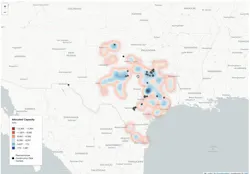
Only 17% of substations have positive withdrawal capacity today, mostly in Northwest and Central Texas, meaning they’re ready for growth. The remaining substations and surrounding land are effectively stranded by existing constraints.
Five Bottlenecks, 250,000 Acres
To identify upgrade priorities, we traced each headroom-constrained site back to its limiting transmission element. When we aggregated constrained acreage by limiting element, just five overloaded transmission elements restrict 250,000 acres of viable land, about 30% of the total. The largest clusters appear in Northwest Texas around Abilene, where single upgrades could unlock multiple neighboring sites. For example, the OpenAI x Crusoe Stargate project falls directly within this optimal Abilene corridor. Developer capital is already flowing toward these capacity-expanding zones.
For planners, this methodology enables a focus on the few elements constraining the most land. Starting from developable land and working backward yields a short list of high-leverage upgrades.
Implications for Grid Planning
This framework offers utilities three practical advantages:
- Anchors load forecasts in development reality rather than speculative interconnection requests, reducing stranded asset risk.
- Identifies upgrades that unlock multiple sites at once, improving capital efficiency.
- Provides a defendable rationale for prioritizing projects amid competing demands and cost recovery concerns.
The approach is replicable across all ISOs. While specific constraints differ region to region, the methodology stays consistent: screen land through real constraints, overlay transmission capacity analysis, and aggregate results by limiting element. The outcome is a set of bus-level load distributions grounded in permitting and siting reality. These can be layered onto interconnection requests to produce a more complete and defensible forecast before entering reliability and economic planning models.
Grid investment must be anchored by actual development patterns, not speculation. This framework gives ISOs, developers, and regulators a shared basis for action. ISOs gain location-specific load forecasts to justify new infrastructure. Developers gain confidence in speed-to-power. Regulators gain tools to avoid stranded investments that burden ratepayers. Constraint-informed planning ties all three together and helps ensure that the next decade of data center growth lands where the grid can support it.
About the Author
Tony Wagler
Tony Wagler is the Solutions & Development Lead at Paces, where he helps renewable energy developers tackle complex development challenges through automation and data-informed siting strategies. Before joining Paces, Tony led origination and development of energy storage projects at Nexamp across the Northeast. He also worked for TotalEnergies in the renewables division across the Middle East and Europe, spanning the full development lifecycle of distribution and behind-the-meter solar projects.