Modern Techniques in Drilled Shaft Inspection for Power Grid Support Structures
Key Highlights
- Traditional NDT methods like visual inspections and soundings are limited in assessing large, steel-rich transmission foundations, often missing critical defects.
- Modern NDT techniques, including thermal profiling and ultrasonic measurements, provide fast, quantitative, and remote assessments of shaft integrity during and after construction.
- Thermal integrity profiling (TIP) can detect anomalies, measure concrete cover, and identify soil inclusions without the need for installed tubes, even in congested cages.
- Base cleanliness devices like the SQUID ensure proper soil removal at the shaft bottom, preventing long-term performance issues caused by debris or soil caving.
- Implementing advanced NDT methods reduces construction risks, improves quality assurance, and ensures foundations meet design specifications for supporting high-capacity transmission lines.
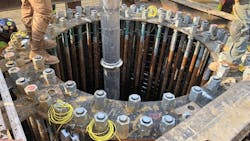
The recent increased demand on the U.S. power grid led by the growth in AI (artificial intelligence) and data centers is leading to the construction of many new high-performance high-voltage transmission line structures. Drilled shaft foundations are increasingly used to support these transmission line structures. These foundations must handle large lateral overturning loads that come from tall monopole and lattice tower structures resisting wind and line tension.
The industry trend is toward larger diameter and deeper shafts, often constructed below the groundwater table with slurry to stabilize the excavation. These larger and more complex foundations are here to stay as the transmission towers continue to get bigger and more complex, requiring the foundations to support much greater loads. Visual shaft inspection is not possible when these bigger shafts are cast under slurry or below groundwater, allowing defects to potentially go undetected. This requires much greater emphasis on the quality control efforts as a single foundation failure could be catastrophic.
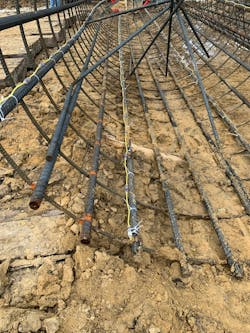
These large diameter shafts are generally designed with a high amount of steel as part of the connection to the transmission line structure. The reinforcing cage effectively transmits larger laterals loads through the foundation. They also include stiffeners to support the entire reinforcement and anchor system for lifting and placement into the excavation.
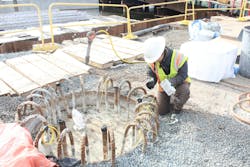
Why Transmission Line Foundations Are Especially Difficult
This high concentration of steel can restrict the flow of concrete to the area outside of the reinforcing cage. Durability and performance of the foundation can be adversely impacted when insufficient concrete cover occurs between the reinforcing cage and the surrounding soils. Having adequate concrete cover around the outside of the reinforcing cage is essential to protecting the reinforcing steel. Exposure to groundwater and caustic soils can cause corrosion of the steel, which may reduce the ability of the shaft to resist the overturning loads.
The connections of transmission line structures to supporting drilled shaft foundations typically are very different from those used in other industries. With pole-type foundations, there is a significant array of anchor bolts that can function either as shaft reinforcement or be placed nominally within the upper ten feet of the shaft and surrounded by a separate reinforcement cage.
These anchor bolts are needed to transfer large overturning moment reactions to the foundation. Internal steel anchor bolt templates and their associated stiffeners are used to maintain tight installation tolerances and are also incorporated into foundations. Lattice tower-type structures can use either base plated foundations with anchor bolts or bent angle steel (stub angles) for load transfer within a reinforcement cage. In both cases, the interior of the drilled shaft is occupied by steel elements that have cross sections more than the exterior reinforcement.
Additionally, shafts are generally cast using slurry methods in open excavations with unstable soil conditions. If not sufficiently stabilized, sidewalls can collapse into the reinforcing cage. That reduces or eliminates the expected concrete cover, resulting in little or no protection for the steel from the surrounding soil and groundwater.
Non-Destructive Testing (NDT) in the deep foundations field is used to test the in-place structures during or just after the foundations have been constructed. The NDT testing is used to address the uncertainty related to shaft geometry and concrete quality after casting. There are different methods used for various purposes, but for this article they will all be considered NDT.
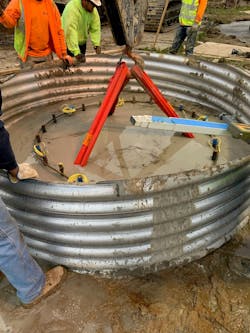
Legacy NDT Methods: Why They Fall Short
The NDT industry has been trying to find the best approaches to accurately assess shaft conditions after construction to help ensure that the constructed foundations satisfy the design intent. Historically, NDT methods have not been well suited for these massive, steel-congested shafts.
Modern testing methods have surpassed the older methods, although there are still many older methods in use. Each has certain advantages, but all have characteristics that generally limit their use with electrical transmission line foundation quality control. The electric power industry has historically relied heavily on visual inspection and soundings with weighted lines to “feel” the base condition of the excavation where the individual must estimate how easily the weight advances into the bottom of the shaft often from distances greater than 50 feet away. But these methods offer little insight into the quality of the shaft if it is not possible to inspect concrete when casting under slurry and vary greatly depending upon the experience of the individual making the measurements. Problems like soil caving, cage misalignment, or blocked concrete flow remain hidden.
The verticality and overall shape of the excavation prior to casting is of interest in many foundation designs but historically has not been routinely inspected because of lack of equipment available. Mechanical calipers can be used for shape profiling, but they don’t provide meaningful information about the excavation. They are rarely used in the electric power industry.
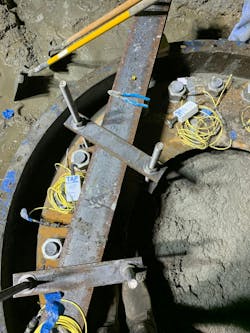
Concrete volume logs are sometimes plotted as a function of elevation to conceptualize the shape of the excavation. This method relies on an individual with a weighted tape measuring the height of concrete after each truck has completed pouring its load. This method offers limited quantitative data and requires personnel to work adjacent to an open excavation.
For post installation inspection the legacy methods include the Low Strain Pulse Echo method and the Cross Hole Sonic Logging (CSL) method. The Low Strain Pulse Echo test is fast and economical but has many limitations which severely limit its use in electrical transmission line foundations. The CSL test requires the installation of many 2-inch steel tubes within the foundation and attached to the interior of the reinforcing cage. This is generally problematic for congested cages, especially where anchor bolt templates block access. In short, legacy methods give partial information and don’t fit the geometry and steel congestion of transmission line foundations.
Modern NDT Methods: Closing the Gap
Over the last decade, new tools have emerged to provide fast, quantitative, and remote-friendly testing for drilled shafts. These include pre-cast geometry and verticality checks, base-cleanliness devices, and post-cast thermal integrity profiling (TIP).
The three-dimensional shape of a drilled shaft can be obtained immediately after excavation is complete by deploying an ultrasonic measurement device. These devices make it possible, prior to casting, to measure and assess the verticality and shape of the excavation and identify possible cave-in locations along the shaft profile in either dry or wet conditions. The devices scan the excavation sidewalls during lowering, with sonic data fed to the surface data logger and interpreted to give a real-time picture of shaft geometry. This eliminates the guesswork of calipers or concrete volume logs.
The cleanliness of the base of a drilled shaft can be obtained immediately after excavation is complete by deploying a downhole device attached to the drill rigs Kelly bar (The SQUID (Shaft Quantitative Inspection Device)). The SQUID device makes it possible, prior to casting, to measure and assess the condition of the soil and debris at the base of a drilled shaft excavation, identifying areas that need further cleaning prior to concrete placement. The penetrometers at the bottom of the device can be forced into the soil at the base of the drilled shaft to assess the thickness of the debris layer at the base of the excavation as well as the strength of the bearing layer. The measurements result in a force versus displacement for each penetrometer. This device can quickly and quantitatively sample multiple locations at the base of a drilled shaft excavation to determine the thickness of the debris layer typically under 15 minutes.
This addresses a key failure point: dirty shaft bases reduce end-bearing and long-term performance.
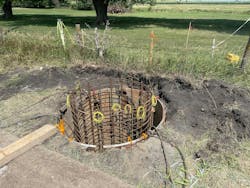
The thermal integrity profiling (TIP) method is an NDT approach used widely over the past decade to assess the integrity of drilled shafts after casting the shaft. Temperature measurements are obtained along the length of the reinforcing or outside anchor bolt cage from cables with thermal sensors cast into the shaft. Data collection begins during the casting process, or immediately after the casting has been completed. The thermal method measures the naturally occurring heat of hydration within the curing concrete to determine the integrity of drilled shafts. The Thermal Wire cables are tied to outside vertical bars at regular intervals (one wire for every 12 inches (305mm)) of shaft diameter rounded up to a whole number.
The TIP method overcomes the limitations of legacy methods as it does not require installed tubes, provides a virtual thermal image in wet conditions of the shaft shape relative to the reinforcing or anchor bolt cage, and provides an estimate of the outside concrete cover thickness. Interior steel within the shaft reinforcement is not an obstacle for this type of NDT method. The TIP method can identify significant anomalies in the shaft at a very early stage, and in some cases these anomalies can be identified while the concrete is still being poured. Each wire is sampled at regular intervals (typically every 15 minutes during the curing process) to obtain a 3-dimensional thermal image of the shaft, showing where concrete cover is inadequate and where anomalies exist.
TIP works even in congested cages since it doesn’t rely on ultrasonic transmission. It provides:
- Cover thickness estimates.
- Detection of soil inclusions or voids.
- Cage eccentricity (if it shifted off-center).
- Results are typically within 24 hours.
The limitation is timing: data loggers must be installed quickly after casting to capture the hydration phase. But its benefits — speed, remote monitoring, and full-section coverage — make it ideal for transmission foundations.
At a site in the southwest U.S., thermal NDT testing was used in conjunction with concrete volume logs measured after placement of each ready-mix transit truck. The monopole transmission line foundation was nominally 10 feet (3.05 m) in diameter and 40.83 (12.5 m) long in relatively dry sands. The shaft was flooded, and polymer slurry was used to stabilize the shaft walls. Permanent casing was placed in the upper 9 feet (2.7 m) of the shaft (7 feet (2.1 m) below grade). 10 thermal cable wires were evenly spaced around the reinforcement. The contractor did not report any unusual conditions during concrete placement but reported a deficit of about 2 yards3 (1.5 m3) from nominal values where an overage of 4 to 8 yards3 (3 to 6 m3) was anticipated from experience on adjacent foundations. A concrete rise graph was developed from the field report and was then compared to the thermal readings taken 28.75 hours after placement, where both showed an anomalous condition in the same general range (lower 17 feet (5.2 m) of the shaft).
The engineering team developed shaft cross sections along the shaft section where insufficient concrete cover was suspected. It was determined that the shaft sidewalls had caved around most of the west-southwest half of the shaft at about 32 to 33 feet (9.8 to 10.1 m) below the top of the foundation, with the caved material deposited in a progressively larger area of the west-southwest portion of the shaft from 35 to 40.8 feet (10.7 to 12.4 m) below top of shaft. Additionally, the thermal data suggested that the reinforcement cage was offset a few inches to the southwest and not within the center of the shaft, resulting in less cover on the southwest region of the shaft below the casing and exacerbating cover loss. The data inferred that there is little to no concrete cover over vertical reinforcement present in the identified west-southwest portion of the shaft for the bottom 5 to 6 feet (1.5 to 1.8 m). Remedial action was needed.
For decades, transmission foundations relied on inadequate QC methods or no QC testing at all. Advances make it possible to:
- Verify shaft geometry and verticality before casting.
- Quantify base cleanliness to ensure strong end-bearing.
- Monitor thermal profiles during curing to confirm adequate cover and detect anomalies.
These methods are fast, quantitative, and remote-friendly, reducing scheduling risks while giving owners confidence that shafts meet design intent.
The bottom line: modern NDT gives transmission engineers and utilities a practical path to reliable drilled shaft foundations, something legacy methods simply are unable to provide.
About the Author
George Piscsalko
George Piscsalko is the President for Pile Dynamics, Inc. He is a registered Professional Engineer in the States of Ohio, Michigan, and New Jersey. He has over 40 years’ experience in designing test equipment for the deep foundation industry. He holds ten US Patents and has co-authored more than 25 peer reviewed papers.